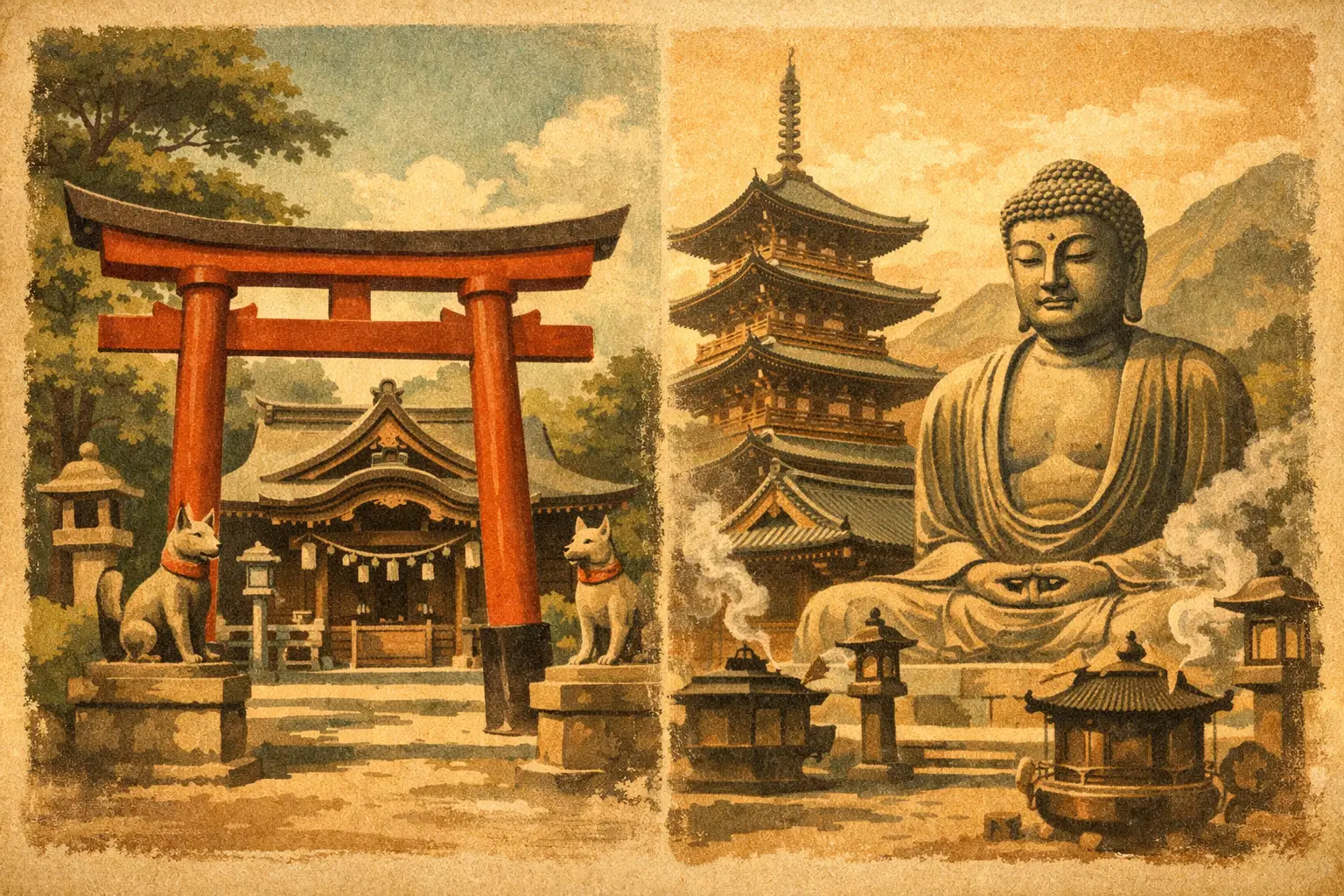
A red torii gate on a forest path, the scent of incense drifting from a hall, a rope thick as a tree trunk, a statue wearing a tiny red bib – Japan’s sacred sites can feel wonderfully mysterious. The phrase shinto vs buddhist shrines is a common search for travelers, but there is one useful correction right away: Shinto places of worship are usually called shrines, while Buddhist places are usually called temples.
That distinction will help you read the landscape of Japan with fresh eyes. More importantly, it lets you visit with the curiosity and respect that makes a trip feel less like checking off landmarks and more like meeting a living culture.
Shinto vs Buddhist Shrines: The Basic Difference
Shinto is Japan’s indigenous spiritual tradition. It centers on kami, sacred presences associated with nature, places, ancestors, and forces of life. A waterfall, an ancient cedar, a mountain, or a local guardian spirit may be connected to a kami. Shinto shrines, called jinja, are places where people honor these kami and ask for protection, gratitude, good fortune, or purification.
Buddhism arrived in Japan from the Asian mainland in the sixth century. Buddhist temples, called otera or ji, are connected to teachings about suffering, compassion, impermanence, and awakening. They may honor the Buddha, bodhisattvas such as Kannon, or revered Buddhist figures. Temples are also places for memorial services, funerals, meditation, and learning.
The cleanest shorthand is this: a shrine is generally Shinto, and a temple is generally Buddhist. But Japan rarely fits into a neat tourist-chart box. For centuries, Shinto and Buddhism were deeply intertwined. Many sacred mountains, pilgrimage routes, festivals, and local customs carry both traditions. Looking for a single, absolute answer can make you miss the fascinating overlap.
Start With the Entrance
The quickest visual clue is often standing right in front of you.
A torii gate usually signals a Shinto shrine. These gates can be bright vermilion, weathered wood, stone, or even metal. Passing beneath one marks a transition from ordinary space into a place connected with the kami. At Fushimi Inari Taisha in Kyoto, thousands of vermilion torii create the famous mountain trail. At a quiet village shrine, you may find only one modest wooden gate beside rice fields.
A Buddhist temple often has a larger gate structure, called a sanmon, with a roof and substantial wooden frame. It may look like a grand entrance pavilion rather than a simple gateway. Temple gates can be guarded by fierce-looking Nio statues, powerful protectors with muscular bodies and dramatic expressions.
Still, do not use gates as your only test. A few sites have mixed histories, and some shrine grounds include Buddhist-looking features. Think of the entrance as your first clue, not the final verdict.
Look for Shimenawa and Paper Streamers
At shrines, you may see a thick sacred straw rope called a shimenawa. It often hangs across a torii, around an old tree, or in front of the main sanctuary. Zigzagging white paper strips, called shide, are another strong Shinto sign. Together, they mark a space or object as sacred.
Shrines also commonly have a temizuya, a water pavilion where visitors rinse their hands and mouth before approaching. This is purification, a central Shinto idea. The water ritual is simple: rinse your left hand, then your right; pour water into your left hand to rinse your mouth without touching the ladle; then rinse the ladle’s handle by tipping it upright. Do not drink directly from the ladle.
Look for Incense, Statues, and Pagodas
At Buddhist temples, incense is one of the most recognizable signs. Visitors may place a small bundle of incense in a large burner, then gently draw the fragrant smoke toward themselves. The gesture is associated with purification and blessings, although practices vary by temple.
You are also more likely to see statues of the Buddha, Kannon, Jizo, or other Buddhist figures. A pagoda is another familiar temple landmark. These elegant tiered towers developed from Indian stupas and often hold sacred relics or symbolize Buddhist cosmology.
Jizo statues are especially moving. Often small and lined up along paths or in temple grounds, Jizo is regarded as a compassionate protector of children and travelers. Red bibs, caps, flowers, toys, and pinwheels left near these statues can reflect personal prayers and remembrance. This is not decoration for visitors. It is a visible expression of care.
How Prayer Customs Differ
At many Shinto shrines, visitors approach the offering box, bow, place a coin in the box, ring a bell if one is present, bow twice, clap twice, make a quiet prayer, then bow once more. The two claps are a familiar shrine practice, though customs can differ at individual sites.
At Buddhist temples, clapping is generally not part of prayer. After making an offering or lighting incense where permitted, visitors usually put their hands together quietly and bow. You may hear chanting, bells, or the rhythmic sound of a wooden fish drum during a service.
The best rule is beautifully simple: watch what local worshippers do, read any posted guidance, and follow the atmosphere of the place. There is no prize for performing a ritual perfectly. Sincerity and calm attention matter more than confidence.
What Is Inside Matters Too
A Shinto shrine’s most sacred building is often the honden, the main sanctuary where the kami is enshrined. Visitors usually do not enter it. In fact, the sacred object may be hidden from view entirely. This can feel surprising if you expect a museum-like display, but the unseen quality is part of the point. The power of the place may be felt through its setting: wind in the trees, moss on stone lanterns, the hush beyond the gate.
A Buddhist temple’s main hall, often called the hondo, may allow visitors inside. You might see an altar, candles, hanging lanterns, elaborate carvings, and a central image of a Buddhist deity. Photography rules vary widely. If signs prohibit photos, put the camera away without debate. A sacred hall is not a backdrop.
This contrast reflects different spiritual moods, though never perfectly. Shrines often emphasize purity, nature, and the presence of kami in a particular place. Temples often provide a more visible setting for Buddhist images, teachings, and communal rites. Both can carry that quiet feeling of mono no aware – the awareness that life is precious because it changes.
Why the Two Traditions Sometimes Blend
For much of Japanese history, Shinto and Buddhism were practiced together. Buddhist temples stood beside shrines, Buddhist figures were understood through local kami, and people did not necessarily see a hard boundary between the traditions. This blending is often called shinbutsu shugo.
During the Meiji era, the government ordered Shinto and Buddhism to be separated more formally. Yet history does not disappear because an official decree says so. On pilgrimage routes such as the Kumano Kodo, you can still sense layers of mountain worship, Shinto devotion, Buddhist practice, and folk belief meeting in the same landscape.
That is why a site may surprise you. You might find a shrine guardian statue that looks unfamiliar, temple-style architecture near a shrine, or a festival that reflects both traditions. Rather than treating this as a contradiction, see it as part of Japan’s cultural texture – a little like wabi sabi, where character and beauty live in complexity rather than perfect uniformity.
A Respectful Visitor’s Mindset
Sacred places are among Japan’s greatest gifts to travelers, but they are not open-air sets. Keep your voice low, avoid blocking worshippers, and do not step into restricted areas. At a torii gate, many people avoid walking directly through the center, which is considered the path of the kami. It is courteous to pass slightly to one side and offer a small bow.
Dress does not need to be formal for everyday visits, but clean, modest clothing is a good choice. If you collect goshuin, the beautiful calligraphy stamps offered at many shrines and temples, remember that they are religious records, not souvenir stamps. Bring a goshuincho book, approach respectfully, and be patient if the office is busy.
Above all, give yourself time. A famous site at opening hour can feel completely different from the same site at midday. Pause by a stone basin, listen to a bell, notice the cedar scent after rain. Whether you are standing before a shrine’s torii or a temple’s incense burner, the most rewarding part of the visit may be the moment you stop trying to identify everything and simply let the place speak.