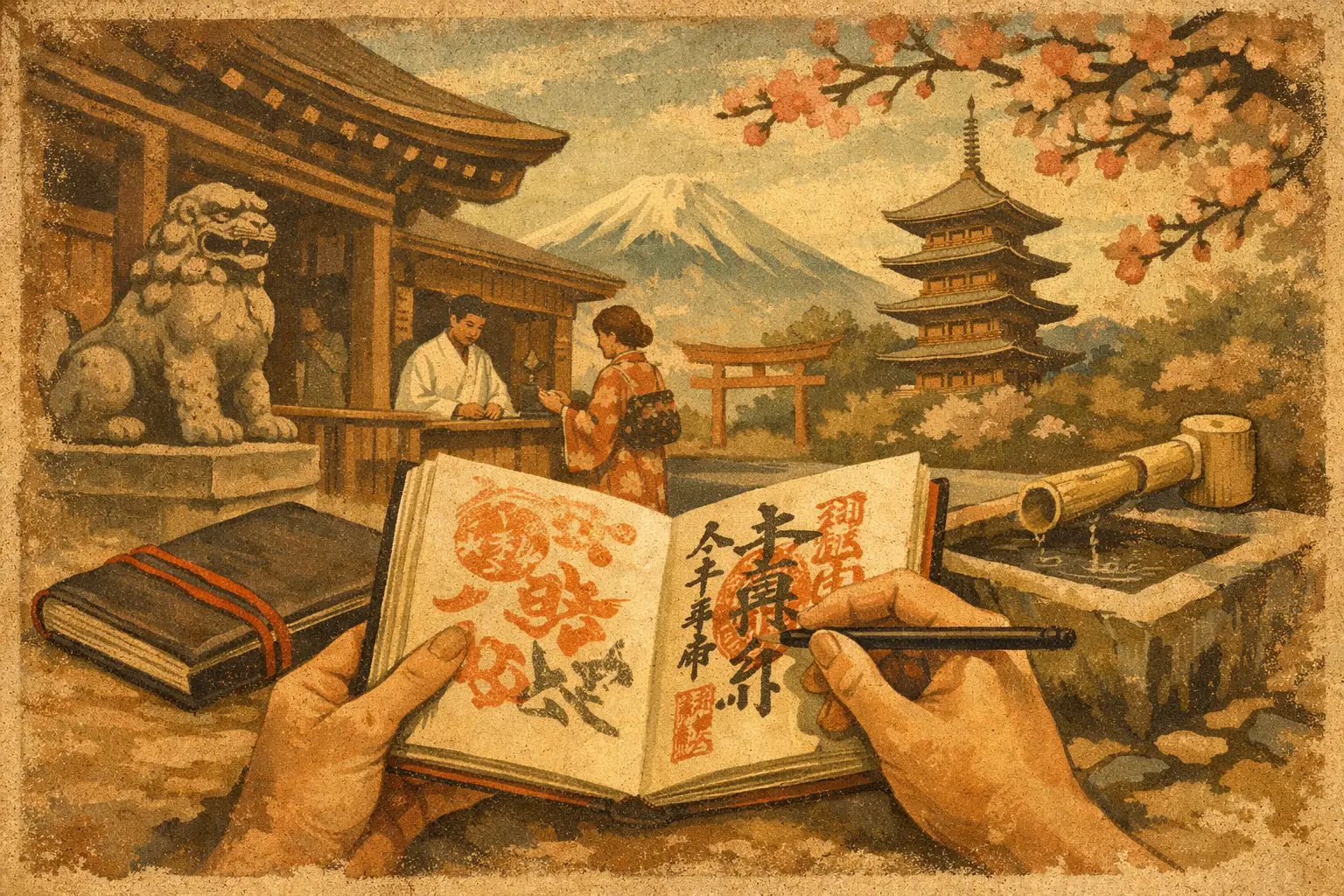
You are standing at a shrine in Japan, the air smells faintly of cedar and incense, and near the office window you notice a stack of beautifully bound books with brocade covers. Someone hands one over, opens it, and a priest or attendant brushes bold black calligraphy across the page before adding a vivid red seal. If you have ever wondered what is a goshuin book, this is the heart of it – a sacred record of your visit, and one of the most meaningful keepsakes you can bring home from Japan.
For many Japan lovers worldwide, a goshuin book feels like the perfect meeting point between travel, art, and spiritual culture. It is not just a souvenir and not quite a journal either. It carries a sense of presence. Each page marks a real visit to a temple or shrine, and each inscription has its own personality, somewhere between ritual object and handmade artwork.
What is a goshuin book?
A goshuin book, usually called a goshuincho in Japanese, is a special accordion-style book used to collect goshuin from temples and shrines in Japan. A goshuin is a handwritten inscription, usually done in brush calligraphy, combined with one or more red stamps or seals. It typically includes the name of the temple or shrine, the date of your visit, and sometimes the principal deity or Buddhist figure enshrined there.
The book itself is made for this purpose only. That point matters. A goshuincho is not a regular notebook, sketchbook, passport holder, or travel diary. It is intended as a respectful place to receive sacred inscriptions connected to religious sites.
That is also why many travelers end up loving them so much. A goshuin book holds more than proof that you went somewhere. It captures a moment, the character of a place, and the human touch of the person who wrote on the page. There is a kind of wabi sabi in it – a beauty in variation, texture, and the fact that no two pages ever feel exactly the same.
Why goshuin books matter beyond collecting
It is easy to see goshuin as Japan’s most elegant stamp-collecting tradition, and yes, there is a collecting element. But reducing it to that misses something important.
Goshuin have religious roots. Historically, they were connected to acts of devotion, including temple worship and sutra offering. Over time, the practice became more widely accessible, and now many visitors, including international travelers, receive goshuin as part of their temple and shrine visits. Even so, the spiritual context has not disappeared.
That is why etiquette matters. You are not buying a decorative stamp at a gift counter. You are asking a religious site to record your visit in a traditional form. Some people approach it with deep faith, others with cultural admiration, and many with a mix of curiosity and respect. All of those can fit, as long as the attitude stays sincere.
For travelers who love Japanese calligraphy, religious architecture, pilgrimage culture, or slower forms of travel, goshuin books can completely change the rhythm of a trip. Instead of rushing through a checklist of famous places, you begin to notice details. The shape of a torii gate. The quiet of temple grounds after rain. The seasonal stamp for spring plum blossoms. It becomes less about collecting fast and more about noticing what each place feels like.
What does a goshuin look like?
A typical goshuin includes flowing black ink calligraphy and one or more red seals pressed onto the page. The black text is often written by hand, although some locations now use pre-written sheets for busy days or special circumstances. The red seals can be circular, square, or layered in different shapes, and they often carry the temple or shrine name.
Some goshuin are visually restrained, almost minimalist. Others are dramatic and dense with layered stamps. In recent years, some places have also created seasonal or limited goshuin with motifs tied to cherry blossoms, autumn leaves, festivals, or local symbols. These can be stunning, but they also make some travelers focus too much on rarity. It depends on your style. If you love beautiful design, that is understandable. Just do not let the hunt overpower the experience of the place itself.
There is a little mono no aware in the best goshuin experiences – that gentle awareness of passing moments. A handwritten page received on a rainy afternoon at a mountain temple will mean more later than any social media trend around the “best” stamp in town.
How to use a goshuin book in Japan
Using a goshuin book is fairly simple once you know the basics. First, buy a goshuincho. You can often get one at temples, shrines, museum shops, or specialty stores. Many are covered in woven fabric or decorative paper, and designs vary from understated to richly ornate.
When you visit a temple or shrine, look for the office that handles goshuin. It may be near the entrance, beside the main hall, or marked with signs in Japanese. At some places, you hand over your book and wait while the goshuin is written directly onto a page. At others, especially when crowds are heavy, you may receive a separate sheet to paste into your book later.
You will usually pay a small fee. This is often around 300 to 500 yen, though special versions may cost more. Have cash ready, and try to present your book neatly and respectfully. If there is a line, watch what others do.
It is also good manners to visit the main worship area before requesting a goshuin. At a shrine, that may mean offering a small coin and saying a quiet prayer. At a temple, it may mean a moment of reflection in front of the main hall. You do not need to perform everything perfectly as a foreign visitor, but making the effort shows respect.
Goshuin book etiquette travelers should know
This is where many first-time visitors get nervous, but the rules are not impossible. They are mostly about common courtesy.
Use the book only for goshuin. Do not mix in train stamps, castle stamps, ticket stubs, or personal notes. Japan has many collectible stamp traditions, and they are fun, but a goshuincho should stay dedicated to sacred inscriptions.
Do not treat the office like a fast souvenir line. Speak politely, be patient, and avoid loud behavior. Photography may be limited, especially while a goshuin is being written, so always check before taking out your phone.
Also, remember that not every temple or shrine offers goshuin every day. Staffing, ceremonies, weather, or local rules can affect availability. Some places may pause the service entirely. That can feel disappointing, but it is part of the reality of visiting living religious sites rather than tourist exhibits.
One more nuance: shrine goshuin and temple goshuin can go in the same book unless a location specifically says otherwise. Some people prefer separate books, but that is more personal preference than universal rule.
Choosing your first goshuincho
If you are wondering what is a goshuin book in practical terms, think of it as part sacred record, part portable art object. So yes, the cover matters.
Some travelers choose a book because it matches a favorite temple aesthetic or regional craft style. Others keep it simple and buy the first one that feels right. Both approaches work. The main thing is to choose one you will want to carry and protect.
Accordion-fold books are the standard, and that format makes it easy to view multiple goshuin at once. A hardcover style offers better protection, while lighter books are easier to travel with. If you plan to collect over many trips, durability matters more than you might think.
There is also a nice emotional side to choosing the first one in Japan. The book itself becomes part of the memory. Maybe you buy it at a shrine in Kyoto, maybe at a quiet mountain temple in Nikko, maybe at a local site that was not even on your original itinerary. That first choice sets the tone for the journey.
Why so many Japan travelers fall in love with goshuin books
Part of the appeal is obvious. They are beautiful. If you love shodo, textiles, old paper, seals, and handmade details, goshuin books are irresistible.
But the deeper reason is that they create connection. They encourage a slower, more intentional way of moving through Japan. Instead of consuming places, you participate in a small act of exchange. You arrive, pay attention, show respect, and leave with something made in that exact moment.
For people who already feel pulled toward Japan through tea culture, temples, gardens, crafts, or pilgrimage routes, a goshuin book often becomes more than a travel item. It becomes a personal archive of encounters. That is a big reason the community at Crazy for Japan keeps coming back to traditions like this. They make Japan feel not just fascinating, but personal.
And unlike many souvenirs, a goshuin book tends to grow in meaning over time. Years later, you may not remember every lunch spot or train transfer, but you will remember the temple where the bell echoed through cold air, or the shrine attendant who carefully placed your finished book back in your hands.
If you are heading to Japan and want one keepsake that is beautiful, rooted in tradition, and tied to real experience, a goshuin book is hard to beat. Start with curiosity, carry it with care, and let each page teach you how to travel a little more attentively.