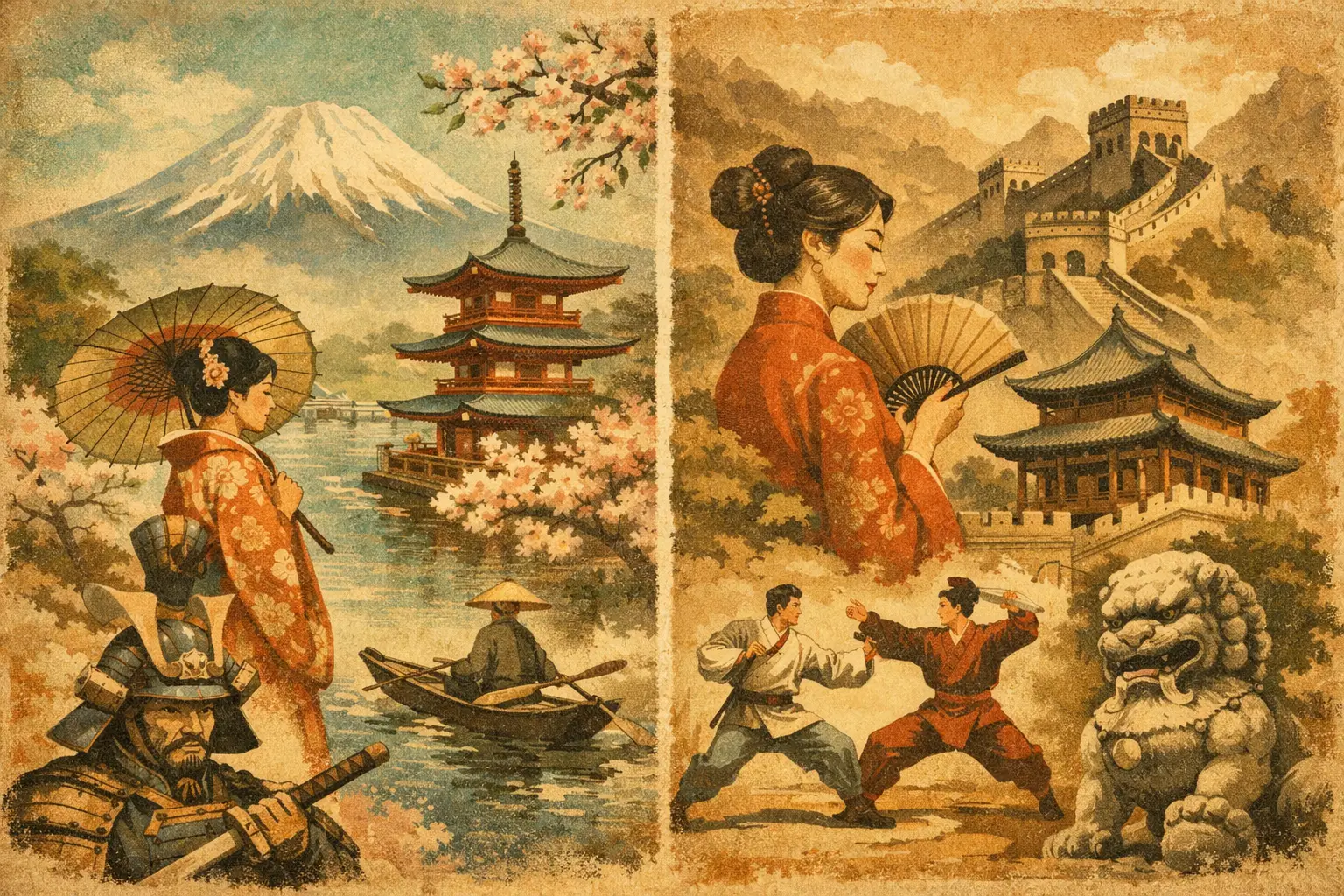
If you have ever walked through a quiet Japanese temple garden one week and a grand Chinese palace complex the next, you already feel the difference before you can explain it. That is what makes japanese culture vs chinese culture such a fascinating topic. They are deeply connected through history, yet they create very different moods, values, and everyday experiences.
For Japan lovers worldwide, this comparison is not about picking a winner. It is about seeing how two major East Asian civilizations influenced each other, then grew into distinct worlds of beauty, ritual, food, and social life. Japan borrowed a great deal from China across many centuries, but it reshaped those influences into something unmistakably Japanese.
Japanese culture vs Chinese culture starts with history
One of the clearest ways to understand japanese culture vs chinese culture is to begin with cultural transmission. China developed one of the world’s oldest continuous civilizations, with major achievements in philosophy, statecraft, writing, ceramics, architecture, and religion long before Japan formed a centralized court culture. Through contact with China and Korea, Japan absorbed Chinese characters, Buddhist ideas, political models, and artistic techniques.
But borrowing did not mean copying forever. In Japan, imported practices were refined, localized, and blended with native beliefs such as Shinto. Over time, Japan developed its own aesthetics and social rhythms. That is why a Zen temple in Kyoto and a Buddhist temple in China may share roots, yet feel entirely different in mood and design.
China often projects scale, continuity, and civilizational breadth. Japan often projects concentration, seasonality, and atmosphere. That difference is not absolute, but it is a useful starting point.
Aesthetics and beauty in daily life
If you love Japanese design, crafts, or traditional arts, this is where the contrast becomes especially vivid. Japanese aesthetics often prize restraint, asymmetry, empty space, and quiet texture. Ideas like wabi sabi and mono no aware shape how beauty is felt – not just how it looks. A weathered tea bowl, a fading autumn leaf, or the silence of a tatami room can carry emotional weight.
Chinese aesthetics, by contrast, often lean more comfortably into richness, symbolism, grandeur, and balance. That can mean elaborate decorative detail, bold color, symmetrical planning, and visual signs of prosperity or rank. In traditional Chinese art and architecture, dragons, phoenixes, red lacquer, gold accents, and formal layouts are more common expressions of beauty and power.
This difference shows up everywhere. A Japanese interior may feel intentionally spare, with natural wood, paper screens, and careful negative space. A traditional Chinese interior may feel more ornate, with carved furniture, patterned surfaces, and stronger visual presence. Neither is better. They simply answer different emotional needs.
Even painting and print culture reflect this. Japanese ukiyoe prints often capture fleeting scenes, seasonal pleasures, and elegant composition. Chinese painting traditions frequently emphasize brushwork, landscape philosophy, poetic inscription, and the moral cultivation of the artist. Both are refined. The feeling they leave behind is just different.
Religion, philosophy, and the shape of everyday values
Religion is another area where overlap and divergence sit side by side. China has long been shaped by Confucianism, Daoism, Buddhism, folk religion, and ancestor veneration. These traditions influence family hierarchy, ritual obligations, moral order, and ideas about harmony between heaven, earth, and society.
Japan includes Buddhism too, but daily cultural life is also deeply shaped by Shinto. Shinto places strong emphasis on place, purity, seasonal festivals, and a spiritual connection to natural spaces. That helps explain why shrines, sacred forests, and local matsuri feel so central to Japanese cultural identity.
Confucian values also influenced Japan, especially in education, ethics, and social relationships. Still, Japanese culture often expresses these ideas through a different tone – less focused on philosophical declaration, more on behavior, etiquette, and atmosphere. In practice, many Japanese customs feel rooted in maintaining wa, or social harmony, through sensitivity and self-control.
China, especially across its huge regional and historical range, can feel more outwardly plural and expansive. Japan can feel more codified in everyday manners. Of course, modern life complicates this. Shanghai and Tokyo are both global cities, and younger generations in both countries negotiate tradition in new ways.
Language and writing reveal shared roots and clear separation
At first glance, written Japanese and written Chinese may seem closely related because Japanese uses kanji, characters borrowed from China. That historical connection is real and important. But the languages themselves are very different.
Chinese is a family of Sinitic languages, with Mandarin as the official standard. It is tonal, and its grammar works very differently from Japanese. Japanese grammar relies heavily on particles, verb endings, and levels of politeness. It also uses three writing systems together – kanji, hiragana, and katakana.
For culture lovers, the most interesting part is how writing reflects identity. Japan took the Chinese writing system and transformed it to fit the Japanese language. That is a perfect example of the broader pattern here: strong influence, then distinct adaptation.
Food culture: shared ingredients, different sensibilities
Food is where many travelers first notice the gap between familiarity and difference. Both Japanese and Chinese cuisines value rice, noodles, soy-based ingredients, tea, pickling, and seasonality. But the dining experience and flavor logic often move in separate directions.
Japanese cuisine tends to highlight clarity, freshness, and the natural character of ingredients. Presentation matters enormously. A meal may feel carefully composed around season, color, and balance. Think of the delicacy of sashimi, the ritual calm of tea, the precision of kaiseki, or the comforting structure of a simple set meal.
Chinese cuisine is far more regionally varied than many outsiders realize. Sichuan, Cantonese, Hunan, Jiangsu, Shandong, and many other traditions bring different heat levels, textures, cooking methods, and flavor structures. Chinese meals often emphasize abundance, shared dishes, and contrast across the table rather than the individually arranged harmony common in Japan.
This is also where etiquette differs. In Japan, quiet appreciation, orderly serving, and attention to the form of the meal are often part of the experience. In China, communal energy at the table can be more central, with conversation and sharing shaping the meal’s rhythm.
Social etiquette and public behavior
Many visitors describe Japan as more restrained in public behavior. That impression is not imagined. Japanese social life often places high value on not imposing on others, reading the room, and observing subtle etiquette. Queueing carefully, speaking softly on trains, exchanging business cards with attention, and separating tatemae from honne all reflect a finely tuned social environment.
China can feel more direct, fast-moving, and openly expressive, especially in major cities and crowded public spaces. Family bonds, hospitality, and social networks remain deeply important, but the public atmosphere may seem less choreographed to foreign visitors than in Japan.
This is one of those areas where stereotypes can mislead. Rural and urban behavior differ. Age matters. Class matters. So does context. Still, many travelers feel that Japan tends to reward quiet social awareness, while China more often tolerates visible spontaneity and strong personal presence.
Art, architecture, and cultural atmosphere
In architecture, Japan often favors human scale, wood, modular space, and the integration of buildings with gardens and landscape. Chinese architecture traditionally leans toward axial planning, monumentality, courtyard systems, and a stronger visual emphasis on authority and order.
You can see this in sacred sites too. A Japanese shrine path framed by torii gates invites a slow transition into sacred space. A major Chinese temple complex may impress through layered gates, large halls, incense, and structural symmetry. Both can be powerful. They simply guide emotion in different ways.
This is why travel in the two countries feels different even when the categories sound similar. A castle, a temple, a tea tradition, a ceramic workshop – the experience is shaped by very different cultural instincts.
So which culture is older, deeper, or more influential?
China is older as a continuous civilization and historically influenced Japan in major ways. That part is clear. But cultural depth is not a competition, and influence is not the same as identity. Japan developed a distinct civilization by selecting, refining, and reimagining what came from abroad alongside its own traditions.
For those of us who feel pulled toward Japan, this matters. Loving Japan does not require ignoring China’s importance. In fact, understanding Chinese influence often makes Japanese culture even more interesting. You start to notice what Japan inherited, what it preserved, and what it made uniquely its own.
That is part of the joy of cultural curiosity. The more carefully you look, the more specific your appreciation becomes. And if your heart already leans toward Japanese temples, calligraphy, tea bowls, kimono, or quiet gardens, then comparing japanese culture vs chinese culture can sharpen that love rather than dilute it.
The best next step is simple: do not stop at broad labels like “Asian culture.” Look closer, ask better questions, and let each tradition speak in its own voice.