You are standing in Kyoto at the edge of a quiet complex. There is a gate, a main hall, a place to pray, and a line of visitors moving with calm purpose. Then the question hits: is this a temple or a shrine? If you have ever mixed them up, you are in very good company. The japanese temples and shrines difference is one of the first things many Japan lovers want to understand, and once it clicks, every visit becomes more meaningful.
This is not just a vocabulary issue. Temples and shrines reflect two different religious traditions in Japan, and each carries its own atmosphere, symbols, etiquette, and history. Knowing which is which helps you read a place more clearly, from the way incense drifts through the air to the shape of a torii against the sky.
The japanese temples and shrines difference at a glance
The simplest way to remember the japanese temples and shrines difference is this: temples are Buddhist, and shrines are Shinto.
A Buddhist temple is called an otera. It is connected to Buddhism, which came to Japan from the Asian mainland and developed deep roots there over many centuries. A Shinto shrine is called a jinja. It is connected to Shinto, Japan’s native spiritual tradition centered on kami, often understood as sacred presences or spirits associated with nature, places, ancestors, and forces of life.
That sounds neat and tidy, but Japan is not always tidy in this way. Buddhism and Shinto influenced each other for a very long time, and some places can feel blended. So while the core distinction is clear, real-life visits sometimes come with overlap. That is part of the beauty.
How to tell a shrine from a temple
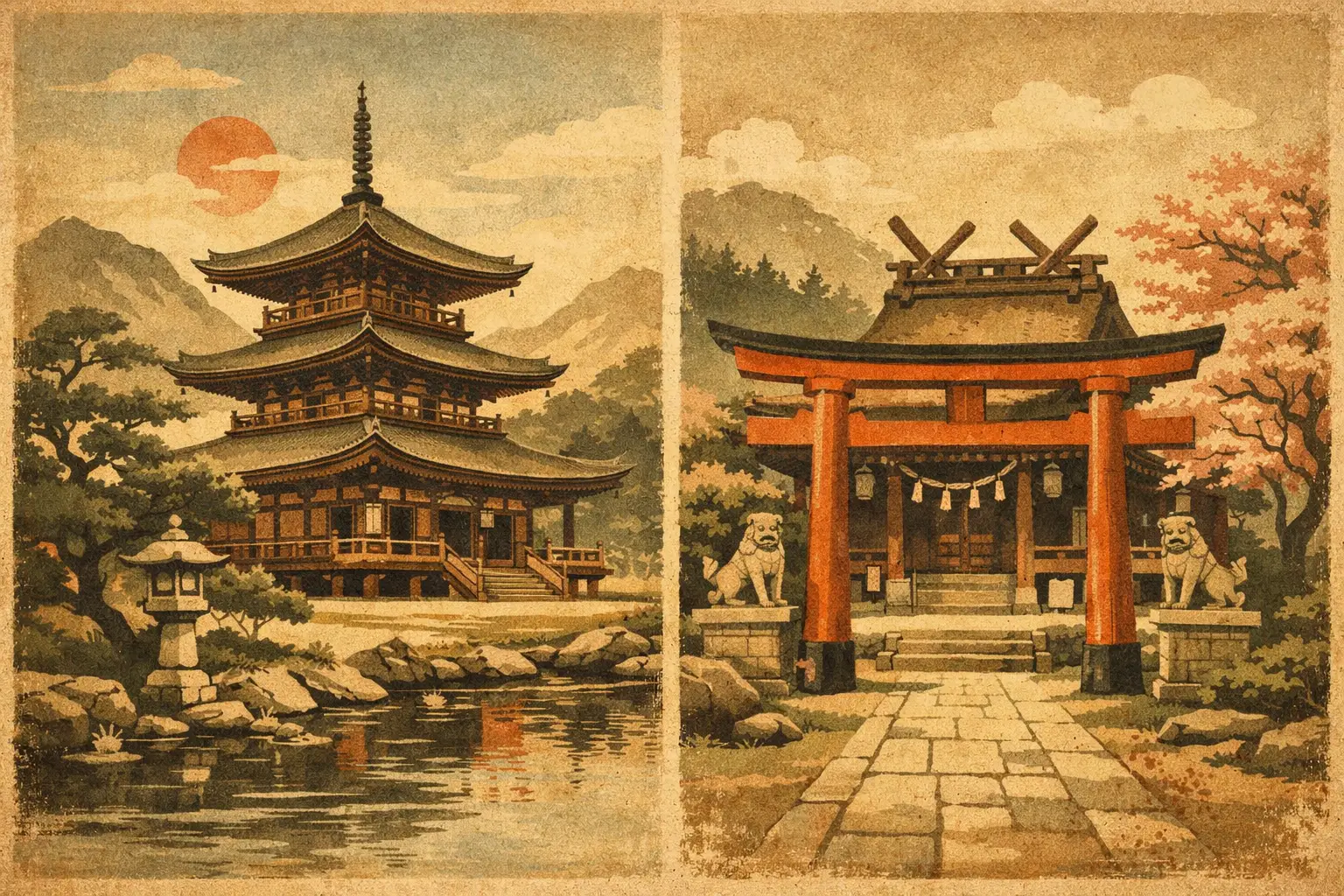
If you are traveling and want quick clues, start with the entrance. A shrine often has a torii, the iconic gate that marks entry into a sacred Shinto space. It may be bright vermilion, weathered wood, or stone. Passing through it feels like crossing a threshold from ordinary life into something quieter and more charged.
A temple usually does not have a torii. Instead, it may have a larger gate called a sanmon, often more architectural and enclosed in style. Temples also commonly feature Buddhist statues, pagodas, bell towers, cemeteries, and incense burners.
At a shrine, you are more likely to see a purification fountain called a temizuya near the entrance. Visitors rinse their hands and mouth before approaching the main hall. You may also spot komainu, the lion-dog guardians at the front.
At a temple, you may see a large incense cauldron. People waft smoke toward themselves, especially toward areas where they hope for healing or blessing. Statues of Buddhas or bodhisattvas are another strong signal that you are in Buddhist space.
Even the atmosphere can feel different. Shrines often carry a crisp, open-air feeling tied to trees, gravel paths, and natural simplicity. Temples can feel more contemplative and inward, with halls, altars, and the scent of incense creating a more meditative mood. Of course, it depends on the site. A mountain temple can feel wild and open, while a city shrine can feel tucked into the urban flow.
What people worship at each one
This is where the difference becomes more than visual.
At shrines, people venerate kami. These are not exactly gods in the Western sense, and translating the word too narrowly can miss the point. Kami can be linked to mountains, waterfalls, foxes, storms, the harvest, famous historical figures, or local protective powers. Shinto often feels deeply tied to place, season, and purity. There is a strong sense of connection to the living world, and for many visitors that creates a feeling close to mono no aware – an awareness of beauty and impermanence.
At temples, the focus is Buddhism. Visitors may pray to a Buddha, a bodhisattva, or other Buddhist figures for compassion, wisdom, protection, safe childbirth, success in study, or memorial remembrance. Temples are also closely tied to funerary practices in Japan, which is one reason many temple grounds include graves.
So if you are asking whether one is more spiritual than the other, the honest answer is no. They simply express spirituality through different traditions and symbols.
Etiquette: what to do at a shrine vs a temple
Many travelers worry about doing the wrong thing. The good news is that respectful behavior matters more than perfection.
At a shrine, begin by bowing lightly before entering through the torii. If there is a purification fountain, use the ladle to rinse your left hand, then your right, then pour water into your left hand to rinse your mouth indirectly. Do not drink straight from the ladle. At the main hall, if there is an offering box, you can toss in a coin, ring the bell if there is one, bow twice, clap twice, make your prayer, and bow once more. That bow-clap pattern is a classic shrine practice.
At a temple, things are usually quieter. You may place a coin in the offering box, put your hands together, and pray silently. No clapping. If incense is available, you can offer it respectfully. Some temples encourage visitors to ring a bell, though practices vary by site.
That last point matters. Japan has local differences everywhere. If you are unsure, pause and observe what people around you are doing. That is often the best guide.
Architecture and objects that reveal the difference
A shrine’s main hall is often called a honden, though visitors may not enter it. The worship hall where prayers are offered is often the haiden. Shimenawa ropes, white zigzag paper streamers, ema wooden prayer plaques, and omamori protective charms are all common shrine elements.
Temples have their own visual language. You may encounter a kondo or main hall, a pagoda, a bell tower, and rows of Jizo statues. Buddhist imagery can range from serene and elegant to dramatic and fearsome, depending on the sect and deity. In some Zen temples especially, there is a wabi sabi beauty in weathered wood, stone paths, moss gardens, and stillness.
If you are a lover of Japanese art and symbolism, this is where visits become addictive in the best way. The rooflines, lanterns, guardian figures, votive tablets, and calligraphy all start to tell a story.
Why Japan has both temples and shrines
Japan did not choose one tradition over the other. It carried both.
Shinto is rooted in Japan itself, while Buddhism arrived from abroad and was gradually embraced, adapted, and woven into Japanese life. For long periods, the two traditions were not sharply separated in everyday practice. People might visit shrines for some life events and temples for others without seeing any contradiction.
Even now, many Japanese people engage with both. A family may go to a shrine for New Year, take a child for a Shinto blessing, and rely on a temple for funeral rites. That lived coexistence is one reason the line can feel softer on the ground than in a textbook.
So if you are looking for a strict either-or answer, Japan gently resists that. It is one of the reasons cultural travel here feels so rich.
Common mix-ups travelers make
One common mistake is assuming every traditional religious site is a temple. Another is thinking a torii means the whole complex must be Shinto, when some places have complicated histories. Travelers also sometimes expect shrine visits to be silent and temple visits to be ceremonial, but in reality either can be peaceful, crowded, festive, or deeply personal depending on the day.
There is also the photography issue. Some temple interiors and shrine sacred areas do not allow photos. The best approach is simple: look for signs, keep your voice down, and treat the space as living culture, not a backdrop.
If you collect goshuin, the beautiful calligraphy stamps from religious sites, remember that both temples and shrines may offer them. For many Japan lovers, this becomes a wonderful way to notice the difference more carefully. Each stamp, seal, and brushstroke turns your trip into a record of real encounters rather than a checklist.
Which should you visit first?
Honestly, whichever one calls to you.
If you love nature, seasonal festivals, and the feeling of sacred space woven into daily life, shrines may grab your heart first. If you are drawn to statues, gardens, meditation, history, and a more visibly layered religious atmosphere, temples may be your starting point.
But most travelers end up loving both for different reasons. A vermilion shrine path at sunrise and a Zen temple garden in late afternoon do not compete with each other. They expand your sense of Japan together.
That is the real reward of understanding the difference. You stop seeing only “old religious buildings” and start noticing living traditions, small rituals, and emotional textures. For all Japan lovers worldwide, that shift changes everything. The next time you step through a gate, pause for a second, look closely, and let the place tell you what it is.