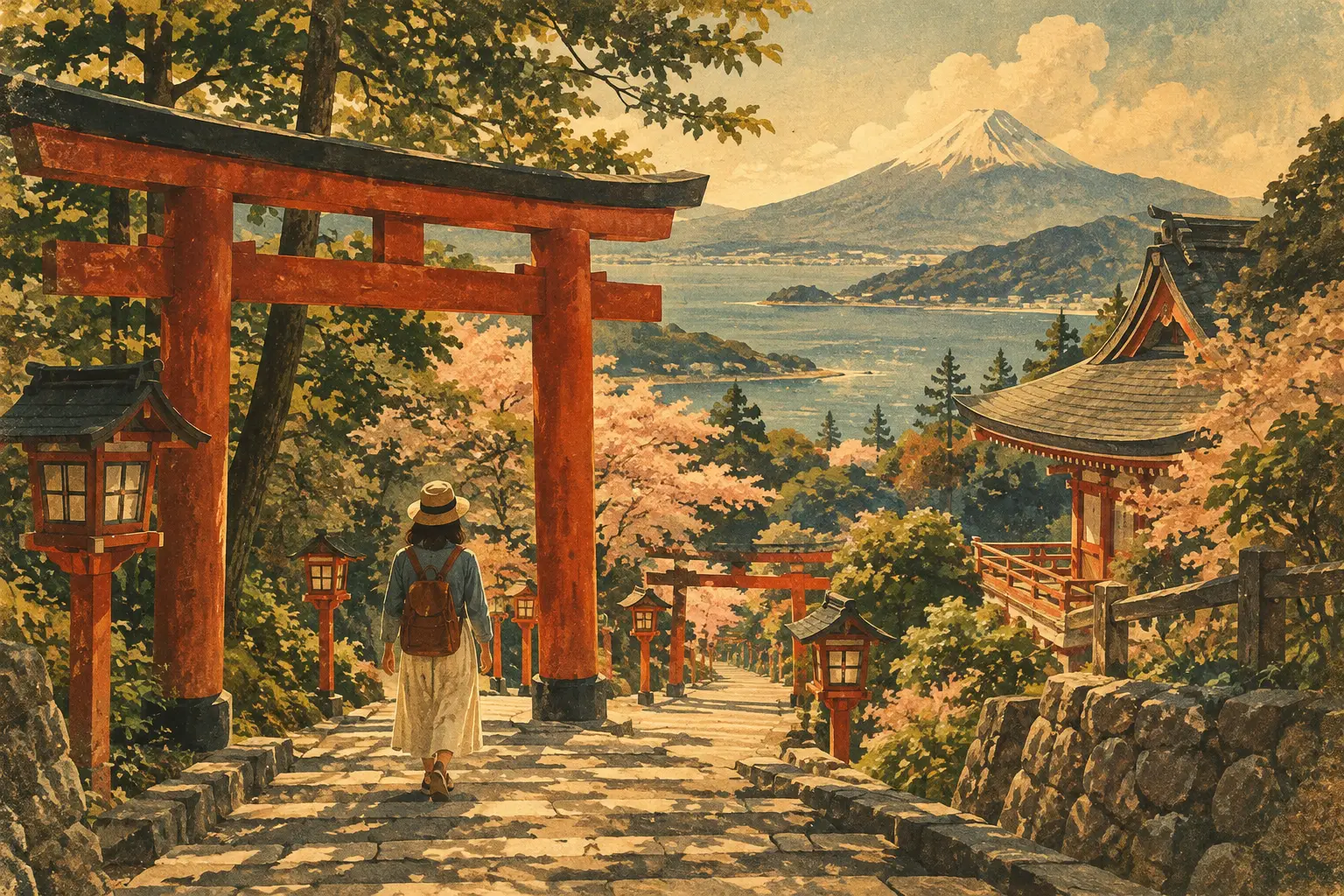
A shrine visit becomes something deeper when you arrive on foot. The best Japanese shrine walks let you feel the distance between ordinary streets and sacred ground: gravel crunching under sandals, cedar trunks rising beside a stone path, a red torii appearing where the trail bends. For Japan lovers worldwide, these routes are a beautiful way to experience Shinto not as a checklist, but as a living relationship with place, season, and community.
Shrines are often confused with Buddhist temples, especially by first-time visitors. A quick visual cue helps: Shinto shrines usually have torii gates, while temples often have large gates, pagodas, incense burners, and Buddhist imagery. On the walks below, keep your eyes open for the smaller details too: shimenawa sacred ropes, paper shide streamers, fox statues, stone lanterns, and the quiet hand-washing pavilion called a temizuya.
Best Japanese Shrine Walks for Every Kind of Traveler
Fushimi Inari Taisha, Kyoto
Fushimi Inari is famous for its thousands of vermilion torii, but the real magic begins after most visitors turn around. The lower paths can be busy from morning onward, especially around the main shrine buildings. Continue uphill toward Yotsutsuji, where Kyoto spreads below you and the gates become more spaced out.
The full mountain circuit takes roughly two to three hours, depending on stops and pace. It is a steady climb, not a technical hike, but wear shoes with grip. This is a shrine dedicated to Inari, associated with rice, prosperity, and commerce, which explains the many fox messengers watching from stone pedestals. Go early, ideally before 8 a.m., and you will understand why this walk has become iconic without feeling like you are moving through a photo line.
The Kumano Kodo Nakahechi Route, Wakayama
If one shrine walk belongs on a serious Japan culture itinerary, it is the Kumano Kodo. This network of pilgrimage trails crosses the forested Kii Peninsula and connects the Kumano Sanzan, the three grand shrines of Kumano. The Nakahechi route is the most accessible and rewarding choice for many international visitors.
You do not need to walk the entire multi-day route to feel its power. A day walk from Takijiri-oji toward Chikatsuyu, or a section ending near Kumano Hongu Taisha, gives you mossy stone steps, cedar woods, old oji subsidiary shrines, and villages shaped around pilgrims for centuries. The walking can be demanding, with real elevation and weather that changes quickly. Good rain gear is not optional in this part of Japan.
Kumano has a strong sense of mono no aware, the tender awareness that everything passes. Mist catches in the trees, worn trail markers sit beside new hiking signs, and a simple cup of tea at a village stop can feel unexpectedly memorable. Stay overnight if you can. This route deserves time, not a rushed bus tour.
Mount Haguro and Dewa Sanzan, Yamagata
Mount Haguro offers one of Japan’s great sacred ascents: 2,446 stone steps through a towering cedar forest. The path leads to Dewa Sanzan Shrine, representing all three sacred mountains of the region, and it has long been associated with the mountain ascetic tradition of Shugendo.
At the bottom, do not rush past the five-story pagoda. Its dark wood form is beautifully restrained, a moment of wabi sabi before the climb begins. The steps are uneven in places and can be slick after rain, so take your time. This is not the place to race for a fitness record. Pause, drink water, and let the forest set the pace.
For travelers who want a shrine experience with physical challenge and deep atmosphere, Mount Haguro is hard to beat. Summer brings lush green shade, while autumn creates a more dramatic color palette. Winter conditions can be severe, so check local access information before planning a cold-season ascent.
Kasuga Taisha Through Nara Park, Nara
Kasuga Taisha is reached through the ancient forest at the eastern edge of Nara Park. The walk from central Nara is gentle and easy to combine with other sights, but it never feels like an afterthought. Hundreds of stone lanterns line the approach, softened by moss and framed by trees.
Yes, you may encounter deer. They are considered messengers of the gods in Nara, which makes the setting feel especially fitting. Still, they are wild animals with a strong interest in snacks. Keep food secured and give them space, even when their bowing looks charming.
The shrine’s lanterns are especially famous during seasonal illumination events, but an ordinary weekday morning has its own appeal. This is a walk for travelers who want sacred architecture, forest atmosphere, and an easy cultural day without committing to a mountain hike.
Ise Jingu’s Quiet Approaches, Mie
Ise Jingu is Japan’s most revered Shinto shrine complex, dedicated to Amaterasu, the sun goddess. The main Inner Shrine, Naiku, is the better-known destination, while the Outer Shrine, Geku, is traditionally visited first. The walk to Naiku begins over the wooden Uji Bridge and continues along broad gravel paths beneath enormous trees.
This is not a long trek, and that is part of its character. Ise teaches a different kind of walking: slow, formal, attentive. The shrine buildings themselves are largely hidden from view, and photography is restricted beyond certain points. That restraint is meaningful. Rather than demanding to see everything, visitors are asked to recognize that some sacred spaces are not designed for display.
Pair the visit with time in Oharai-machi, the old-style street outside the shrine precinct. It can be busy, but it adds a welcome human rhythm of tea, local sweets, and craft storefronts before or after the quiet of the woods.
Itsukushima Shrine and Mount Misen, Miyajima
On Miyajima, the tide changes the entire experience. At high tide, the floating torii of Itsukushima Shrine seems to rise from the Seto Inland Sea. At low tide, visitors can walk closer to its base. The shrine promenade itself is level and accessible, but the island becomes a true walking destination if you continue toward Mount Misen.
Several routes lead upward through forest, stone markers, and views over the water. The climb can be strenuous, particularly in humid weather, so a cable car may be the better choice for some travelers. There is no prize for exhaustion. What matters is making room for the island’s mixture of shrine tradition, mountain worship, sea air, and playful deer.
Try to spend enough time to see the island at different moods. A morning arrival feels entirely different from the late-afternoon light after day-trippers leave.
Tsurugaoka Hachimangu and the Old Kamakura Paths
Kamakura is ideal for travelers who want to combine shrine culture with a walkable historic town. Tsurugaoka Hachimangu sits at the end of a broad approach that runs through the center of Kamakura, linking the shrine visually and physically to the coast. The avenue can be lively, but the grounds offer ponds, bridges, seasonal flowers, and a satisfying climb to the main hall.
For a longer day, connect the shrine visit with one of Kamakura’s wooded hiking paths toward Kita-Kamakura or the Great Buddha area. These trails can be muddy and uneven, especially after rain, but they reveal another side of a city often treated as a day-trip collection of landmarks. Kamakura rewards wandering. Turn down a quiet lane and you may find a small shrine, a ceramic shop, or a garden wall that feels lifted from an ukiyoe print.
How to Walk Respectfully at Japanese Shrines
The etiquette is simple, and trying matters more than performing it perfectly. At a torii gate, avoid walking directly down the center, which is traditionally reserved for the kami, or divine presence. Step slightly to one side and offer a small bow if you wish.
At the temizuya, rinse your left hand, then your right. Pour water into your cupped left hand to rinse your mouth discreetly, without touching the ladle to your lips. Rinse your left hand once more and let remaining water run down the handle. If the basin is closed or instructions say not to use it, simply skip the ritual.
At the prayer hall, visitors commonly offer a coin, bow twice, clap twice, make a quiet wish or expression of gratitude, then bow once more. Customs vary slightly by shrine, so follow posted instructions when present. Photography is welcome in many outdoor areas, but never assume it is allowed everywhere. Signs, attendants, and barriers deserve your full attention.
Choosing the Right Walk for Your Trip
Choose Fushimi Inari for torii gates and an easy first shrine hike. Choose Kumano Kodo when pilgrimage, landscape, and several days of walking matter more than convenience. Mount Haguro is for those who want stone steps and sacred mountain energy, while Kasuga Taisha and Ise offer quieter, lower-effort immersion.
The best timing depends on your priorities. Spring and fall bring comfortable temperatures but bigger crowds. Summer is lush and festive, though humid, while winter can offer striking calm if you are prepared for cold and route closures. A small hand towel, water, cash for offerings, and shoes you genuinely enjoy walking in will serve you better than a packed sightseeing schedule.
Pick one shrine walk that leaves room for slowness. Sit on a bench after your visit, notice the sound of wind in the trees, and let the route stay with you long after the last torii is behind you.