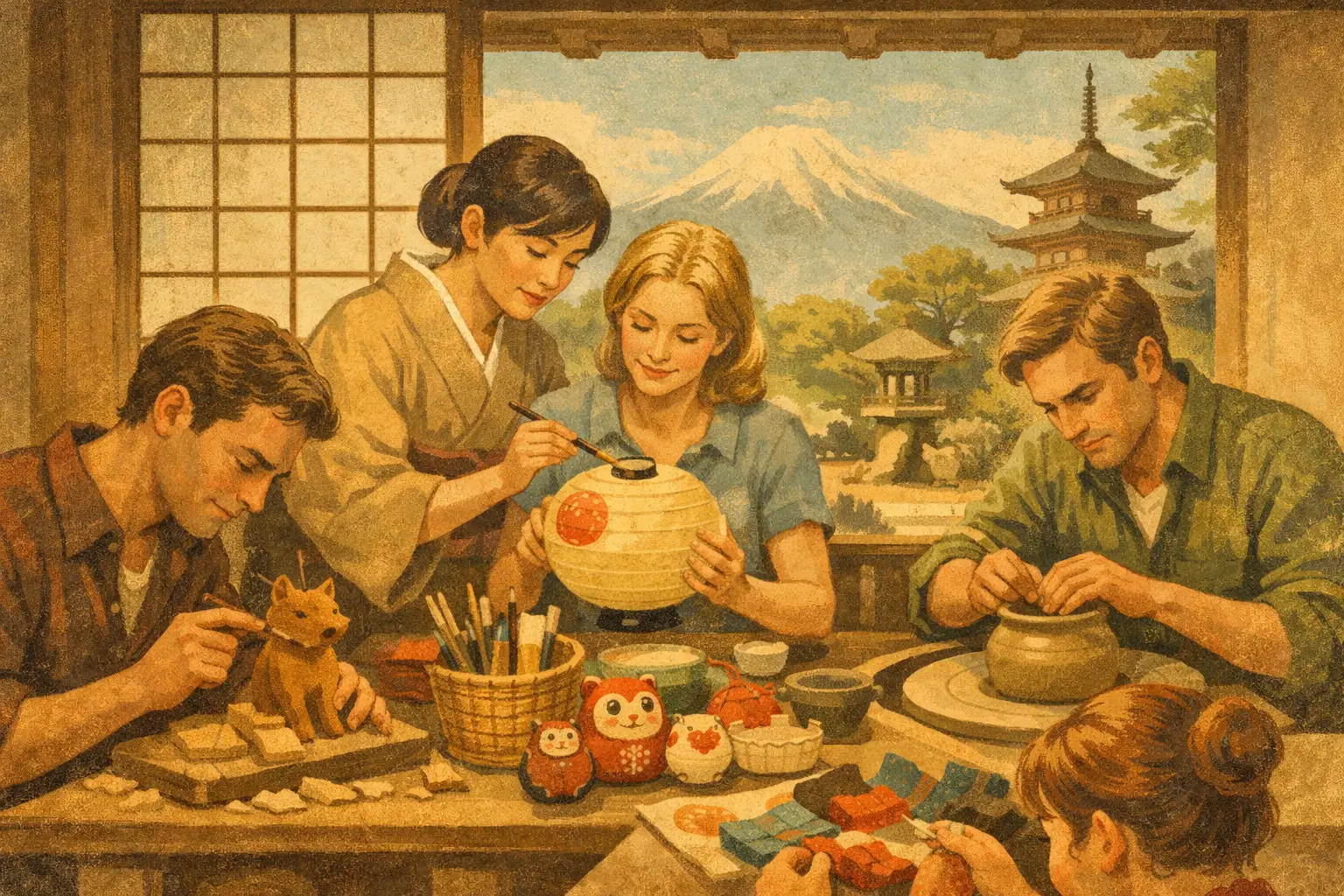
A hand-thrown tea bowl still warm from the kiln. Indigo dye staining your fingertips. The crisp sound of a woodblock meeting paper. If you are wondering how to join a Japanese craft workshop, start by thinking beyond the souvenir shop. A workshop lets you spend a few unhurried hours with a living tradition and leave Japan with a story built into the object you bring home.
For Japan lovers worldwide, this is one of the best ways to move from admiring Japanese craft to participating in it. You do not need to be an artist, speak fluent Japanese, or know the difference between kutani and kintsugi before you arrive. You only need curiosity, a little planning, and respect for the maker whose craft you are entering.
Choose a Craft That Fits Your Trip
Japan has workshops for almost every kind of cultural curiosity. In Kyoto, you might paint a ceramic cup, make a wagashi sweet, try Yuzen fabric dyeing, or assemble a traditional incense blend. In Kanazawa, gold leaf workshops are a favorite, while visitors to Tokushima can try indigo aizome dyeing. Rural towns may offer paper-making, bamboo weaving, or woodwork in small studios that feel far from the usual tourist circuit.
Start with the experience you actually want, not simply the one with the best photos. Pottery is tactile and satisfying, but finished pieces often need time to dry, glaze, and fire. A sushi, soba, or wagashi class is easier to fit into a short itinerary because you enjoy the result that day. Textile dyeing can be wonderfully hands-on, although the colors and patterns may be more guided than fully custom.
If your heart is set on something specific, search using the craft name plus the region. Useful terms include tōgei for pottery, aizome for indigo dyeing, washi for handmade paper, shodō for calligraphy, and ukiyoe for woodblock prints. Adding the word taiken, meaning hands-on experience, can help identify visitor-friendly sessions.
Pick the Right Level of Guidance
Most travelers will be happiest with a beginner workshop. These are designed to be welcoming, usually provide materials and tools, and often include a short explanation of the tradition before you begin. The goal is not to produce museum-level work. It is to understand the rhythm, care, and occasional imperfections behind an object that might otherwise look effortless.
More advanced classes can be rewarding if you already practice a craft at home, but check whether instruction is available in English. A studio may advertise an English-friendly booking page while offering the actual lesson mostly in Japanese. That can still be enjoyable, especially for visual crafts, but know what you are signing up for.
How to Find and Book a Japanese Craft Workshop
The easiest options are often listed through local tourism offices, hotel concierge desks, cultural centers, and experience booking platforms. Yet some of the most memorable workshops belong to independent artisans with limited online information. A guesthouse owner, regional visitor center, or a small gallery can be an excellent source of introductions.
When reviewing a workshop, look beyond the headline price. Confirm the location, duration, language support, age limits, cancellation policy, and whether all materials are included. For ceramics, ask when the piece will be ready and whether international shipping is possible. A bowl that needs three weeks in a kiln is not ideal if you leave Japan in four days.
Book ahead for popular areas and peak travel periods, especially spring cherry blossom season, Golden Week, summer school holidays, and autumn foliage season. Small studios may only have room for four or six guests, and the artisan may reserve certain days for production rather than teaching.
If a booking form is only in Japanese, do not assume you cannot attend. Use a translation tool to understand the basics, then send a brief, polite message. Keep it simple: introduce yourself, name the date you want, say how many people are coming, and ask whether an English explanation is available. Clear communication goes a long way.
Questions Worth Asking Before You Pay
Three questions can save a surprising amount of stress: Can I take my piece home the same day? Is shipping available if it needs firing or drying? And what should I wear or bring?
Also ask about accessibility if you need it. A traditional machiya studio may involve steep stairs, floor seating, or narrow entrances. There is no shame in requesting details. The best craft experience is one where you can focus on the work rather than managing an unexpected obstacle.
Arrive Ready to Be a Good Guest
Japanese craft workshops are often working studios first and visitor experiences second. The tools, materials, and displays around you may represent years of practice. Arrive 10 to 15 minutes early, silence your phone, and follow the maker’s directions closely.
Wear clothes you do not mind getting dirty. Clay, ink, lacquer, and dye are part of the fun, but they do not always come out of a favorite white shirt. Avoid loose sleeves for activities involving wheels, carving tools, or open flames. If shoes must come off, clean socks are a small but thoughtful detail.
Photography rules vary. Many artisans welcome photos of participants but may not want close-ups of their tools, preparation methods, or private work areas. Ask before photographing the instructor or recording video. A quick “Shashin wa daijōbu desu ka?” – “Are photos okay?” – is useful, but a gesture toward your phone and a friendly question works too.
Let Go of the Perfect Souvenir
The quiet surprise of a craft workshop is that it changes how you see Japanese objects. Your tea cup may have a thumbprint near its base. Your dyed scarf may have a softer edge than the sample on the wall. That is not failure. It can be a small encounter with wabi sabi, the beauty found in irregularity, age, and the human hand.
Try not to rush toward a perfect result. Watch how the artisan handles a brush, folds paper, or centers clay. Ask what first drew them to the craft and how long they have practiced it. Even with a language barrier, their gestures reveal a great deal. This is where a workshop becomes more than an activity on an itinerary.
For crafts with a deeper cultural setting, such as tea ceremony utensils, incense, or calligraphy, a little background reading can make the experience richer. You will notice that many Japanese traditions make room for restraint and passing seasons. That feeling of mono no aware – awareness that a moment is beautiful partly because it cannot last – can be present in something as simple as painting a fall maple leaf onto a plate.
Plan for Your Finished Piece
Before leaving the studio, make sure you understand exactly what happens next. If your item will be shipped, verify the address, expected delivery window, shipping fee, and tracking method. If it is being mailed to your hotel, tell the hotel in advance and confirm that it can receive parcels after you check out if necessary.
For pieces you carry yourself, ask how to pack them. A fragile ceramic cup belongs in your carry-on, wrapped in clothing and placed near the center of your bag. Wet or scented items may need special handling. Food workshops are easiest: eat your creation, take a photo, and carry the memory home without worrying about customs rules.
A Japanese craft workshop will not turn you into a master in one afternoon, and that is not the point. It offers a more personal way to meet Japan: through clay under your nails, the scent of wood and ink, and the patient guidance of someone keeping a tradition alive. Choose one that genuinely excites you, show up with an open mind, and let your imperfect handmade piece become part of your own Japan story.