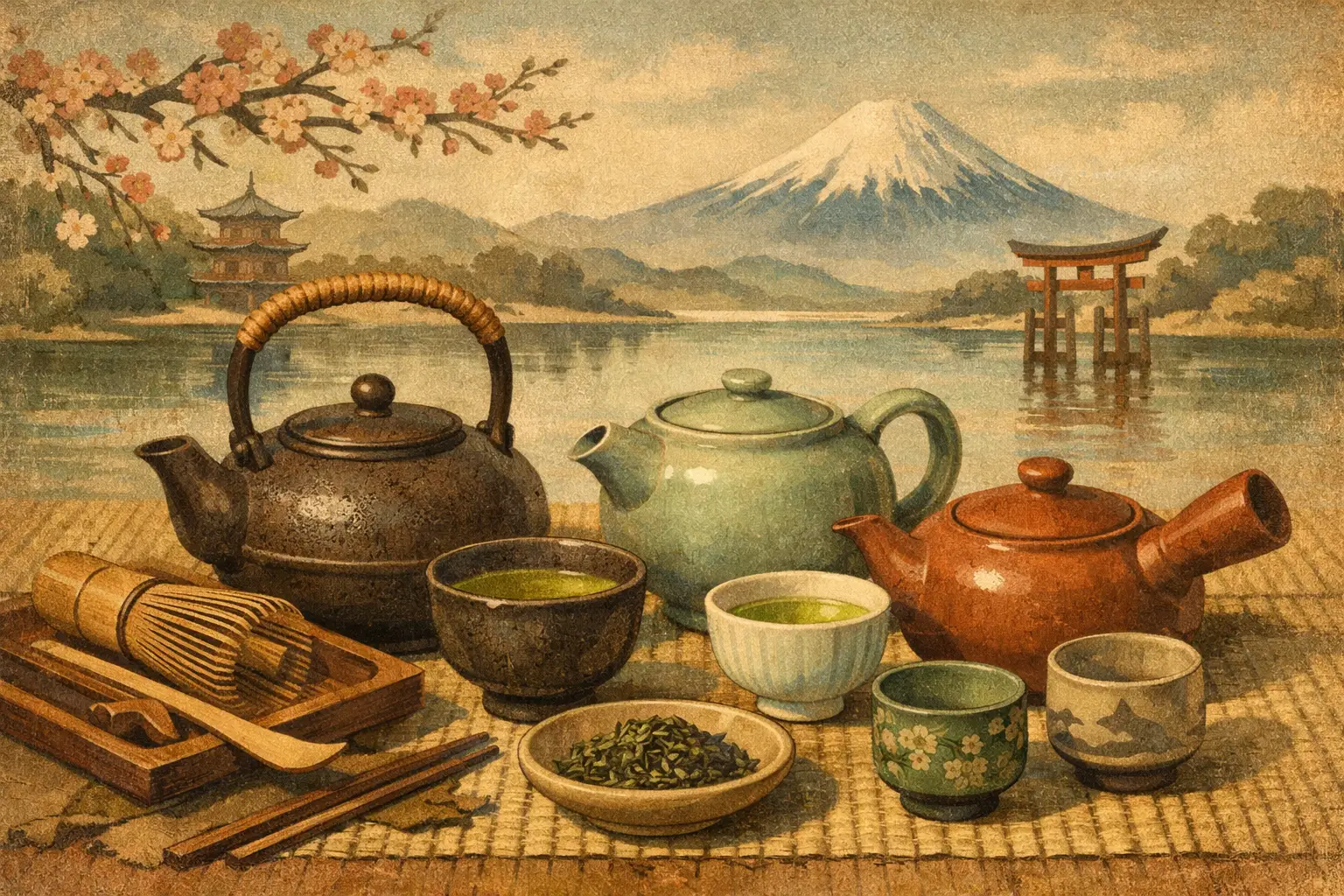
A good cup of sencha can taste strangely flat in a thick souvenir mug, while the same leaves become sweet, grassy, and aromatic from a small kyusu and yunomi. That is the real purpose of this Japanese teaware review: not to tell you that every tea lover needs a shelf full of ceramics, but to help you choose pieces that make your daily tea feel more Japanese, more intentional, and more enjoyable.
Japanese teaware is full of personality. A hand-thrown cup may lean slightly to one side. A glaze may pool darkly near the foot. A clay pot can develop a deeper color after years of use. These are not necessarily flaws. They are often part of wabi sabi, the appreciation of modest, imperfect, changing beauty. For all Japan lovers worldwide, that character is exactly what makes teaware worth bringing into everyday life.
Japanese Teaware Review: Start With How You Drink Tea
The best teaware depends on the tea you actually make. If you mostly drink loose-leaf Japanese green tea, a kyusu is the strongest first purchase. If matcha is your ritual, start with a chawan and bamboo whisk. If you enjoy tea with meals or want a beautiful daily cup, yunomi are the easiest entry point.
Avoid buying a complete matching set just because it looks polished in a photo. Japanese tea culture is not always about matching. A charcoal-gray kyusu paired with two different cups can feel warmer and more personal than identical pieces. Think of your collection as a group of objects with a shared mood, not a showroom display.
Kyusu: The Everyday Japanese Teapot
A kyusu is a side-handled Japanese teapot, usually used for sencha, gyokuro, hojicha, and other loose-leaf teas. Its side handle gives you controlled pouring, while the broad body gives leaves room to open. That space matters, especially with high-quality sencha, which needs water circulation to release its flavor evenly.
The built-in strainer is one of the biggest differences between a kyusu and a generic teapot. Some have fine ceramic holes formed directly into the pot. Others use a mesh screen. Ceramic filters are beautiful and can pour exceptionally well, but tiny tea leaves may require more careful cleaning. Metal mesh is practical, especially for fukamushi sencha, a deep-steamed tea with very fine leaf particles.
For most beginners, a 10- to 14-ounce kyusu is the sweet spot. It can prepare two modest cups or several small pours without leaving tea sitting too long. Very large pots are useful for family meals, but they can make solo tea feel wasteful. Japanese green tea is best poured out completely after steeping, so no bitter liquid remains in the pot.
Tokoname Clay: Worth the Attention?
Tokoname ware, from Aichi Prefecture, is one of Japan’s most famous teapot traditions. Many Tokoname kyusu are made from unglazed red clay, often called shudei. Fans value it for its warm color, fine craftsmanship, and the way it can soften the sharp edges of green tea over time.
Is unglazed clay objectively better? It depends. A glazed kyusu is easier to clean, does not retain aromas as readily, and can be used for a wider range of teas. An unglazed Tokoname pot feels more specialized. It is wonderful if sencha is your regular habit, but it is less ideal if you want to switch constantly between jasmine tea, smoky black tea, and herbal blends.
In this Japanese teaware review, Tokoname earns high marks for tea lovers who enjoy the ritual as much as the drink. The clay has a quiet presence. It asks you to slow down, use it often, and let it become yours.
Yunomi and Chawan Are Not the Same Cup
It is easy to call every Japanese tea cup a chawan, but the distinction matters. A yunomi is generally an everyday tea cup, often tall and handleless. A chawan is a tea bowl, most closely associated with matcha. Both can be beautiful, but their shapes support different experiences.
A yunomi fits naturally into daily meals. It holds sencha, genmaicha, or hojicha comfortably and keeps your hands close to the warmth of the tea. Look for one that feels balanced when full, not just attractive when empty. The rim should be pleasant against your mouth, and the base should sit securely on a table.
A chawan is wider and more open because matcha must be whisked inside it. Its bowl-like form also invites you to hold it with both hands, notice its glaze, and turn it slightly as you drink. That small turn is part of tea ceremony etiquette, traditionally done to avoid drinking from the bowl’s front, where the maker may have placed the most expressive design.
For everyday matcha, choose a chawan with enough interior space for the whisk to move freely. A bowl that is too narrow may look elegant but makes whisking frustrating. Winter bowls are often deeper to hold warmth; summer bowls may be wider and shallower. You do not need separate seasonal bowls, but knowing this detail makes the forms feel more alive.
Glaze, Texture, and the Pleasure of Imperfection
Japanese ceramics are not meant to be judged only by smoothness or symmetry. A rough Shigaraki-style surface, an earthy Bizen-like finish, or a crackled glaze can create a tactile connection that factory-perfect cups often lack. The object becomes part of the tea moment, not merely a container.
That said, texture has trade-offs. Strongly textured rims can be less comfortable for daily drinking. Pale crackle glazes may stain gradually from tea, especially if left unwashed. This aging can be lovely, a small form of mono no aware, but it is not for everyone. If you want easy care and a crisp, clean look, choose a glazed porcelain or stoneware cup with a simpler interior.
Porcelain is especially good for appreciating delicate teas. Its nonporous surface adds little flavor of its own, and its lighter body lets you see the color of the liquor. Stoneware feels more grounded and retains heat longer. Neither is automatically superior. Porcelain highlights clarity; stoneware emphasizes warmth and texture.
What to Look for Before You Buy
The most rewarding pieces are not always the most ornate. Check the practical details first. The lid of a kyusu should sit securely without being jammed tight. The pour should be clean rather than dribbling down the spout. A cup should not wobble. If buying handmade work, expect small variations, but avoid obvious cracks, sharp edges, or a glaze that feels poorly finished around the rim.
Be cautious with vague labels such as “Japanese style.” A piece can be inspired by Japan without being made in Japan, and that is fine if the price and description are honest. But if you are seeking traditional craft, look for a clear mention of the region, studio, material, or production method. A real connection to place makes the story richer, whether it is Tokoname clay, Mino ware, Kutani decoration, or a local potter’s small workshop.
Price is also not a simple quality scale. A modestly priced Japanese-made yunomi may be more useful and better finished than an expensive decorative bowl. Meanwhile, a handmade chawan from a respected artist can cost much more because you are paying for skill, limited production, and a distinct artistic voice. Buy the best piece you will genuinely use, not the most impressive one you can keep in a cabinet.
Care That Keeps Teaware Beautiful
Most Japanese teaware asks for gentler care than everyday kitchenware. Hand-washing is the safer default, particularly for handmade ceramics, gold decoration, and unglazed clay. Use warm water and mild soap when needed, then dry thoroughly. Never leave tea sitting in a kyusu after brewing.
For an unglazed clay teapot, dedicate it to one family of tea if possible. Sencha and gyokuro work well together; heavily scented teas are better kept elsewhere. Do not use baking soda, bleach, or abrasive scrubbers on clay. If fine leaves clog the filter, soak the pot in warm water and use a soft brush gently from the inside.
A small tea cloth, a tray, and a place to let your pieces air-dry can make a surprisingly big difference. The ritual does not need to be formal. It simply gives your tea tools the respect they deserve.
The right Japanese teaware will not make every afternoon feel like a full tea ceremony, and it should not have to. Choose a piece that invites you to pause for five honest minutes: warm the cup, pour the tea, notice the glaze in your hands, and enjoy a little Japan wherever you are.