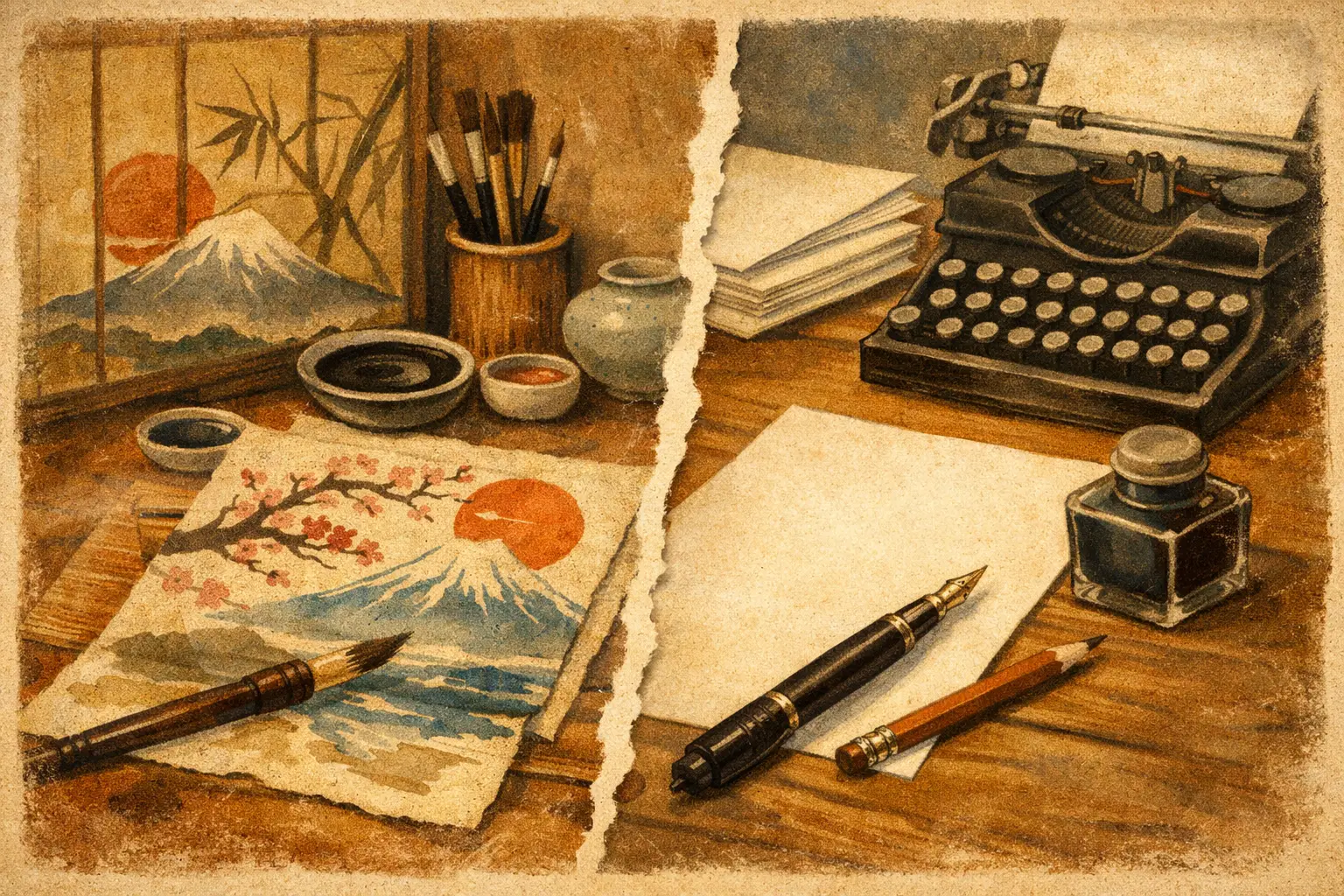
A sheet of washi can make an ordinary moment feel ceremonial. Hold it up to the light and you may see long fibers drifting through the surface like fine threads in water. That sensory difference is the heart of washi paper vs regular paper: this is not simply Japanese paper with a pretty pattern. It is a material shaped by plant fibers, hand skills, and a Japanese appreciation for objects that gain character over time.
For Japan lovers worldwide, washi is one of the easiest traditional crafts to bring into daily life. It can become a letter to a friend, a backing for a small ukiyo-e print, a window covering, an origami crane, or a carefully wrapped gift. But it is not automatically the best choice for every project. The paper you use should match what you want it to do.
What Makes Washi Different?
Washi is the Japanese word for traditional paper, although the label is used broadly today. Historically, high-quality washi is made from long plant fibers, especially kozo (paper mulberry), mitsumata, or gampi. These fibers are prepared, beaten, suspended in water, and formed into sheets by hand or machine.
Regular paper is usually made from wood pulp. It may be excellent paper – smooth office stock, sturdy watercolor paper, crisp stationery, or glossy photo paper all have their place – but its fibers are generally shorter and more uniform. That changes how the finished sheet looks, bends, tears, absorbs ink, and ages.
Traditional washi often has a visible, almost living structure. Some sheets are thin enough to glow, yet surprisingly hard to tear. Others are soft, cloudy, or textured with plant fragments and decorative fibers. That irregularity is part of the appeal. It carries a touch of wabi sabi, the beauty found in natural variation and quiet imperfection.
Not every sheet sold as “washi” is handmade, though. Decorative washi paper and washi-style paper may be machine-made or made partly from wood pulp. That does not make it useless. It simply means the name alone cannot tell you how it will perform. Check the fiber content and intended use when a project calls for particular strength or ink behavior.
Washi Paper vs Regular Paper: The Feel Test
The fastest comparison happens in your hands. Regular printer paper tends to feel smooth, even, and predictably thin. Washi may feel warm, flexible, fibrous, or slightly soft. It often folds with less of a sharp crackle and can have a gentle translucency that regular paper lacks.
That tactile quality matters for craft projects. If you are making a hand-bound journal cover, lining a keepsake box, or wrapping a tea gift, washi creates a sense of occasion before the recipient has even seen what is inside. A rich chiyogami pattern, for example, can turn simple packaging into something worth keeping.
For projects that need crisp precision, regular paper may win. A standard sheet is usually easier to feed through a home printer, easier to measure, and more consistent from one page to the next. If you are printing travel notes, cutting labels, or making practice worksheets for Japanese vocabulary, dependable copy paper saves time and frustration.
Strength is not the same as thickness
One of washi’s most delightful surprises is its strength. Long kozo fibers can interlock across the sheet, creating paper that remains durable even when it is thin. Historically, washi has been used for shoji screens, book repair, lanterns, and conservation work because it can be light without being fragile.
Still, “strong” does not mean indestructible. Thin washi can snag, stretch when wet, or tear if handled roughly at an edge. Regular cardstock may be better for a greeting card that needs to stand upright, while a thin, sturdy washi is beautiful for a lampshade panel or layered collage.
How Ink, Paint, and Glue Behave
This is where choosing by appearance alone can lead to disappointment. Washi can be highly absorbent, and its texture may make ink lines feather or spread. For Japanese calligraphy, that can be exactly the point. A brush loaded with sumi ink responds to the paper’s fibers, creating dry-brush shifts, soft edges, and expressive marks that feel impossible to reproduce on slick paper.
Beginners sometimes assume any washi will work for shodo, or Japanese calligraphy. In reality, calligraphy paper varies greatly. A sheet made for brushwork is designed to receive ink differently from decorative patterned washi. If you are practicing kanji with a brush pen, start with inexpensive hanshi practice paper. Save a special handmade sheet for a finished piece you want to display.
For fountain pens, gel pens, and markers, test a corner first. A thin or absorbent washi may show bleed-through, especially with wet ink. Smooth regular stationery often gives sharper writing and is a better choice for a long letter written on both sides. On the other hand, a small note on textured washi can feel more personal, even if you write only a few lines.
Watercolor and paint also depend on the specific sheet. Heavy cotton watercolor paper is usually more reliable for saturated washes than lightweight washi. Yet washi offers effects that conventional paper cannot: pigment can sink into the fibers, creating soft, atmospheric color with a feeling close to mono no aware, the gentle awareness that moments do not last forever.
Glue requires a light hand. Washi can wrinkle if it becomes too wet, so use a thin, even layer of adhesive and work from the center outward. For collage, book covers, or box decoration, a glue stick or carefully applied paste is often easier to control than a puddle of liquid glue.
The Best Paper for Popular Japanese-Inspired Projects
For origami, the right answer depends on the model. Standard origami paper is thin, square, affordable, and made to hold clean creases. It is usually more practical than handmade washi for complex modular designs or models with many tiny folds. Good folding paper needs consistency.
Washi shines when the finished model is meant to be admired up close. A simple crane, star box, envelope, or folded flower gains depth from fibers and pattern. Use a thinner washi for simple folds, and avoid heavily textured sheets when you need precise points. Beautiful paper cannot compensate for a fold that refuses to stay sharp.
For printmaking, washi is beloved because it can pick up fine detail and conform gently to a printing block. Many printmakers use Japanese papers for woodblock printing, echoing the material traditions behind ukiyo-e. The caveat is that specialty printmaking washi can be expensive, so test your ink and pressure before committing to a full edition.
For home decor, washi is especially rewarding. Frame it as art, cover a notebook, line a drawer, make gift tags, or use it in a shoji-inspired lantern project. Keep it away from direct sunlight and humid rooms if you want colors and fibers to remain at their best. A bathroom may feel like the perfect place for a Japanese-inspired paper accent, but steam is not kind to unprotected paper.
Is Washi Worth the Higher Price?
Sometimes, absolutely. Buying a small number of quality sheets can connect you to a craft with deep regional roots. The papers of Echizen, Mino, Tosa, and other papermaking areas each reflect local materials and generations of knowledge. Choosing one sheet for a meaningful letter or a framed piece can feel far more satisfying than using something disposable.
But regular paper deserves no shame. It is the practical choice for draft sketches, printer work, children’s craft sessions, study notes, and high-volume projects. The best approach is not to replace every sheet in your home with washi. It is to reserve washi for moments where touch, texture, and tradition are part of what you are making.
Try this simple experiment: write the same short phrase on regular stationery and on a piece of washi. Fold each into an envelope, then open them a week later. One may be cleaner and more convenient. The other may make you pause. That pause is often where a traditional material earns its place in your creative life.