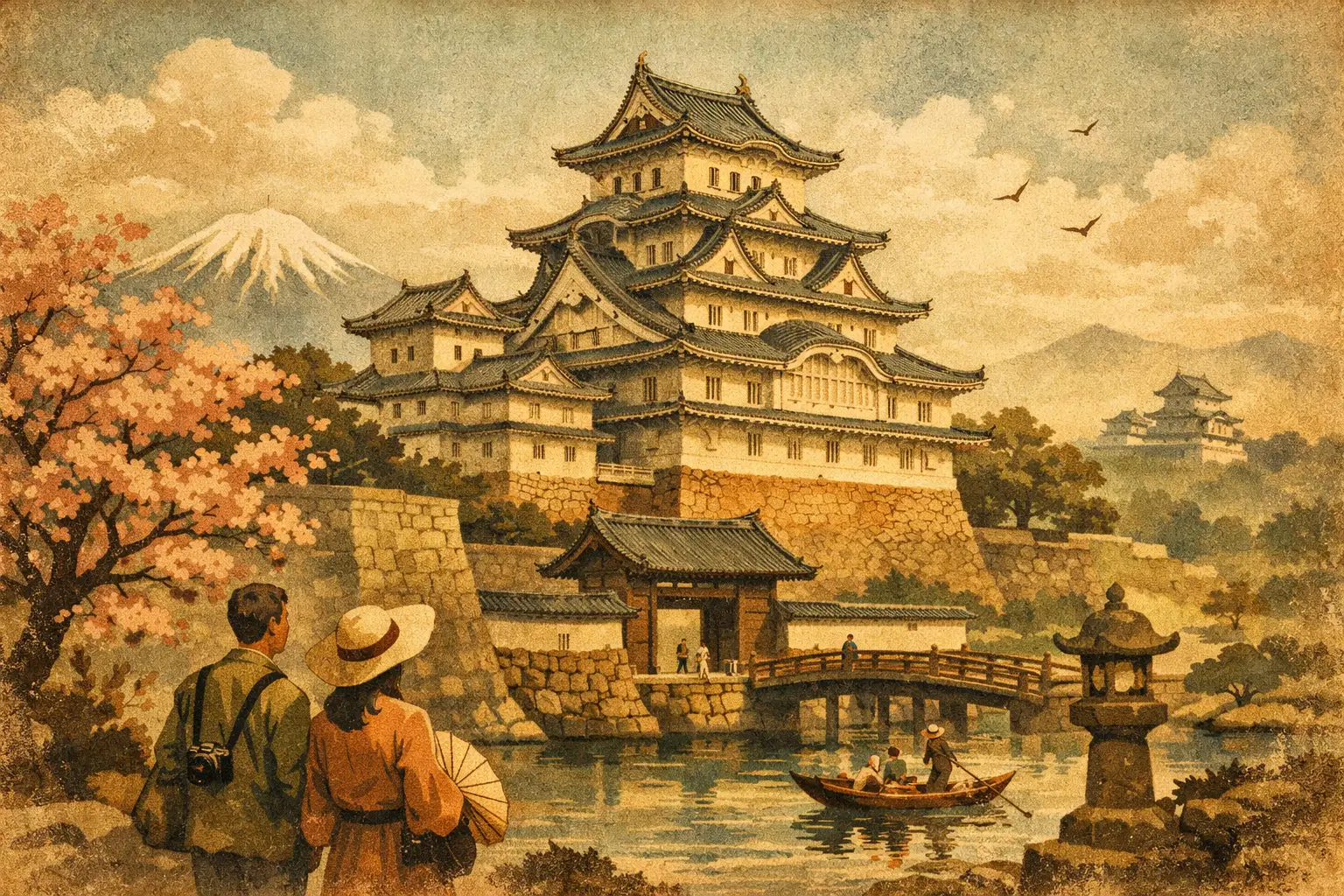
A castle keep rising above a field of cherry blossoms looks like a perfect Japan travel moment. Then you reach the gate and discover a steep stone path, a line for the ticket office, and a six-story wooden staircase that feels more like a ladder. That contrast is exactly why a good guide to visiting Japanese castles matters. These places are beautiful, but they are also defensive landscapes, living local symbols, museums, and, sometimes, demanding little hikes.
For all Japan lovers worldwide, castles offer one of the clearest ways to see how history, craft, and place fit together. Look past the famous black-and-white silhouette for a moment. Notice the enormous fitted stones, the bends in the approach, the roof tiles, and the view from the top. A castle visit becomes far more memorable when you understand what you are looking at.
What Makes Japanese Castles Different
Japanese castles were built for protection, power, and administration, but their visual language is unusually refined. A European-style stone fortress can feel massive and self-contained. Japanese castles often use a central keep, or tenshu, surrounded by layered moats, gates, walls, watchtowers, and a maze-like route designed to slow an attacking force.
The keep is the image most travelers recognize, yet it was only one part of the complex. The defensive intelligence is often outside it. Sloped stone walls made climbing difficult, moats created distance, and gates forced visitors and enemies to turn repeatedly. At a large site such as Himeji, the route itself tells the story. At a smaller hilltop castle, the terrain may be the main defense.
There is also a strong sense of wabi sabi in many castle grounds. Weathered stone, old pine trees, uneven paths, and changing light can be more moving than a perfectly polished exhibit. A castle is not just a building to photograph. It is a place where military planning, regional identity, and seasonal beauty meet.
A Guide to Visiting Japanese Castles: Choose Your Type
Not every Japanese castle offers the same experience. Choosing the right one can shape an entire trip.
If original architecture matters most to you, seek out one of Japan’s surviving original keeps. Only 12 remain, and they include Himeji, Matsumoto, Hikone, Inuyama, Matsue, and Kochi. Their interiors tend to be wonderfully atmospheric: exposed timber, narrow stairs, low ceilings, and few modern comforts. They feel close to the past because, in a real sense, they are.
Reconstructed castles deserve time too. Many were destroyed by war, fire, or demolition and rebuilt later, often in reinforced concrete. Osaka Castle is the best-known example. Its interior has a modern museum layout and elevator access for part of the route, which may be a better fit for travelers who want historical context without climbing a very steep original staircase. The trade-off is that it does not have the same interior texture as an original wooden keep.
Then there are castle ruins. Do not dismiss them as “just stones.” Sites like Takeda Castle, where mountain mist creates a floating-in-the-clouds effect, or the ruins of Yoshida-Koriyama, can be deeply rewarding for walkers and history fans. Ruins ask more of your imagination, but they often give more space, stronger landscapes, and fewer crowds.
A castle visit can also be about a particular mood. Matsumoto is dramatic with its black exterior against the Japanese Alps. Himeji is graceful and intricate, earning its White Heron nickname. Hikone feels intimate, with a preserved keep and a handsome garden nearby. Kumamoto is a powerful lesson in resilience, where restoration work after the 2016 earthquakes remains part of the experience.
Read the Grounds Before You Enter the Keep
Start at the outer moat or main gate instead of rushing to the tenshu. Most castles make better sense from the outside in. Look for the stonework pattern, called ishigaki, and see whether the wall curves outward near the base. This curved style helped support the wall while making it harder to scale.
Pay attention to gates too. A gate may look decorative, but it was engineered as a choke point. The path can turn sharply, narrow between walls, or bring attackers into view from above. Once you begin spotting these choices, every walk through a castle compound becomes more interesting.
Inside the keep, slow down. Displays may include armor, maps, roof ornaments, or household items from the ruling clan. They are worth reading, but do not let the museum labels pull you past the architecture. Look at the thick beams, the small windows, and the floor level changes. Imagine carrying supplies up the stairs or keeping watch through winter wind.
Original keeps are especially physical places. Staircases can be extremely steep, handrails may be limited, and shoes are commonly removed before entering. Wear socks without holes, choose shoes that come off easily, and leave large bags at your hotel when possible. This is practical courtesy, not travel fussiness.
Time Your Visit for More Than Cherry Blossoms
Cherry blossom season is magical around castle moats, particularly at Hirosaki, Himeji, and Osaka. It is also busy. Popular grounds can feel more like a festival than a quiet history stop, especially on weekends and during evening illuminations. If that shared excitement is what you want, go for it. Just reserve your patience for crowds and plan to arrive early.
Autumn offers another beautiful route. Red maple leaves bring color to castle gardens, while cooler weather makes hilltop ruins and expansive grounds much easier to explore. Winter can be extraordinary at Matsumoto or Hirosaki, where snow turns the castle into something close to an ukiyoe print. Opening hours may be shorter, though, and upper levels can close in severe weather.
For many travelers, the best answer is a weekday morning in late spring or autumn. You will have softer light, more room to look around, and a better chance of hearing the sound of gravel under your feet rather than a dozen tour groups.
Give the Castle Town Equal Time
The castle was once the political center of a jokamachi, or castle town. Its influence often remains in street layouts, merchant districts, local food, and craft traditions. A great visit should not end at the exit gate.
In Matsumoto, spend time on the old streets and seek out local soba. In Hikone, walk toward the lake and explore the quieter corners around the castle. In Himeji, the garden beside the castle offers a calmer frame for the huge white keep. Inuwashaki? No: Inuyama pairs easily with the Kiso River and traditional town streets, making it ideal for travelers who prefer a full day of wandering over a checklist of landmarks.
This is where mono no aware can quietly appear. A castle is a surviving image of a former world, but the town around it has continued changing for centuries. A family buying snacks under the moat-side trees, school groups in uniforms, an elderly local on a morning walk – these moments keep the site from becoming a frozen postcard.
Castle Etiquette That Makes Everyone’s Day Better
Japanese castle grounds are generally welcoming and easy to enjoy, but a little awareness goes a long way. Follow marked routes, especially on historic stonework and narrow stairways. Do not climb walls or sit on restricted ramparts for a photo. Those stones are cultural property, and some are less stable than they look.
Keep voices low inside original structures, where floors and beams carry sound. If shoes must come off, place them neatly where directed and wear the provided slippers only if they are offered. Photography rules vary: exterior photos are usually welcome, while certain museum displays or interiors may prohibit them. Signs are your best guide.
Most importantly, give yourself permission not to rush. You do not need to visit ten castles to be a serious fan. One carefully chosen castle, one good meal in its town, and time to notice the landscape can be a richer connection than a packed day of transit.
Build a Castle Day That Feels Human
A practical rhythm works well: arrive near opening, walk the outer grounds before the crowds, visit the keep, then have lunch in the castle town. Save a garden, museum, or riverside walk for the afternoon. If the castle offers an evening illumination, decide whether it is worth returning for rather than forcing yourself to stay all day.
Check current opening days, last-entry times, and restoration closures shortly before you go. Japanese castles are historic structures, and maintenance is not an inconvenience – it is how future visitors get to stand on the same floors and look through the same windows.
When you pause at the top of a keep, resist the urge to see only the skyline. Look down at the moats, roads, roofs, and distant hills. That view is the real reward: a chance to see Japan as a castle lord once did, while feeling very much like a visitor in the present.