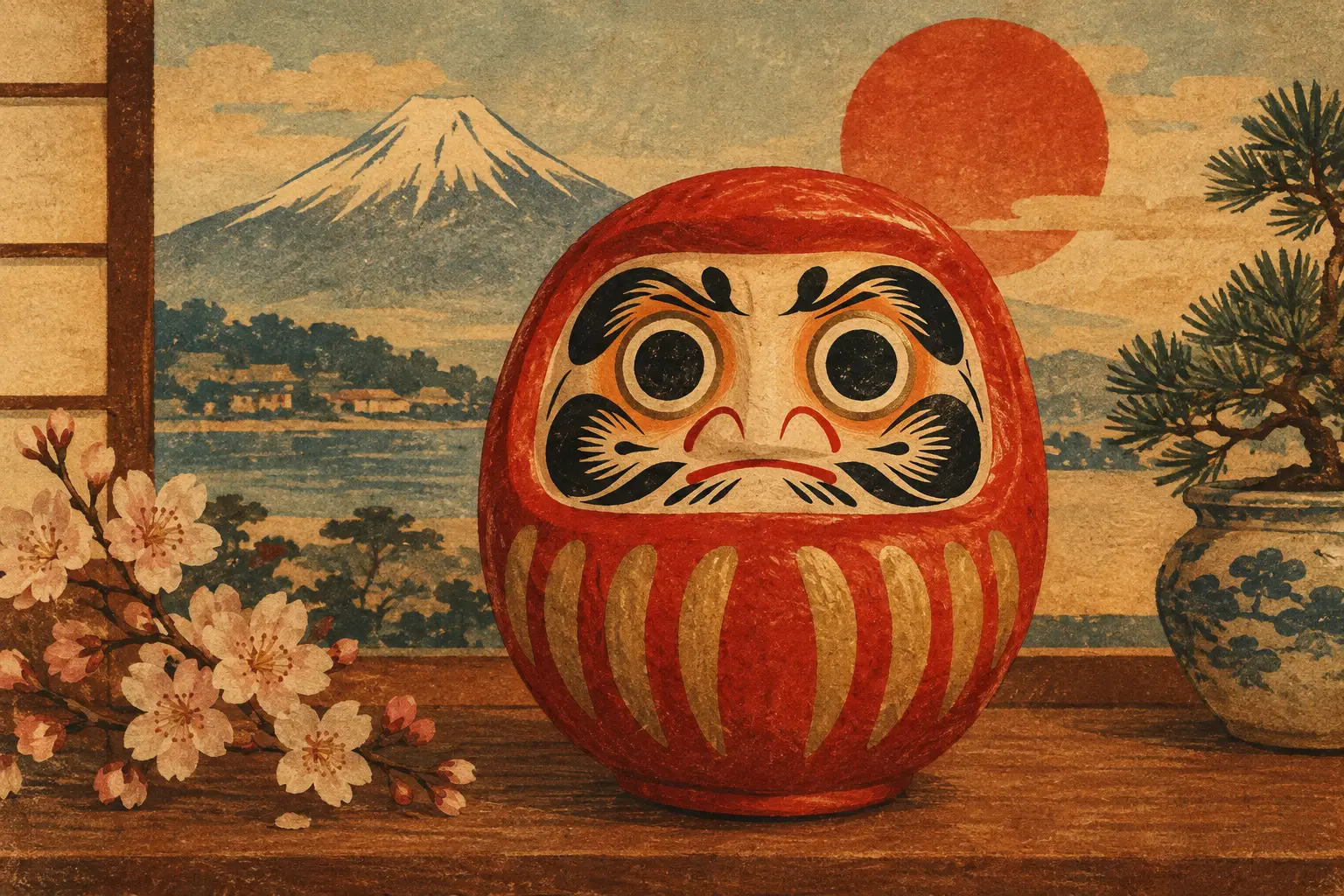
A round red figure with a fierce face, blank white eyes, and no arms or legs can feel mysterious at first. The daruma doll meaning is wonderfully direct: it represents perseverance, recovery after setbacks, and the decision to keep moving toward a goal. For Japan lovers worldwide, it is also one of the most personal traditional objects you can bring into your home.
A daruma is not simply a cute souvenir or a decoration for a shelf. It is a small visual promise. You choose an intention, paint in one eye, and live with the doll as a daily reminder that the work is not finished yet. When your goal is reached, you paint the second eye. That ritual gives the doll its enduring power.
Daruma doll meaning: fall down seven times, rise eight
The proverb most closely tied to Daruma is nana korobi ya oki – “fall down seven times, get up eight.” Its message is not that life will be perfectly smooth if you work hard enough. It says something more realistic and more encouraging: setbacks happen. What matters is the willingness to stand back up.
Traditional daruma dolls are weighted at the bottom, so they return upright when tipped over. This tumbler shape makes the proverb visible. A difficult exam, a new creative project, a move to Japan, a language-learning goal, or a personal change can all have frustrating moments. The daruma does not pretend those moments do not exist. It sits there, steady and stubborn, asking you to try again.
That quality makes daruma especially meaningful at the start of a new year, during a career transition, or before a major journey. Unlike a generic “good luck” object, it is tied to effort. You are not handing your ambition over to the doll. You are giving your ambition a physical place in your everyday life.
The Buddhist roots behind the round face
Daruma is the Japanese name for Bodhidharma, a Buddhist monk traditionally credited with bringing Zen Buddhism from India to China. His life story has accumulated legends over centuries, and daruma dolls draw from those vivid tales rather than aiming for a realistic portrait.
One famous legend says Bodhidharma meditated facing a wall for nine years. According to another, his arms and legs withered away from remaining still for so long. That is why the doll has its famously round, limbless form. Its intense eyebrows and beard are usually painted to resemble cranes and turtles, creatures associated with longevity in Japan.
The connection to meditation is part of the daruma doll meaning, but you do not need to be Buddhist to appreciate one. In Japan, daruma are widely used by people of many backgrounds as symbols of resolve, business success, health, election campaigns, and academic achievement. They live at the meeting point of religious tradition, local craftsmanship, and daily motivation.
Why one eye is painted at a time
The unpainted eyes are the feature most visitors remember. Traditionally, when you choose a goal, you paint one pupil – often the left eye from the doll’s perspective, which appears on your right when facing it. After accomplishing the goal, you paint the other.
This custom is called kaigan, or “opening the eyes.” It turns an abstract wish into a small ceremony. The daruma watches your progress from a desk, kitchen counter, studio, or entryway. Each time you see its single dark eye, your intention becomes harder to ignore.
There is no universal rule about the exact order of the eyes, and regional practices can differ. What matters is being intentional. Pick a goal that is specific enough to act on: pass the JLPT, finish a portfolio, save for a trip along the Kumano Kodo, open a small business, or practice Japanese conversation three times a week. “Be happier” may be sincere, but it gives the daruma little to hold you accountable for.
When the goal is complete, add the second eye and take a moment to recognize the effort involved. That moment matters. Japanese culture has many rituals that make ordinary transitions feel meaningful, from a cup of tea shared with care to seasonal customs that invite reflection. A completed daruma gives you a similar pause.
Red is traditional, but colors can change the message
Classic daruma are red, a color historically associated with protection and the power to ward off misfortune. Red also gives the dolls their unmistakable presence. A line of red daruma at a temple market feels energetic, almost like a crowd cheering you forward.
Today, daruma appear in many colors. Their meanings are often modern and can vary by maker or shop, so treat color associations as guidance rather than strict tradition. Gold is commonly connected with wealth or financial success, white with new beginnings or a fresh start, pink with love, green with health, and black with protection in business.
A red daruma remains the safest choice if you want the most traditional version. But choosing a color that speaks to your current goal can make the ritual feel more personal. A handmade daruma with visible brushwork and slight irregularities can be especially appealing. That touch of wabi sabi – beauty found in the imperfect and handmade – is part of what makes traditional crafts feel alive.
Takasaki Daruma and the craft behind the charm
The city of Takasaki in Gunma Prefecture is Japan’s best-known center for daruma production. Takasaki Daruma are generally made from papier-mâché, shaped over molds, dried, painted, and finished by skilled craftspeople. Their bright red bodies, strong facial expressions, and bold calligraphy are immediately recognizable.
Many daruma have a Japanese character written on the front, often fuku for good fortune or a phrase expressing a wish. Some are left plain so the owner can write a goal, name, or date. If you buy one while traveling, ask the maker or seller what the writing means. That tiny conversation can turn a lovely object into a memory connected to a specific place and person.
There are also regional styles with different features, colors, and proportions. That variety is worth celebrating. Japan’s traditional crafts are not frozen in one perfect form. They change from town to town, family workshop to family workshop, and generation to generation.
How to use a daruma respectfully at home
You do not need a formal altar or a perfect ritual to welcome a daruma into your home. Give it a clean, visible place where it will not be knocked over or hidden in a drawer. A work desk is ideal for professional or study goals; a shelf near your front door can suit a travel or life-change intention.
Before painting the first eye, take a minute to name your goal out loud or write it down. Keep the promise realistic. A daruma works best as a companion to practical action, not a replacement for it. If your aim is to visit Japan, pair the doll with a savings plan. If you are learning Japanese, pair it with a study schedule. The symbolic act becomes more powerful when it has a real habit behind it.
At the end of the year, many people bring completed daruma back to the temple or shrine where they bought them for a ceremonial burning. This is often done during daruma ichi, or daruma fairs, and reflects gratitude rather than disposal. If returning it is not possible because you live abroad, handle it respectfully. You might keep it as a record of a completed goal, or consult the seller’s guidance on how they recommend retiring it.
A small object for a serious promise
The appeal of daruma is not that it offers an instant answer. It offers companionship during the long middle of a goal, when excitement has faded and progress is uneven. Its wide-eyed expression can be funny, fierce, and oddly comforting all at once.
Choose a daruma for something that genuinely matters to you, paint that first eye with care, and place it where you will see it on the hard days. Let its round shape remind you that starting over is not failure. It is part of the path.