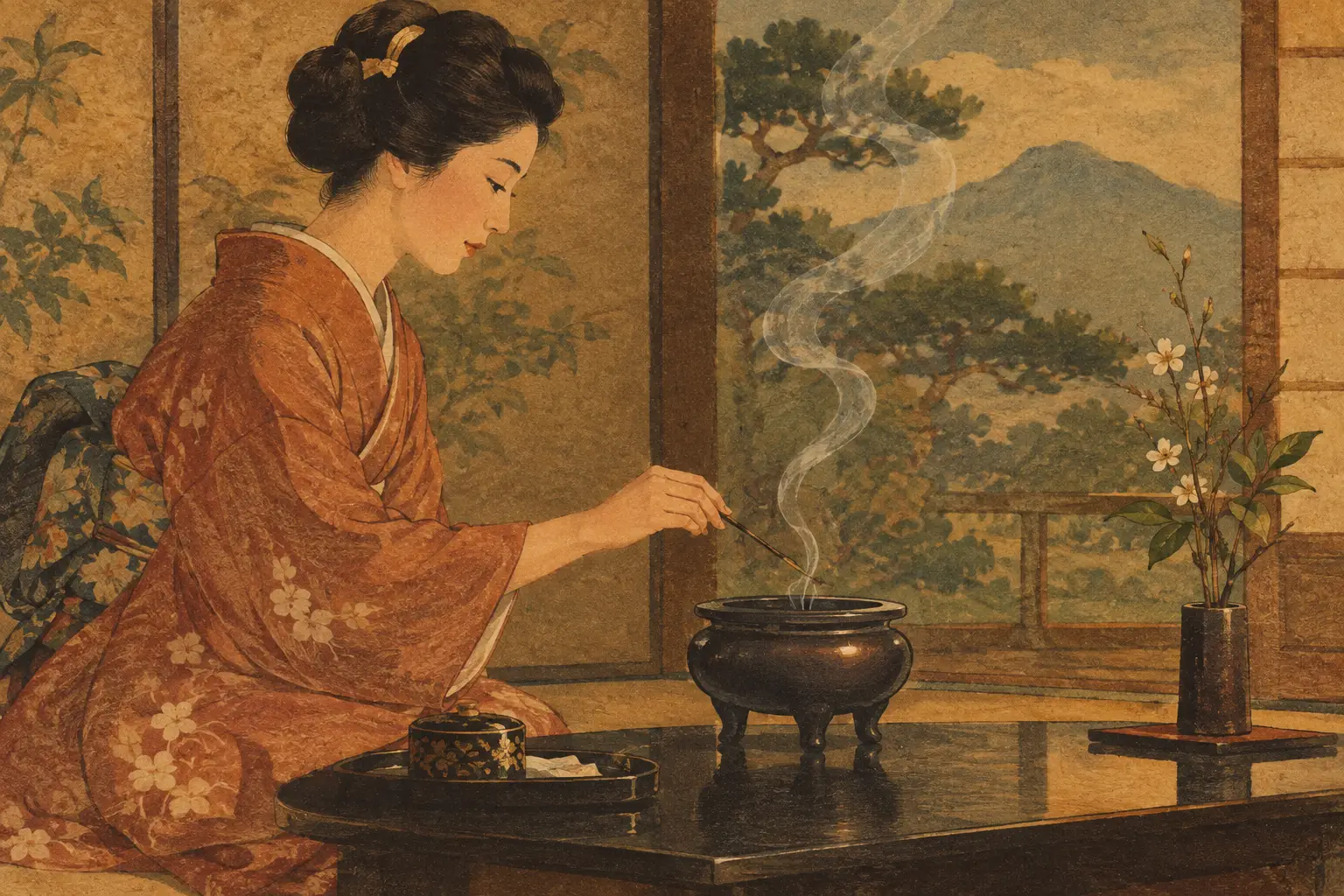
A Japanese incense ceremony does not begin with clouds of perfume. It begins with attention. In a quiet room, a host warms a tiny piece of fragrant wood over a mica plate and passes it to each guest. Rather than saying they smell the fragrance, participants say they are listening to incense. That small change in language opens the door to kōdō, one of Japan’s most subtle and rewarding traditional arts.
For Japan lovers worldwide, kōdō offers a different kind of cultural encounter. It is not loud, fast, or made for a quick photo. It asks you to slow down, notice a shifting fragrance, and share a moment of concentration with other people. There is wabi-sabi in its restraint, and perhaps a touch of mono no aware in the way one fleeting aroma can never be exactly repeated.
What Is a Japanese Incense Ceremony?
Kōdō literally means “the way of fragrance.” Along with chadō, the way of tea, and kadō, the way of flowers, it is counted among Japan’s great classical arts of refinement. Its formal development took place during the Muromachi period, when elite circles began to appreciate aromatic woods not simply as room fragrance or religious offerings, but as materials to be identified, compared, and contemplated.
The heart of kōdō is not incense stick burning. Traditional ceremonies use small chips of fragrant wood, especially aloeswood, warmed gently rather than set alight. Heat releases the wood’s character without producing smoke that would overwhelm the room. The resulting scent may be sweet, peppery, resinous, earthy, cool, or surprisingly medicinal. It can also change several times during a single listening.
The most prized woods are often classified as jinkō, a term commonly translated as fragrant wood or aloeswood. Within that category, kyara is especially celebrated for its depth and rarity. These woods were historically precious trade goods arriving in Japan through maritime routes from Southeast Asia. A piece no larger than a fingernail may carry immense value, which is one reason a ceremony uses it with such care.
Listening, Not Smelling
The Japanese phrase mon-kō means “listening to incense.” Guests do not place the cup under their nose and take a dramatic inhale. They hold the incense cup lightly, creating a small opening with the fingers, then take a quiet breath of the warmed aroma.
This practice is less about proving that you have an exceptional nose. It is about being present enough to notice what is there. A host may invite guests to consider whether the fragrance feels like a forest after rain, warm honey, dried plum, or an old temple hall. There is no need to force poetic answers. In many settings, silence and honest attention are the point.
The Ritual Inside a Japanese Incense Ceremony
A formal kōdō gathering can look intimidating at first because the utensils have specific names and the movements are deliberate. Yet the atmosphere is usually one of shared focus, not performance. A knowledgeable host will guide newcomers through the basic handling and etiquette.
The central object is the kōro, or incense cup. Inside it are ash, charcoal, and a thin mica plate. The wood rests on the mica, safely warmed by the charcoal beneath. The host prepares the cup with an almost sculptural precision, often smoothing the ash into a neat pattern before the fragrance is introduced.
Guests are seated in an order determined by the gathering. The cup is passed from person to person, usually with a small bow of acknowledgment. Each guest listens briefly, returns the cup carefully, and avoids speaking over the experience. The controlled pace makes even a short ceremony feel separate from ordinary time.
Some gatherings include a game called kumikō. Guests listen to several prepared fragrances, then try to identify them or recognize a repeated wood. Their answers may be recorded on a sheet marked with elegant symbols. One famous format, Genji-kō, connects five incense samples to chapters of The Tale of Genji through a pattern of lines. It is a wonderful example of how fragrance, literature, visual design, and social ritual meet in a single Japanese art.
Kumikō is not a test you need to fear. Even experienced participants can disagree about what they perceive. The pleasure comes from the comparison: one wood appears bright and citrus-like beside another, while a third seems almost dark or velvety. Your memory, mood, and the season can change the experience too.
Why Kōdō Feels So Different From Modern Fragrance
Many of us know incense through sticks, cones, scented candles, or fragrance oils. Those can be enjoyable, but kōdō is built on a different relationship with scent. It uses very little material, avoids a heavily perfumed effect, and treats aroma as something that unfolds rather than fills a room.
That makes the ceremony especially appealing to travelers and culture lovers who want an experience beyond the familiar temple visit. You may have seen incense burning at a shrine or Buddhist temple, where it is tied to prayer, purification, and offering. Kōdō shares historical roots with those practices, but it is not primarily religious. It is a cultivated appreciation of fragrance, much as an ukiyo-e print invites close attention to line and color.
The trade-off is that kōdō can feel quiet to the point of being challenging. If you expect a dramatic scent, a fast workshop, or constant explanation, the restraint may initially seem puzzling. Give it time. The art rewards curiosity more than expertise, and the near-silence becomes part of what you remember.
How to Experience Kōdō in Japan
The most meaningful way to try kōdō is through a small guided session led by a trained practitioner. Kyoto is a natural place to look because of its long connection to traditional arts, incense houses, and tea culture. Tokyo also has established incense businesses and cultural spaces that occasionally offer workshops or demonstrations. Availability changes by season, so confirm whether a session is intended for beginners and whether it is conducted in English, Japanese, or with interpretation.
A museum exhibition can also be an excellent introduction. Look for displays of kōdō utensils, lacquered boxes, incense cups, answer sheets, and Genji-kō designs. The objects reveal how much craftsmanship surrounds the ceremony. A cup may be practical, but it can also be a work of ceramics, lacquer, metalwork, or seasonal design.
If you attend a session, wear clean, low-scented clothing. Skip perfume, strongly scented hair products, and fragrant hand lotion, since they can interfere with the wood. Arrive a little early, silence your phone, and follow the host’s lead. Asking a question afterward is usually more welcome than interrupting the concentration of the group.
Bringing the Spirit Home Without Copying the Whole Ritual
You do not need rare kyara or a room full of antique utensils to build a thoughtful incense practice at home. In fact, trying to recreate every formal detail too soon can distract from the central lesson: careful attention.
Start with quality Japanese incense sticks or a small amount of fragrant wood from a reputable specialist. Choose a calm, ventilated space and burn or warm only a little. Sit for several minutes without scrolling, cooking, or trying to multitask. Notice whether the fragrance changes as it fades, and write down a few words afterward if that helps you remember.
A simple seasonal approach can make the practice more personal. You might choose a green, woody fragrance in spring, something light during humid summer days, a resinous note in autumn, or a warmer scent in winter. This is not formal kōdō, and it does not need to pretend to be. It is an inspired everyday ritual, rooted in respect for the tradition rather than imitation.
For a deeper connection, pair your quiet incense time with a few pages of Japanese literature, a piece of calligraphy, or a moment looking at a favorite craft object. The goal is not to create a perfect Japan-themed scene. It is to make room for genuine attention.
The next time a fragrance reaches you, resist the urge to name it immediately. Sit with it for one extra breath. That small pause is where kōdō begins to feel less like an unfamiliar ceremony and more like an invitation to notice the world with greater care.