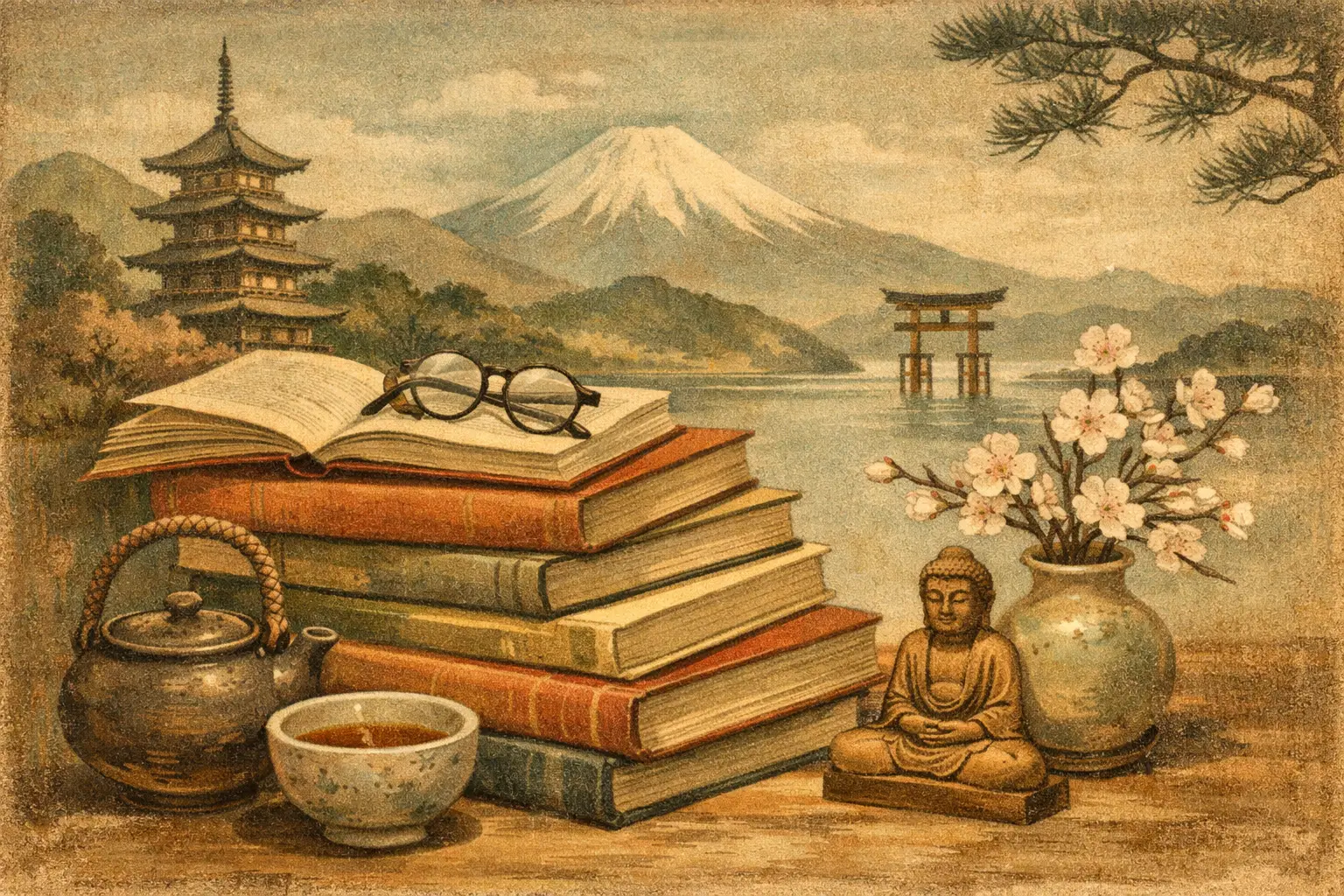
A well-worn tea bowl, the hush beneath a temple roof, a single maple leaf floating in a garden pond: Japanese beauty is rarely about adding more. It is about noticing more. The best books on japanese aesthetics help turn those powerful moments from a feeling into something you can recognize, question, and carry into daily life.
For Japan lovers worldwide, this reading list moves beyond pretty coffee-table images. These books connect ideas such as wabi sabi, mono no aware, ma, and mottainai to tea, pottery, architecture, gardens, kimono, and the everyday objects that make Japanese culture so endlessly rewarding. Some are gentle introductions; others ask you to slow down and think. That variety is the point.
The Best Books on Japanese Aesthetics for Your Shelf
1. In Praise of Shadows by Junichiro Tanizaki
Start here if you want a short book that changes the way you see a room. Tanizaki’s classic essay celebrates shadow, patina, dim light, lacquerware, and the quiet atmosphere of traditional Japanese interiors. He contrasts them with the bright, polished modern world, sometimes sharply and sometimes with real tenderness.
This is not a neutral history lesson. Tanizaki has strong preferences, and parts of the book reflect the Japan of the 1930s. Read it as a personal meditation rather than a rulebook. Its great gift is making you notice how a candle, a paper screen, or a dark bowl can create depth that bright lighting erases.
2. The Book of Tea by Kakuzo Okakura
Tea is never only tea in this compact, influential classic. Okakura uses the tea ceremony, or chanoyu, to introduce art, flowers, architecture, ceramics, and the spiritual dimensions of simplicity. His writing is elegant and full of big ideas about East and West.
Keep in mind that it was written for an English-speaking audience in the early 1900s, so it can feel romanticized and broad in its claims. Still, it is an excellent doorway into wabi, sabi, and the cultivated attention behind a tea gathering. Read it before visiting a tea house or choosing your first chawan.
3. The Unknown Craftsman by Soetsu Yanagi
If handmade Japanese objects speak to you more than museum masterpieces, Yanagi belongs on your list. A founder of the mingei folk-craft movement, Yanagi argues that beauty can live in humble, useful things: storage jars, baskets, textiles, tools, and bowls made for ordinary hands.
His focus on anonymous makers is both inspiring and worth examining critically. It can overlook the named artisans, labor, and economic realities behind craft traditions. But the book remains a moving case for looking at a handmade object not as a souvenir, but as the result of skill, use, and care.
4. The Beauty of Everyday Things by Soetsu Yanagi
This companion volume is often more approachable than The Unknown Craftsman. Its short essays make Yanagi’s ideas feel immediate, whether he is looking at Korean ceramics, Japanese woodwork, or the relationship between usefulness and beauty.
Choose this one if you prefer reading in small, satisfying stretches. It is especially good for people who love Japanese tableware, indigo textiles, and traditional crafts but do not want a dense academic text. You may find yourself looking more closely at the cup in your own kitchen afterward.
5. Wabi-Sabi for Artists, Designers, Poets & Philosophers by Leonard Koren
Koren’s slim, visually spare book has introduced countless readers to wabi sabi. It describes an aesthetic of impermanence, incompleteness, irregularity, and modesty. Think weathered wood, a cracked glaze, an unfussy flower arrangement, or the beauty of something that shows its age.
It is a Western interpretation, not a complete guide to Japanese philosophy or history. That limitation matters, especially because wabi sabi is often reduced online to a decorating trend. But Koren is useful for beginners because he gives the idea room to breathe instead of turning it into a shopping checklist.
6. Japanese Aesthetics by Yuriko Saito
For readers who want more intellectual depth, philosopher Yuriko Saito offers a clear path into the ideas behind Japanese beauty. She explores concepts including wabi, sabi, yugen, iki, and mono no aware, connecting them to art, nature, and ordinary experience.
This is a more demanding read than Tanizaki or Koren, but it pays you back. Saito is especially helpful when you want to understand why one Japanese aesthetic term cannot simply be replaced by an English word. Take it slowly, perhaps alongside examples from a museum visit, a garden, or a favorite ukiyo-e print.
7. The Japanese Sense of Beauty by Hayao Kawai
Psychologist Hayao Kawai approaches Japanese beauty through stories, symbols, religion, and cultural memory. Rather than offering a tidy dictionary of aesthetic terms, he considers the deeper habits of seeing that appear in myths, gardens, and artistic traditions.
This is a thoughtful choice for readers drawn to Shinto, Buddhist imagery, and the emotional side of Japanese culture. It is less practical than a design book and more reflective than a travel guide. Read it when you are curious about why absence, asymmetry, and seasonal change can carry such emotional weight.
8. Japanese Gardens by Mira Locher
A Japanese garden can look wonderfully simple until you begin asking why every stone, view, path, and patch of moss sits where it does. Mira Locher explains garden styles, historical development, and design principles in a way that helps visitors look beyond the postcard view.
This is a strong pick for anyone planning a trip to Kyoto, considering a garden visit closer to home, or building a small contemplative corner outdoors. It also introduces ma, the meaningful interval or pause. In a garden, empty space is not empty at all. It directs the eye and gives every element room to matter.
9. The Art of Japanese Architecture by David and Michiko Young
Traditional Japanese architecture makes a powerful case for restraint. This book examines homes, temples, tea houses, castles, and other structures through materials, proportion, light, and the relationship between building and landscape.
It is particularly useful for travelers who have wondered why a machiya townhouse feels different from a Western home, or why a temple approach can feel ceremonial before you even reach the gate. The Youngs make architectural details approachable without stripping away their cultural meaning.
10. Kimono: A Modern History by Terry Satsuki Milhaupt
Kimono is often treated as a fixed emblem of “traditional Japan,” but its colors, patterns, textiles, and social meanings have constantly changed. Milhaupt shows how kimono design responded to fashion, trade, technology, and modern life from the late nineteenth century onward.
This book is ideal if you love textiles, seasonal motifs, or the visual drama of formal dress. It also corrects the idea that Japanese aesthetics belong only to an unchanging past. A kimono can hold deep convention and bold innovation at the same time.
11. Japanese Design Since 1945 by Naomi Pollock
Japanese aesthetics did not stop at the temple gate. Naomi Pollock introduces postwar design across furniture, graphics, products, interiors, and architecture, revealing how Japanese designers have reworked simplicity, playfulness, precision, and material intelligence.
This is a great bridge for readers who admire both a hand-thrown sake cup and a perfectly designed stationery item. It shows that minimalism is not the only Japanese design language. Color, humor, technical experimentation, and pop sensibility have their place too.
12. Traditional Japanese Arts and Culture by Stephen Addiss, Gerald Groemer, and J. Thomas Rimer
For a broad, reliable foundation, this illustrated sourcebook brings together painting, calligraphy, theater, music, poetry, ceramics, and more. It helps place individual art forms within their historical and cultural settings, which is useful when one aesthetic idea appears across several traditions.
Pick this book if you are still finding your personal path through Japanese culture. Maybe calligraphy draws you in first, then Noh theater, then incense ceremony. This volume gives you enough context to follow those connections without pretending that one book can contain all of Japan.
How to Choose the Right First Book
If you want a poetic, atmospheric beginning, choose In Praise of Shadows. If tea, ceramics, and quiet rituals are your entry point, read The Book of Tea and then Yanagi. If you want clear explanations of terms you keep seeing online, begin with Saito or Koren, then move into the more historical books.
The best reading experience is not to chase a perfect definition of Japanese beauty. These ideas shift across eras, regions, social classes, and art forms. Iki is not wabi sabi; the beauty of a bold Edo-period ukiyo-e print is not the same as the stillness of a Zen garden. Let those differences make your interest bigger.
Try reading one chapter before your next museum visit, tea session, pottery class, or Japan trip. Then pause long enough to notice one detail you might once have passed by: the uneven rim of a bowl, the empty space around a flower, or the soft mark of time on a wooden threshold. That is where the conversation with Japanese aesthetics really begins.