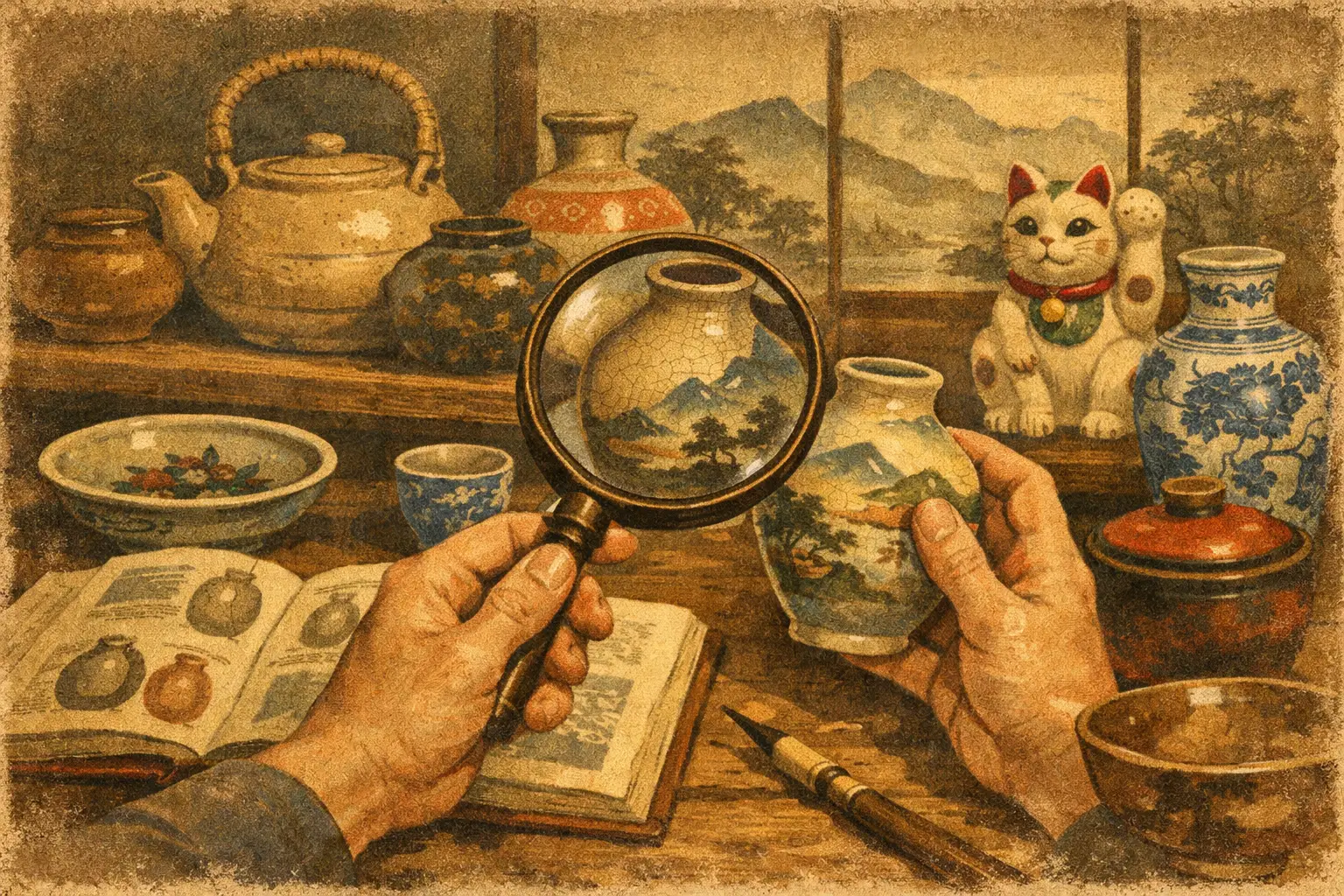
A small bowl can carry a surprising amount of Japan: the iron-rich clay of Bizen, the milky softness of Hagi glaze, or the crisp blue painting of Arita porcelain. Learning how to identify japanese pottery is less about finding one magic stamp and more about noticing a collection of clues. The best part? You do not need to be a museum curator to start seeing them.
Japanese pottery rewards close looking. Turn the piece over. Feel its weight. Follow a brushstroke that is slightly uneven because a human hand made it. That willingness to notice the quiet details is close to wabi sabi – finding beauty in irregularity, age, and honest materials.
Start by Asking What the Piece Is Made Of
The first useful divide is between earthenware, stoneware, and porcelain. This will not identify every region on its own, but it narrows the field quickly.
Earthenware is usually porous, relatively soft, and often warm red, tan, or buff where the glaze does not cover it. Many tea bowls, storage jars, and folk pieces fall into this family. Stoneware is fired hotter, making it denser and less porous. It often has a substantial, grounded feel, with natural ash effects or rich, dark clay showing around the foot.
Porcelain is hard, fine, and often white or pale gray beneath the glaze. Hold a thin porcelain cup toward a bright window and you may see some light pass through it. Japanese porcelain is famously associated with Arita in Saga Prefecture, though it was made in other areas as well.
Do not assume that a heavy piece is old or that a light piece is automatically porcelain. Modern studio potters intentionally play with thickness, texture, and clay bodies. Think of material as your first clue, not your final verdict.
Look at the Foot Ring Before the Decoration
Collectors often turn a vessel upside down first, and you should too. The unglazed base, called the foot ring, can reveal far more than an attractive front design.
On hand-thrown pottery, the foot may show trimming marks from the potter’s tool. It may be slightly uneven, but it should feel intentional rather than sloppy. On pieces fired in a traditional kiln, you may find tiny kiln scars, specks of ash, or areas where glaze thinned naturally near the base.
A fully glazed bottom can appear on some modern wares, so it is not automatically suspicious. Still, mass-produced imitation pieces frequently have a very uniform foot, a thick glossy glaze pooled near the edge, and artificial-looking wear. Real wear tends to appear where hands and tables actually touch the object: the rim, handles, and lowest edge of the foot.
If the bottom has a paper label, treat it as useful but temporary evidence. Labels fall off, get replaced, and can be misleading. A stamped or painted mark fired into the ceramic is generally more meaningful, though even marks need context.
Understand Japanese Pottery Marks, But Do Not Rely on Them Alone
A maker’s mark, kiln mark, shop mark, or export mark may appear under a piece. It can be impressed into clay, painted in underglaze blue, written in red, or printed over the glaze. Some Japanese ceramics have no visible mark at all.
Marks are helpful when they are clear and you can read Japanese, but they are not a shortcut to certainty. A mark might name a retailer rather than the potter. It may identify a town, a kiln, or a company. Some marks also use older characters, artistic signatures, or stylized calligraphy that is difficult to interpret.
Be especially cautious with the word “Nippon.” Pieces marked Nippon were exported from Japan largely for the American market in the late 19th and early 20th centuries, but the word alone does not make a piece rare, antique, or high value. Condition, maker, style, and quality still matter.
A good habit is to photograph the entire piece, then take clear photos of the mark, foot ring, rim, and any damage. Comparing only a stamp can lead you astray. Comparing the full object gives the mark a proper story.
Learn the Regional Personalities
Japan’s great ceramic traditions have distinct visual languages. Once you recognize a few, pottery becomes much more fun to browse at flea markets, antique stores, and Japanese craft fairs.
Bizen Ware: Earthy, Unpredictable, and Un-glazed
Bizen-yaki from Okayama is usually unglazed stoneware fired for long periods in wood-burning kilns. Its surfaces range from reddish brown to charcoal, with natural flame markings, ash deposits, and occasional pale patterns created by straw or stacking methods in the kiln.
Bizen often feels elemental and quiet. No two pieces fire exactly alike, which is part of its appeal. A perfectly repeated Bizen-style pattern may suggest a factory-made imitation rather than a kiln-born surface.
Hagi Ware: Soft Glaze and Gentle Change
Hagi-yaki from Yamaguchi is beloved for subdued glazes in cream, pale pink, gray, or soft blue. The clay is often light, and the glaze may develop fine crackle lines over time. Tea lovers value the way a Hagi tea bowl can slowly change color through use, a quality sometimes called Hagi no nanabake, or Hagi’s seven transformations.
Fine crackling is not proof of age. It can occur naturally in new ceramics, and it can also be faked. Look for a glaze that feels integrated with the form rather than a uniform network of dark lines applied for dramatic effect.
Shigaraki and Iga: Rough Beauty From the Kiln
Shigaraki-yaki and Iga-yaki are known for coarse clay, feldspar flecks, dramatic ash glaze, and rugged forms. You may see tiny white mineral bursts in the clay, greenish ash deposits, or scorch-like fire colors. These are pieces with strong wabi sabi character: imperfect, textured, and deeply connected to the firing process.
The trade-off is that rustic does not always mean old. Japanese potters continue to make extraordinary Shigaraki and Iga work today, and contemporary pieces can be every bit as collectible as antiques.
Arita, Imari, and Kutani: The World of Painted Porcelain
Arita ware is often associated with refined porcelain and cobalt-blue decoration beneath a clear glaze. Imari is a broad term commonly used for richly decorated export-style porcelain, often combining blue with red, gold, green, or black enamels. Kutani ware is known for bold overglaze color, especially red, green, yellow, purple, and gold, sometimes with detailed landscapes, birds, or figures.
These traditions overlap in the market, so avoid trying to label every colorful porcelain plate at first glance. Instead, study the painting. Is the cobalt a little soft under the glaze or sharply printed on top? Are gold details worn naturally at raised edges? Does the decoration follow the shape of the vessel with care? Hand-painted work often has small variations that give it life, much like an ukiyoe print retains evidence of its making.
Separate Handmade Character From Artificial Distress
A handmade Japanese bowl is not necessarily lopsided, and a machine-made bowl is not necessarily bad. Japan has a long history of high-quality production ceramics, including useful everyday tableware. The question is what you are looking at and whether its details agree with one another.
Watch for contradictions. A supposed centuries-old tea bowl with a bright, unblemished printed label deserves skepticism. So does a “rustic” vessel with identical chips repeated around its rim. Artificial aging often looks theatrical. Genuine use usually looks quieter: softened edges, small scratches, tea staining inside a bowl, and wear that matches how the object functions.
When shopping, ask sellers direct questions: Where did it come from? Is the mark known? Is there restoration, hairline cracking, or repair? A trustworthy seller should not resent careful questions. Repairs are not always deal-breakers, especially on old tea ware, but they should be disclosed and reflected in the price.
Build Your Eye One Piece at a Time
The fastest way to improve is to handle good ceramics whenever you can. Visit Japanese cultural events, pottery exhibitions, museum collections, and reputable dealers. Compare the underside of pieces as often as you admire their fronts. Keep a small photo library of styles you love, organized by kiln, region, glaze, and form.
Start with affordable contemporary work if you are building a collection. A handmade yunomi cup or small plate lets you live with the material daily, and daily use teaches more than a piece locked in a cabinet. You will begin to recognize the balance of a well-thrown cup, the texture of a natural ash glaze, and the difference between decoration that feels printed and decoration that feels alive.
Japanese pottery is not a puzzle that must be solved in one afternoon. It is an invitation to slow down, look closely, and enjoy the human trace in clay. Let each piece lead you toward the next question – and let the pleasure of that search become part of your own Japan-loving story.