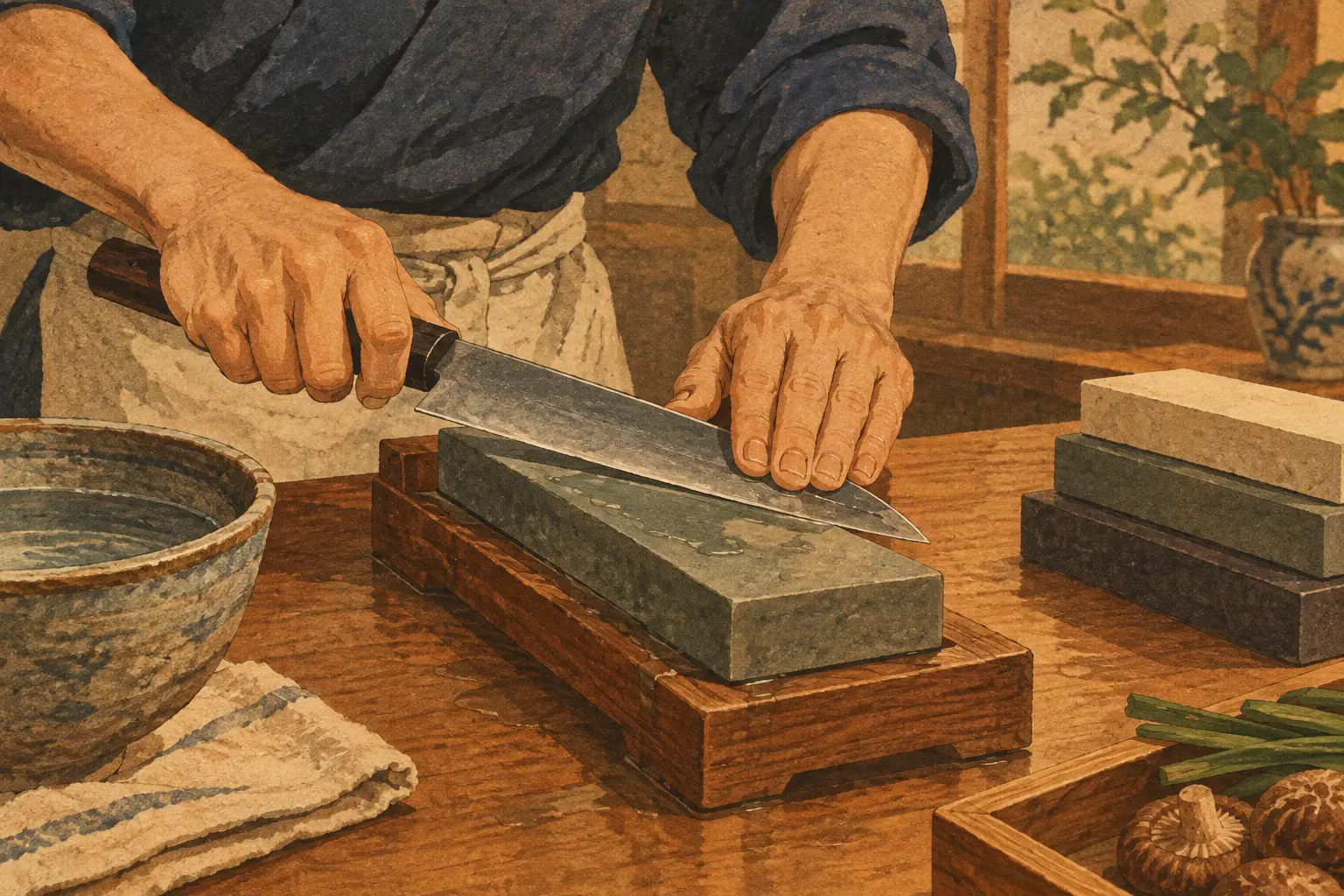
A Japanese knife can make slicing a ripe tomato, shaving daikon, or preparing a weeknight bowl of donburi feel wonderfully precise. But a beautiful blade is only as satisfying as its edge. This Japanese knife sharpening stone review looks at the whetstones that give home cooks a practical, authentic way to care for their knives, whether your kitchen holds a modest santoku or a treasured carbon-steel gyuto.
Whetstone sharpening is not instant. It asks for water, a steady angle, and a few quiet minutes at the counter. That small ritual is part of the appeal. Like the wabi-sabi character of a well-used tea bowl, a stone develops marks and wear over time. It becomes a useful object with a story rather than another disposable kitchen accessory.
What Makes Japanese Whetstones Different?
Many Japanese sharpening stones use water as the lubricant, rather than oil. As the blade moves across the surface, the stone releases a fine abrasive slurry that helps refine the edge. The sensation is tactile and direct: you can hear when the angle is wrong, feel when a burr begins to form, and see the stone change as it works.
Grit matters, but it is not the whole story. A 1,000-grit stone is the standard starting point for most maintenance because it can restore an edge that has become dull through regular cooking. A 3,000- to 6,000-grit stone refines that edge for cleaner, smoother cuts. Very high grits, such as 8,000 and above, create a polished finish, but they are optional for most home kitchens.
For a first stone, a good 1,000-grit model is usually a better buy than a large, complicated grit collection. If your knife is reasonably sharp but losing its easy bite, add a finishing stone later. If it has chips, a bent tip, or a very blunt edge, you may need a coarser stone around 220 to 400 grit before moving to 1,000.
Japanese Knife Sharpening Stone Review: The Best Fits
There is no single best stone for every Japan lover. Some stones are forgiving and inexpensive; others feel fast, crisp, and deliberately premium. The right choice depends on your knife steel, how often you sharpen, and whether you enjoy the process as much as the result.
King Deluxe 1000: The welcoming classic
The King Deluxe 1000 is often the first real whetstone people try, and for good reason. It is affordable, widely respected, and relatively soft. That softness produces slurry quickly, giving beginners clear feedback as they work. It can put an excellent working edge on stainless and carbon-steel kitchen knives without making the learning curve feel intimidating.
The trade-off is maintenance. This is a soaking stone, so it needs time in water before use, and its soft surface dishes with repeated sharpening. You will need a flattening plate or another method of keeping it level. Still, for someone ready to leave pull-through sharpeners behind, the King has a warm, approachable personality. It is the kind of stone that invites practice rather than perfectionism.
Naniwa Professional 1000: Fast, refined, and compact
The Naniwa Professional 1000 is a favorite among serious home cooks and knife enthusiasts. It cuts quickly, stays flatter longer than a soft traditional stone, and gives a refined edge that feels more polished than its grit number suggests. It is also a splash-and-go stone, meaning a quick wetting is generally enough instead of a long soak.
Its firmer feel can be a joy once you understand angle control. It is less muddy and less forgiving of a wandering hand than the King, however. It also costs more. Choose it if you value quick setup, regularly sharpen quality Japanese knives, and want a stone that feels like a long-term kitchen tool rather than an entry-level experiment.
Shapton Glass 1000: Precise performance in a thin package
Shapton Glass stones are known for their hard surface, fast cutting action, and slim profile. The 1000 grit is especially useful for wear-resistant stainless steels, including knives that seem to resist ordinary sharpening. It is splash-and-go, tidy to store, and mounted on a glass backing that provides support despite the stone’s thin appearance.
This is a performance-minded choice. It does not offer the soft, creamy sensation many people imagine when they picture traditional Japanese sharpening. Some beginners may find it less communicative, and the narrow stone can feel restrictive if you have large hands or broad Western chef’s knives. But for owners of harder modern steels who want efficient results, Shapton Glass is impressive.
Suehiro Cerax 1000: A generous traditional feel
The Suehiro Cerax 1000 sits in the sweet spot between beginner friendliness and enthusiast satisfaction. It is a soaking stone with a pleasant, smooth feel and enough softness to make sharpening feedback easy to understand. Many cooks love the broad, even edge it leaves before a finishing stone is used.
Because it is softer, it does require flattening. It can also feel slower to prepare than a splash-and-go alternative when dinner is already underway. Yet if sharpening is a weekend ritual with a cup of green tea nearby, this is not a disadvantage. The Cerax makes the process feel unhurried and hands-on, with a little mono no aware in every gradually worn surface.
Morihei Hi 1000: For the person who enjoys the craft
Morihei Hi stones have earned a devoted following for their distinctive feel and strong feedback. The 1000 grit produces a keen, toothy kitchen edge while offering a satisfying tactile connection to the blade. It is especially appealing to people who have moved beyond their first stone and want sharpening to become part of their appreciation for Japanese craft.
This is not necessarily the most practical first purchase. Availability can vary, and its particular feel is best appreciated when you already know what a stable sharpening angle feels like. But if you love handmade ceramics, ukiyo-e printmaking, or the quiet focus of shodo, a Morihei stone may speak to the same part of you. It turns maintenance into a small act of attention.
Choose the Stone for Your Kitchen, Not the Hype
For most first-time users, the King Deluxe 1000 or Suehiro Cerax 1000 makes the most sense. Both provide useful feedback, cost less than premium stones, and teach the fundamentals honestly. Pair either with a reliable flattening tool, because a hollowed stone makes consistent sharpening much harder.
Choose the Naniwa Professional 1000 if convenience matters and you want an upgrade you will not outgrow quickly. Choose Shapton Glass 1000 if your knives use hard, abrasion-resistant stainless steel or if you prefer a clean splash-and-go setup. Consider Morihei Hi when the tactile experience itself is part of why you are sharpening.
Also consider your knife before choosing. Carbon-steel Japanese knives often sharpen beautifully on nearly any of these stones, but they can rust if left wet after sharpening. Stainless knives are easier to live with but may need a faster-cutting stone depending on the alloy. A single-bevel yanagiba or usuba deserves more specialized technique than a double-bevel santoku, so beginners should practice first on an everyday double-bevel knife.
A Simple Way to Start Sharpening
Soak only stones designed for soaking. For splash-and-go stones, wet the surface as directed and add water whenever it starts to dry. Place the stone on a stable base or a damp towel so it cannot move. Hold the knife at roughly 10 to 15 degrees for many Japanese double-bevel knives, then use controlled strokes from heel to tip.
Work one side until you can feel a tiny burr along the opposite edge. Repeat on the other side, then use lighter alternating passes to reduce the burr. Do not chase a mirror polish on your first attempt. A sharp, even edge that slices paper cleanly is a real success.
Rinse and dry the knife immediately, especially if it is carbon steel. Let the stone air-dry fully away from direct heat or strong sun, which can cause cracking. Flatten it when you notice a dip in the middle. These habits matter as much as the logo on the stone.
The best whetstone is the one that makes you want to return to the counter, slow down, and care for the tools that help you cook. Start with one good 1,000-grit stone, make a favorite meal afterward, and let every sharper slice bring a little more Japan into your kitchen.