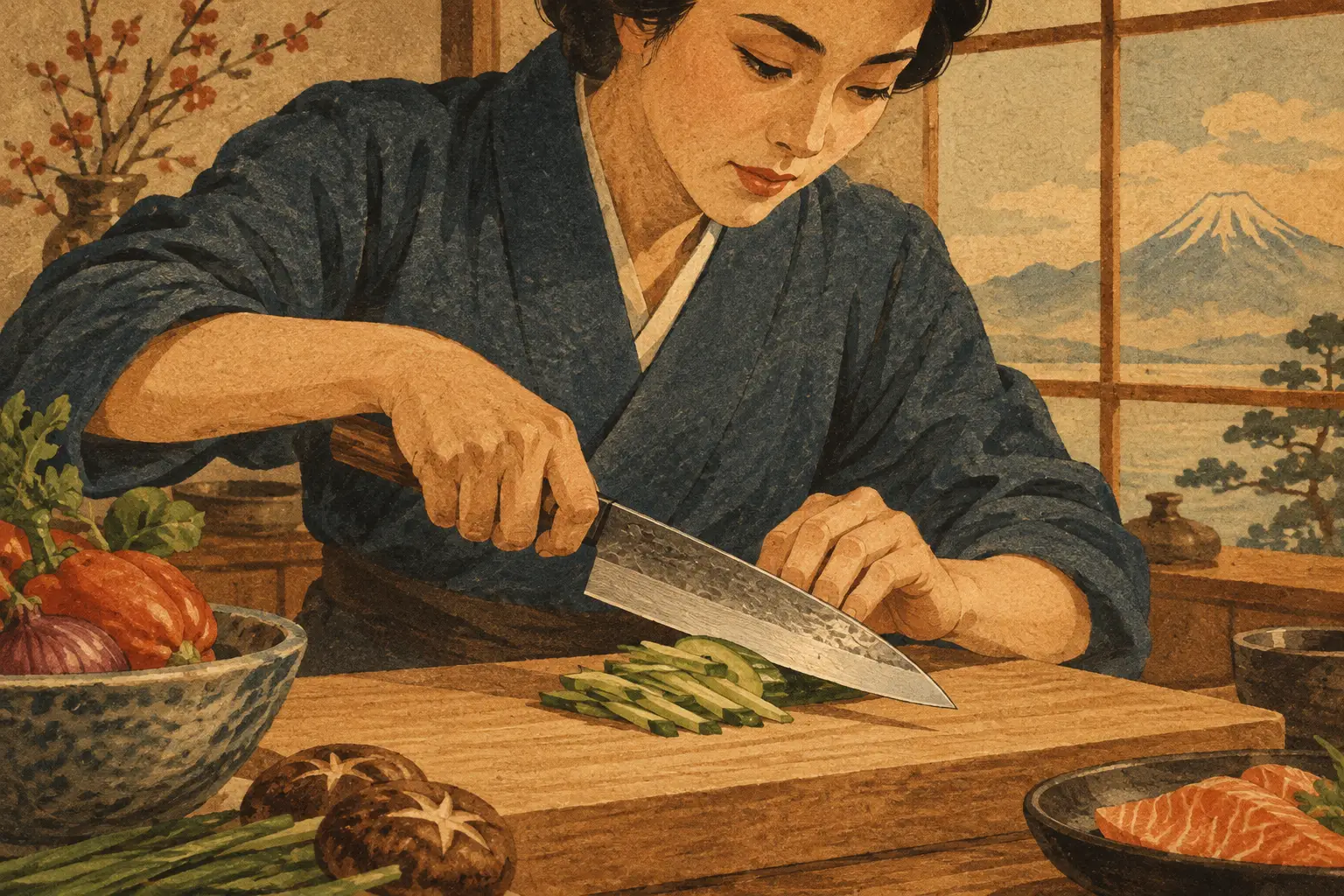
A good knife changes the sound of cooking. A ripe tomato gives way without collapsing. Herbs stay bright instead of bruised. An onion slices cleanly, and suddenly the small ritual of making dinner feels more deliberate. That is the pull of Japanese knives: they turn a familiar kitchen tool into a close connection with Japanese craft.
For Japan lovers worldwide, a knife can be more than a souvenir with a beautiful handle. It can bring a piece of shokunin – the Japanese spirit of dedicated craftsmanship – into daily life. But choosing one is not as simple as picking the sharpest blade on the shelf. Japanese knives come with distinct shapes, steels, traditions, and care needs. The best one depends on what you cook, how you like a knife to feel, and whether you are ready to give it a little attention.
Why Japanese Knives Are Different
Japan has a long history of exceptional metalworking. After the country’s sword-making traditions changed in the late 19th century, many craftspeople in places such as Sakai, Seki, and Tsubame-Sanjo applied their skills to kitchen cutlery. The result was not one single style of knife, but a family of tools shaped by professional cooking, regional ingredients, and generations of refinement.
The immediate difference is often sharpness. Many Japanese blades are ground to a thinner, finer edge than common Western chef’s knives. That geometry lets them move through vegetables, fish, and boneless meats with very little resistance. Rather than forcing a cut, you guide the blade. It is a small sensation, but one that can make prep work feel almost meditative.
There is a trade-off. A very thin edge can chip if it meets a chicken bone, a frozen ingredient, or a glass cutting board. Japanese knives reward good habits. Use wood or quality plastic boards, cut with a controlled motion, and reach for a heavier tool when the job involves bones or hard squash. Precision is the pleasure, but it asks for respect.
Many Japanese knives also use harder steel. Hardness helps the edge stay sharp for a long time, which is wonderful if you cook often and want clean, consistent slices. Yet harder steel is usually less forgiving than softer steel. It may chip rather than bend, and sharpening requires a gentler touch. There is no universal winner here. A busy home cook who wants easy maintenance may prefer stainless steel and a slightly less delicate edge. A devoted cook may enjoy the performance and ritual of high-carbon steel.
The Japanese Knife Shapes Worth Knowing
The familiar chef’s knife is versatile, but Japanese kitchens developed specialized forms for particular ingredients and cuts. You do not need a drawer full of them. Knowing a few shapes will help you choose a knife that feels useful rather than merely collectible.
Gyuto: the flexible everyday choice
A gyuto is the Japanese answer to a Western chef’s knife. Its pointed tip handles detail work, while its curved belly allows some rocking motion. For most home kitchens, a 7- or 8-inch gyuto is the easiest first Japanese knife. It can slice onions, mince herbs, trim meat, and handle nearly every everyday task that does not involve bones.
Santoku: compact and vegetable-friendly
The santoku is shorter, wider, and flatter along the edge than a gyuto. Its name is often translated as “three virtues,” referring to its usefulness with meat, fish, and vegetables. Many people love it because it feels controlled and approachable, especially in a smaller kitchen. It favors an up-and-down chopping motion over dramatic rocking.
Nakiri: a joy for vegetable cooks
With its rectangular blade and blunt tip, the nakiri is made for vegetables. It cuts straight down cleanly, creating neat slices without the accordion effect that can happen when the bottom of a vegetable remains attached. If your happiest meals involve cabbage, daikon, carrots, mushrooms, or piles of greens, a nakiri can become a favorite quickly.
Petty knife: small blade, big usefulness
A petty knife is a slim utility knife, usually around 5 inches long. It is excellent for fruit, garlic, shallots, trimming, and work that feels awkward with a larger blade. It is also a smart choice for cooks with smaller hands or anyone building a thoughtful two-knife setup: a gyuto or santoku for main prep, plus a petty for fine work.
Specialized knives such as the deba for breaking down fish and the yanagiba for slicing sashimi are beautiful expressions of Japanese cuisine. They are best purchased with a purpose, though. Their single-bevel construction and intended techniques make them less practical as a first all-purpose knife.
Steel, Finish, and the Beauty of Use
A Japanese knife is often admired for its steel, and understandably so. Stainless steels resist rust and ask less of the owner. They suit cooks who want high performance without drying the blade immediately after every wash. Carbon steel can take an exceptionally keen edge and develops a dark patina over time. That changing surface has a quiet wabi sabi beauty: character created through use, not hidden from view.
Carbon steel does require commitment. Wash it by hand, dry it right away, and never leave it wet beside the sink. Acidic foods such as lemons and tomatoes can react with the blade, particularly when it is new. A stable patina is normal; orange rust is not. If the idea of watching a knife’s surface evolve sounds meaningful, carbon steel may be for you. If it sounds like one more chore after dinner, choose stainless and enjoy cooking.
You may also see blade finishes described with Japanese terms. Tsuchime means hand-hammered, leaving small indentations that can help food release from the blade. Nashiji has a pear-skin-like textured appearance. Kurouchi refers to a dark, rustic forge finish left on part of the blade. These finishes are visually striking, but they are not a shortcut to quality. Look first for comfortable balance, a well-finished handle, and a blade suited to your cooking.
How to Care for a Japanese Knife
The simplest rule is this: treat it as a cutting tool, not a general kitchen pry bar. Do not twist it through hard foods, scrape ingredients with the sharp edge, or toss it into a dishwasher. The heat, detergent, and collisions inside a dishwasher are hard on both blade and handle.
Wash the knife by hand after use, dry it fully, and store it where the edge will not strike other utensils. A knife block, magnetic strip, blade guard, or drawer organizer all work if they keep the blade protected. Never leave a quality knife loose in a crowded drawer.
When it loses its bite, a whetstone is the traditional and most effective sharpening choice. It takes practice, but it is a satisfying skill – a small moment of shokunin attention in an ordinary week. If you are not ready to learn, find a sharpener who understands Japanese blades. Avoid aggressive pull-through sharpeners, which can remove too much metal and damage a fine edge.
Honing and sharpening are not the same thing. Honing realigns an edge, while sharpening removes a tiny amount of steel to create a new one. Many hard Japanese knives do not need frequent honing with a traditional honing rod. Regular gentle sharpening on a stone is usually more useful.
Choosing Your First Japanese Knife
Ignore the idea that a serious knife must be expensive, handmade, or dramatic-looking. The right first purchase is one you will reach for several times a week. A stainless gyuto or santoku from a reputable maker, paired with a wood or quality plastic cutting board, is a strong starting point. If vegetables dominate your meals, consider a nakiri instead.
Pay attention to the handle. Traditional wa handles are often lightweight and octagonal or D-shaped, shifting the balance slightly toward the blade. Western-style handles may feel more familiar if you are used to classic chef’s knives. Neither is automatically better. Hold the knife if you can, or study its dimensions and weight before choosing.
A Japanese knife does not need to make you cook like a restaurant chef. It simply invites you to slow down enough to notice the slice, the ingredient, and the care behind the tool. That everyday attention is its own small expression of mono no aware – an appreciation for fleeting moments that are more beautiful because they do not last.