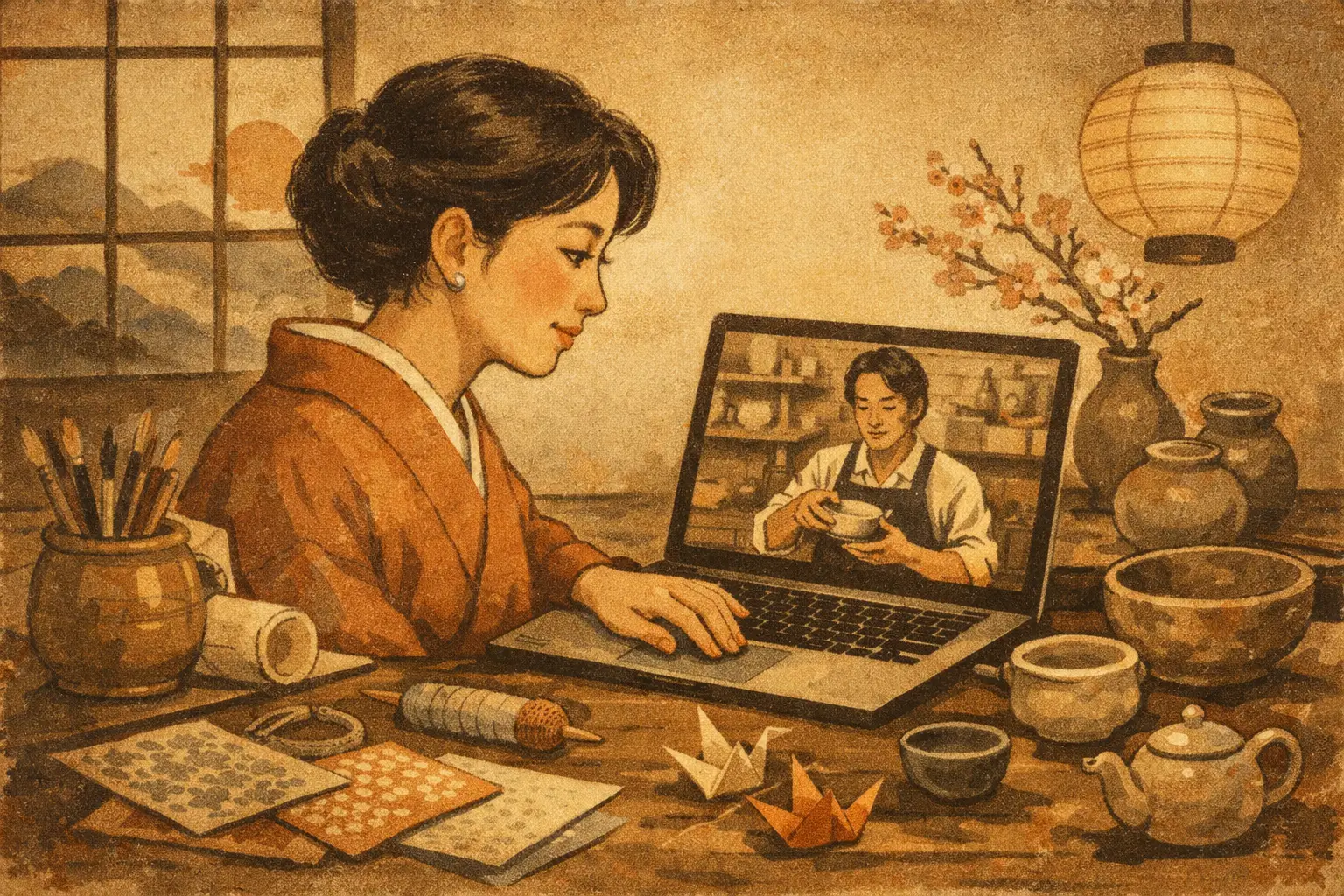
A hand-thrown tea cup changes the way you notice tea. A few uneven lines in a brush-written kanji can make you understand why calligraphy is more than handwriting. That is the special promise of Japanese craft workshops online: they bring a physical, patient piece of Japan into your own home, not just onto a screen.
For Japan lovers worldwide, an online workshop can be a brilliant bridge between planning a future trip and living with Japanese culture right now. You may not be able to sit at a potter’s wheel in Mashiko or join a textile studio in Kyoto this weekend, but you can still learn from craft traditions shaped by generations of makers. The best classes do not pretend distance disappears. They use it well, creating a focused experience with demonstrations, questions, practice time, and a finished object that carries your own effort.
What Makes Japanese Craft Workshops Online Special?
Japanese craft is often taught through attention rather than speed. A teacher may show how to hold a brush, fold a corner, or pull thread through cloth several times before asking students to try. For beginners used to fast tutorials, that can feel almost startling. It is also where the pleasure begins.
Many traditional crafts carry ideas that are easy to feel before they are easy to explain. Wabi sabi finds beauty in irregularity, age, and modest materials. Mono no aware is the gentle awareness that moments pass – something you might sense while pressing a flower into paper or watching indigo shift in a dye bath. A good instructor will not turn these ideas into a lecture. Instead, they will let the materials teach them.
Online classes also offer access to specialists whose studios may be far from major tourist routes. A maker can explain why a particular washi paper has long fibers, why a chasen bamboo tea whisk is cut in fine tines, or why a small change in pressure transforms a calligraphy stroke. That direct context is far more satisfying than copying a craft project with no story behind it.
Choose the Right Japanese Craft Workshop Online
The right class depends less on finding the most elaborate project and more on choosing a craft you genuinely want to return to. Some workshops make a beautiful one-time event. Others open the door to a practice that can become part of your week.
For a calming, hands-on ritual: pottery and kintsugi
Online pottery workshops may focus on hand-building rather than wheel throwing, since a wheel, clay recycling system, and kiln are not practical for every home. Pinch pots, small plates, incense holders, and tea bowls work especially well. The limitation is real: firing usually requires a local ceramic studio, and a teacher cannot correct your hand position as quickly through a camera. Still, hand-building teaches the quiet discipline of working with clay.
Kintsugi-inspired repair workshops are another appealing choice. Traditional kintsugi uses natural urushi lacquer and is a skilled, time-intensive practice with careful safety requirements. Many online beginner classes use modern, food-safe alternatives or decorative methods instead. That does not make them meaningless, but it is worth knowing what you are signing up for. Choose a class that clearly explains the method rather than presenting every gold-lined repair as identical to traditional kintsugi.
For color lovers: shibori and indigo dyeing
Shibori is a Japanese resist-dyeing tradition with many ways of binding, stitching, folding, and compressing fabric before dyeing it. The reveal is wonderfully dramatic: when the ties come off, the cloth shows patterns that are partly planned and partly surprising.
A beginner-friendly online shibori workshop often works with a cotton scarf, napkins, or a small tote bag. Look for instructors who explain fabric type, dye safety, preparation, and cleanup. Indigo has a deep visual pull, but it can be messy, and some kits need a well-ventilated area. If you live in a small apartment, a class using fiber-reactive dyes or smaller fabric samples may be the smarter first choice.
For focus and expression: Japanese calligraphy
Shodo, or Japanese calligraphy, is accessible in a way few crafts are. You need relatively little space, and early practice can begin with brush, ink, paper, and a calm surface. Yet the craft has enormous depth. A single character contains balance, rhythm, direction, and breathing room.
The most rewarding online shodo classes teach more than a few decorative words. They explain posture, brush loading, stroke order, and the difference between copying a character and giving it life. Beginners should not worry about writing perfect kanji. A class that starts with basic lines, hiragana, or one meaningful character can be much more enjoyable than trying to create a polished wall hanging immediately.
For paper lovers: origami, washi, and bookbinding
Origami is familiar, but a thoughtful workshop can take it far beyond a quick crane. You might learn modular forms, seasonal decorations, or patterns connected to Japanese celebrations. Washi-making and Japanese-style bookbinding workshops can be equally satisfying, especially for journal keepers, artists, and stationery fans.
Paper crafts are often the easiest option for households with limited tools, children nearby, or a tight budget. They also make excellent gifts. A hand-bound notebook or folded paper ornament has the kind of quiet charm that feels at home beside a favorite ukiyo-e print or a carefully chosen tea tin.
What to Check Before You Book
Before committing, read the workshop details as carefully as you would read a recipe. The experience changes dramatically depending on what is included and how it is taught.
First, check the time zone and whether the session is live, recorded, or both. A live workshop offers the chance to ask questions and meet fellow Japan fans, but a recording is kinder to busy schedules and international time differences. If the teacher is in Japan, an evening class there may land in the middle of the night in the United States.
Next, look closely at materials. Some workshops send a complete kit, while others provide a supply list for local purchase. A kit can make the first session easier and lets you use authentic materials chosen by the instructor. On the other hand, international shipping may increase the price or delay the start. Supply-list classes are often more flexible, especially if you already own art tools.
Also consider class size. A large demonstration can be inspiring and affordable, but a small group is better if you want feedback on your brush grip, stitched resist pattern, or clay shape. The description should make clear whether students can show their work on camera and receive personal guidance.
Finally, pay attention to cultural context. A great teacher shares the origins and meaning of a craft without making it feel distant or precious. You should leave with more respect for the tradition and more confidence to keep practicing.
Make the Workshop Feel Like an Occasion
Treat the session as more than content to consume between errands. Clear a table, set out your tools before class, and give yourself permission to work slowly. If you are joining with friends, agree to keep the cameras on when possible. Seeing other imperfect first attempts makes the experience warmer and more human.
Afterward, do not hide the result because it is not flawless. Use the indigo cloth. Put a small flower in the uneven vase. Keep your first calligraphy sheet inside a journal. Japanese craft traditions remind us that marks of making are not necessarily mistakes. They are evidence of attention.
If a workshop sparks a bigger curiosity, follow that thread. Learn a few Japanese terms, study the region associated with the craft, or plan a future visit to a studio when you travel. Crazy for Japan is built for exactly that kind of enthusiasm: one small discovery leading to the next.
The best online workshop is not always the one with the fanciest kit or the most photogenic final project. It is the one that makes you look at your hands, your home, and Japan itself with a little more care.