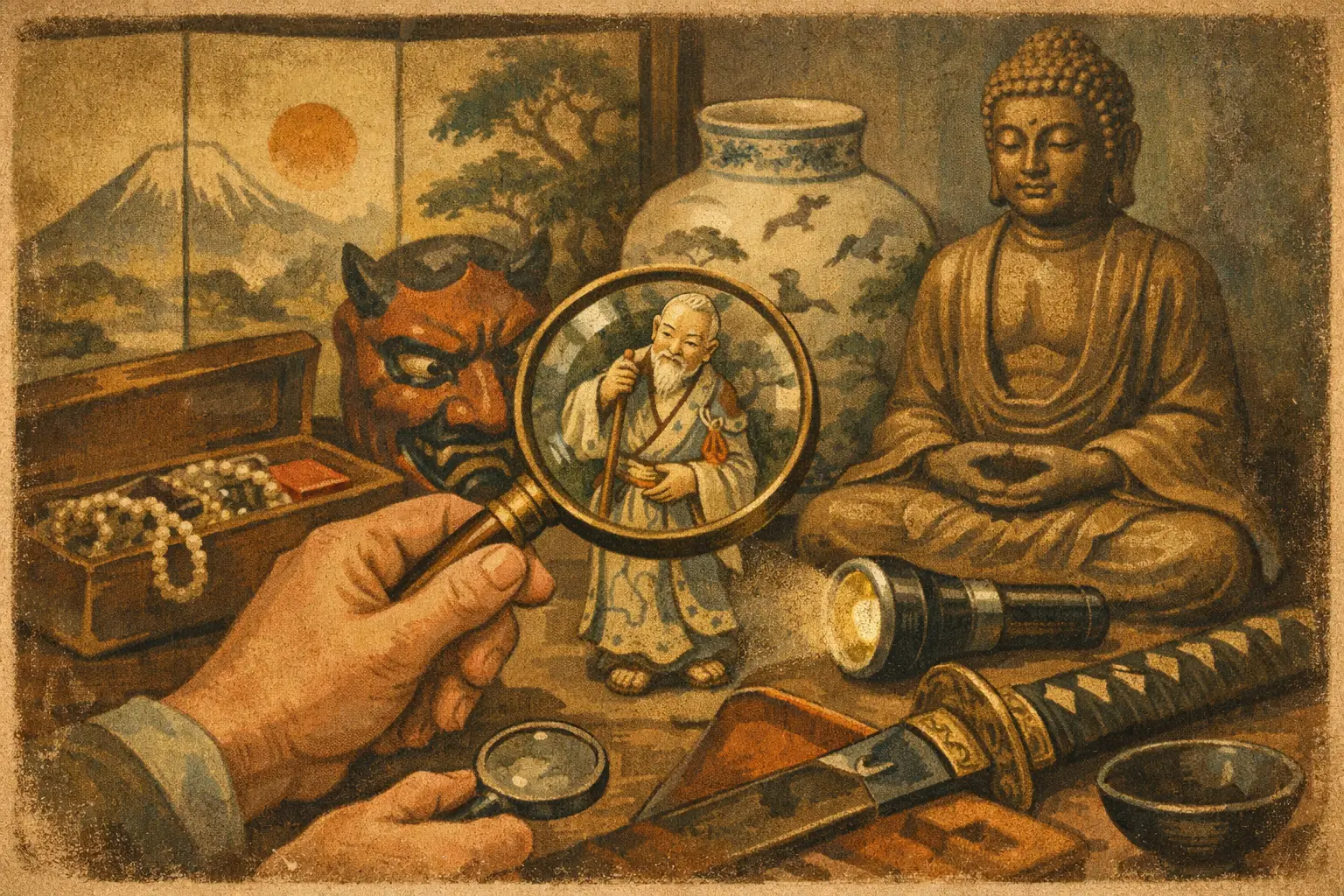
A tea bowl with a soft, uneven glaze. A woodblock print that seems to hold a century of quiet life. A tansu chest with dark iron hardware. These are the kinds of finds that make Japan lovers stop scrolling or linger at a market stall. But learning how to spot fake Japanese antiques protects more than your budget. It helps you appreciate the makers, collectors, and families behind the real mono no aware – the beauty found in age, change, and imperfection.
A fake is not always a cartoonishly bad imitation. Some are decorative modern reproductions sold honestly. Others are deliberately aged, falsely signed, or paired with paperwork meant to make a recent object look rare. The goal is not to become suspicious of every old-looking item. It is to slow down, ask better questions, and buy the story only when the object supports it.
Start With the Object, Not the Story
Sellers may lead with an exciting claim: Edo period, samurai family heirloom, temple piece, museum quality. Those words can be true, but they are not evidence. Look at the item itself before you let the description set the value in your mind.
Ask what the object was made to do. A rice bowl, kimono, incense burner, or writing box had a practical life before it became collectible. Real use tends to leave wear in logical places. On a tea bowl, the foot ring may show gentle rubbing from a wooden shelf. On a lacquer box, handling may soften the edges around the lid and corners. On a kimono, wear may appear at the collar, lining, hems, or points where ties created stress.
Artificial wear often feels too evenly distributed or strangely theatrical. You may see dark grime pressed into every carved line, fresh-looking scratches scattered across a surface, or wear that sits where hands would never naturally touch. A piece can certainly be cleaned, repaired, or stored carefully for decades, so a lack of damage is not automatic proof of a fake. The question is whether the condition makes sense for the object, material, and claimed age.
Know What Materials Should Feel Like
Japanese antiques cover a huge range of materials, and each one ages differently. You do not need to identify every kiln or textile school to notice when a material behaves oddly.
Ceramics and tea ware
For pottery, turn the piece over. The foot is often one of the most revealing areas because it is harder to make look convincingly old. A genuinely older bowl may have subtle wear, small firing flaws, glaze pooling, and a surface that feels integrated rather than painted with a layer of “age.” Handmade pottery is not perfectly symmetrical, especially in traditions that value wabi sabi.
Be cautious of crackle glaze presented as proof of great age. Some glazes naturally craze, while newer pieces can be stained to make those lines look dramatic. Staining that collects too uniformly in every crack, or has a harsh brown-black color, deserves a closer look. Also look for modern mold seams or identical examples appearing repeatedly from the same seller.
Lacquerware and wood
Real Japanese lacquerware can be remarkably durable, but lacquer is not plastic. It may show fine checking, small chips, or wear that reveals underlying layers in believable spots. A heavy chemical smell, extremely glossy coating, or painted-on gold that looks flat and glittery can point to a newer decorative piece.
With wood, inspect the underside, interior, and joins. Old wood does not simply become dark everywhere. It develops variation based on light, handling, dust, and use. Freshly cut-looking joints hidden beneath a deeply “aged” exterior are a warning sign. So is a chest that claims to be nineteenth-century but uses clearly modern screws, machine-cut hardware, or uniform factory-style construction.
Textiles, kimono, and paper
Silk, cotton, and paper are especially easy to misread from online photos. Antique kimono can have repairs, faded areas, and changed linings, and these do not erase their history. In fact, careful mending can be part of the appeal. But watch for printed fabric marketed as hand-painted yuzen, or synthetic-feeling cloth described as prewar silk.
For ukiyoe prints, bright color alone is not a verdict. Some prints were beautifully preserved; others were later reprints made from recut blocks. Instead, examine the impression. Traditional woodblock printing often has a soft, tactile quality, subtle color variation, and registration that is not mechanically perfect. Modern posters and digital reproductions can look sharp but flat, especially under magnification. Paper that is uniformly creamy, artificially speckled, or suspiciously pristine should make you ask more questions.
How to Spot Fake Japanese Antiques Through Details
The smallest details often reveal the biggest problems. Makers’ marks, signatures, seals, and labels can help, but they are not magic authentication stamps. Famous names have been copied for generations, sometimes by skilled craftspeople and sometimes by factories producing souvenirs.
A signature should fit the item. Compare its placement, brushwork, carving, and aging with known examples when possible. Does the mark sit naturally beneath the glaze, in the lacquer, or within the design? Or does it look newly scratched into an old-looking surface? A dramatic signature on a modest, poorly made object is often more suspicious than an unsigned piece with convincing craftsmanship.
The same goes for family crests, temple labels, and old tags. Paper can be aged, stamps can be reproduced, and a handwritten note may only record what a previous owner believed. Treat these as clues, not final proof.
Construction is another useful test. Older objects were made with the tools and methods available at the time. Hand-cut joinery, irregular stitching, hand-forged nails, and variations in carving can all be meaningful. Yet handmade does not always mean antique, and machine-made does not always mean worthless. Japan has a long history of superb industrial craftsmanship. What matters is whether the construction matches the date and origin being claimed.
Provenance Is a Trail, Not a Sales Pitch
Provenance means the documented history of ownership. The strongest provenance creates a clear trail: a respected dealer invoice, an estate record, old collection labels, exhibition history, or paperwork that identifies the maker and period without making wild promises.
A seller does not need a museum archive for every small object. Many genuine pieces come from house clearances, flea markets, and inherited collections with incomplete histories. Still, a trustworthy seller should be comfortable saying, “I do not know,” rather than filling gaps with a dramatic tale.
Ask direct, friendly questions: Where did this come from? When and how was it acquired? Is the signature guaranteed? Has it been restored? Can I see detailed photos of the underside, interior, edges, and damage? Honest answers are usually specific without being overly rehearsed.
If an item is expensive, get an independent opinion before you buy. A specialist in Japanese ceramics, textiles, prints, or arms will see things a general antiques dealer may miss. This matters especially for nihonto, Japanese swords. Authentic swords can involve registration papers, export rules, restoration issues, and a market full of copied signatures. Papers can be useful, but they should be evaluated alongside the blade, tang, condition, and source – never in isolation.
Be Careful With Bargains and Urgency
A wonderful bargain can happen, especially when a seller has not researched an item. But a price far below the market deserves an explanation. Scarcity claims, countdown pressure, and phrases like “buy now before another collector takes it” are designed to stop you from thinking.
Online buying adds another layer of risk because lighting can hide repairs, stains, and modern materials. Request clear images in natural light, including scale references. Look at a seller’s past listings. Do they offer one carefully described family object, or an endless supply of supposedly rare Edo treasures in identical condition? Pattern recognition is one of a collector’s best tools.
Do not confuse restoration with deception. Japanese objects were often repaired rather than discarded. A kintsugi repair, for example, can honor a bowl’s life and add beauty, provided it is described honestly. The issue is concealed damage, not a repaired object with an open history.
Build Your Eye Before You Buy Big
The most enjoyable way to avoid fakes is to spend time with authentic examples. Visit museum collections, study auction catalogs, handle objects at reputable antiques fairs, and compare details across many pieces. Pay attention to the quiet things: the density of a textile, the depth of a carved line, the warmth of old wood, the way a tea bowl sits in your hand.
Start with a category you genuinely love instead of trying to collect everything Japanese at once. Maybe it is folk mingei pottery, indigo textiles, Meiji-era metalwork, or small calligraphy tools. A focused interest makes it easier to recognize quality and ask informed questions. It also keeps collecting joyful rather than stressful.
The best Japanese antique may not be the oldest, most famous, or most expensive piece in the room. It is the one whose materials, craftsmanship, condition, and history feel honest – and whose presence gives you a deeper connection to the human hands that made it.