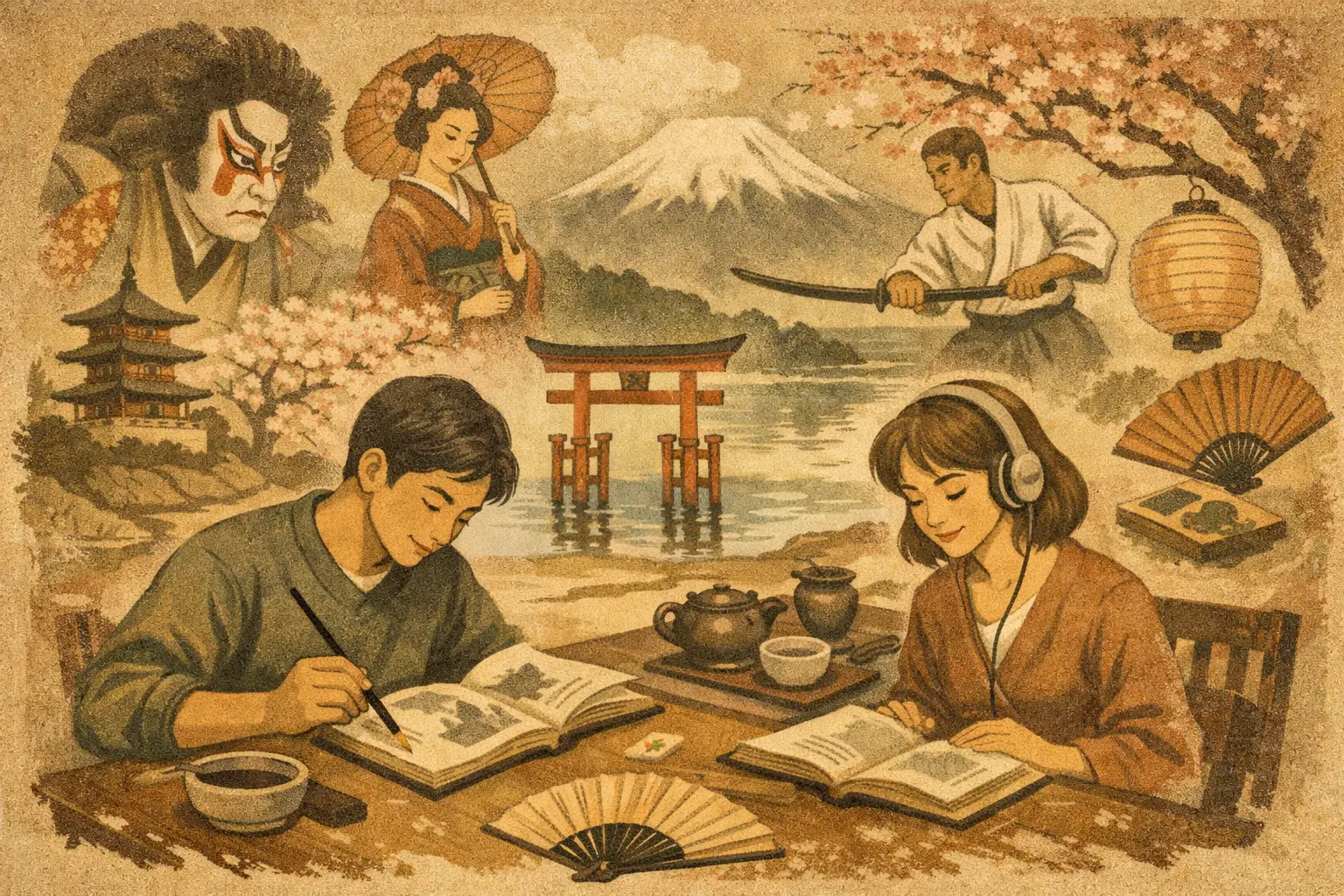
A tea bowl can teach you as much about Japan as a history book. So can the quiet at a shrine, the fold of a kimono sleeve, the smell of hinoki in a bath, or the care behind a handwritten note. If you are looking for 日本文化を学ぶ方法, the best approach is not to chase everything at once. It is to build a real relationship with the parts of Japan that make you stop, look again, and feel something.
That matters because Japanese culture is not one big topic. It is a living mix of craft, ritual, place, etiquette, food, design, spirituality, and seasonal awareness. If you try to study it as a giant abstract subject, it can feel flat. If you approach it through specific experiences, it becomes memorable, personal, and much easier to keep learning.
日本文化を学ぶ方法は「好き」から始める
A lot of people make the same mistake early on. They think they need to start with a formal definition of Japanese culture, then move through a giant checklist. That usually leads to burnout or shallow knowledge. A better path is to start with the part that already pulls you in.
Maybe that is kutani pottery, shodo calligraphy, Japanese knives, temple architecture, incense, or regional food. Maybe it is the atmosphere of onsen, the elegance of furoshiki wrapping, or the quiet sadness and beauty of mono no aware. That first point of fascination is not a distraction from serious learning. It is your doorway.
When you begin with genuine interest, you notice details. You ask better questions. You remember what you discover. Someone who starts with ukiyoe prints may end up learning about Edo-period city life, publishing culture, kabuki, and woodblock carving techniques. Someone drawn to kimono may soon be exploring textile regions, dyeing traditions, seasonality, and social etiquette. One passion opens into many others.
Learn through objects, not just explanations
Japanese culture often reveals itself through things people use, wear, make, give, clean, store, and care for. That is why hands-on learning works so well.
If you can join a workshop, do it. Try tea ceremony, calligraphy, lantern making, wagashi shaping, indigo dyeing, or simple origami beyond the childhood versions. When your hands are involved, abstract ideas become concrete. Wabi sabi stops sounding like a trendy phrase and starts feeling like an appreciation for texture, irregularity, restraint, and time.
Even from home, you can learn this way. Choose one object and study it closely for a few weeks. A tea whisk, a noren curtain, a bento box, a sensu fan, or a piece of handmade paper can teach you about material culture, design values, and everyday aesthetics. Ask where it comes from, how it is made, when it is used, and what behavior surrounds it. In Japan, objects are rarely just objects.
There is a trade-off here. Buying random decor without context can create a thin version of cultural learning. But choosing fewer, better pieces and taking time to understand them leads to a richer connection.
Use food as a serious cultural teacher
Food is one of the most accessible ways to study Japan, but it deserves more than a restaurant bucket list. Japanese food culture is full of regional identity, etiquette, seasonal timing, and craftsmanship.
Start paying attention to why dishes appear when they do. Spring sweets, summer noodles, autumn mushrooms, New Year foods – each carries a sense of season that is central to Japanese life. That awareness of fleeting time connects directly to ideas like mono no aware.
It also helps to look beyond sushi. Learn about miso varieties, pickling traditions, dashi, tofu making, rice cultivation, street snacks, temple cuisine, and bathhouse milk drinks. If you cook, make one dish repeatedly instead of trying ten dishes once. Repetition teaches texture, balance, and care.
And notice the setting. How food is plated, shared, served, and received matters. A simple meal can express omotenashi, the spirit of thoughtful hospitality, more clearly than a luxury dinner.
Language helps, but fluency is not required
Some people hesitate to begin because they do not speak Japanese. Others think language study alone equals cultural study. The truth sits in the middle.
Learning a little Japanese helps a lot. Even basic words sharpen your understanding of what you see. Terms like matsuri, engawa, shoji, sento, omamori, and torii carry meanings that do not always transfer neatly into English. Romanized Japanese words can become cultural clues when you learn them in context.
But you do not need advanced fluency to start understanding Japan deeply. What you do need is curiosity about meaning. If you come across words like ikigai, wabi sabi, or ukiyoe, do not memorize a one-line translation and move on. Look at how the idea shows up in real life. How does wabi sabi appear in ceramics, gardens, interiors, and even aging materials? How does it differ from generic minimalism? Those questions lead to substance.
If you are studying Japanese, connect vocabulary to things you can observe. That creates a stronger bond between language and culture than flashcards alone.
Travel helps, but focused travel helps more
Visiting Japan can transform your understanding fast, but only if you travel with attention. Rushing between famous spots is exciting, yet it often produces photos more than insight.
A better method is to choose one theme for each trip or even each day. You might follow temple architecture in Kyoto, local lacquerware in Wajima, castle history in Himeji, or pilgrimage culture on the Kumano Kodo. Slow travel gives culture room to speak.
Watch what people do, not just what they visit. Notice how shoes are handled, how public space is respected, how seasonal displays appear in shops, how wrapping is done, how silence works in sacred places. These everyday habits tell you a lot about values.
That said, travel is not the only path. Many Japan lovers build a deep connection from abroad through classes, books, museum visits, community events, and carefully chosen cultural experiences. If you cannot get on a plane soon, your learning is not on hold.
Build a personal study rhythm
The best 日本文化を学ぶ方法 is the one you can actually keep doing. Consistency beats intensity.
Instead of trying to absorb everything in a burst, create a rhythm that feels natural. You might read about one craft tradition each week, practice calligraphy on Sundays, cook one regional dish each month, and keep a notebook of words, customs, and places you want to explore further. Over time, this becomes your own cultural map.
This is also where community matters. Learning Japan in isolation can get narrow. Conversations with other Japan enthusiasts, travelers, teachers, makers, and collectors often open new doors. A platform like Crazy for Japan can be useful here because it brings different interests into one shared space – not just reading, but discovering experiences, goods, and inspiration that keep the connection alive.
Try not to turn your study into a performance. You do not need to prove expertise. You are building familiarity, respect, and joy. That is a healthier and more sustainable mindset.
Look for values, not just facts
Facts matter, but values make culture coherent. If you only collect trivia, Japan can feel like a pile of interesting fragments. If you start noticing recurring values, patterns emerge.
You may begin to see attention to seasonality, appreciation for impermanence, respect for form, care in presentation, and sensitivity to place. These values show up in very different settings – a tea room, a bento box, a shrine approach, a handmade knife, a flower arrangement, a wrapping cloth.
This is also where nuance matters. Japan is not uniform, and it is not frozen in the past. Urban and rural life differ. Traditions change. Younger generations reinterpret old forms. Commercial versions of culture exist alongside deeply rooted practice. It depends on where you are looking and who is carrying the tradition forward.
That complexity is part of the appeal. Real cultural learning is not about finding one tidy answer. It is about becoming better at seeing layers.
Respect beats imitation
One final point matters more than people sometimes realize. Learning from another culture is not the same as copying its surface. Wearing a yukata, attending a tea event, or practicing shodo can be meaningful. But those experiences become much richer when paired with context, etiquette, and humility.
Ask why something is done a certain way. Learn when an item is appropriate. Understand whether an experience is sacred, social, formal, casual, regional, or commercial. Respect does not make learning stiff. It makes it real.
If you stay curious, patient, and open, Japanese culture keeps unfolding. A small object leads to a craft. A craft leads to a place. A place leads to history. A meal leads to seasonality. Before long, Japan is no longer just something you like. It becomes something you are in relationship with, one thoughtful step at a time.
Keep following what genuinely moves you – the temple bell, the brushstroke, the steam rising from an onsen, the quiet beauty of an old bowl – and let that be your teacher.