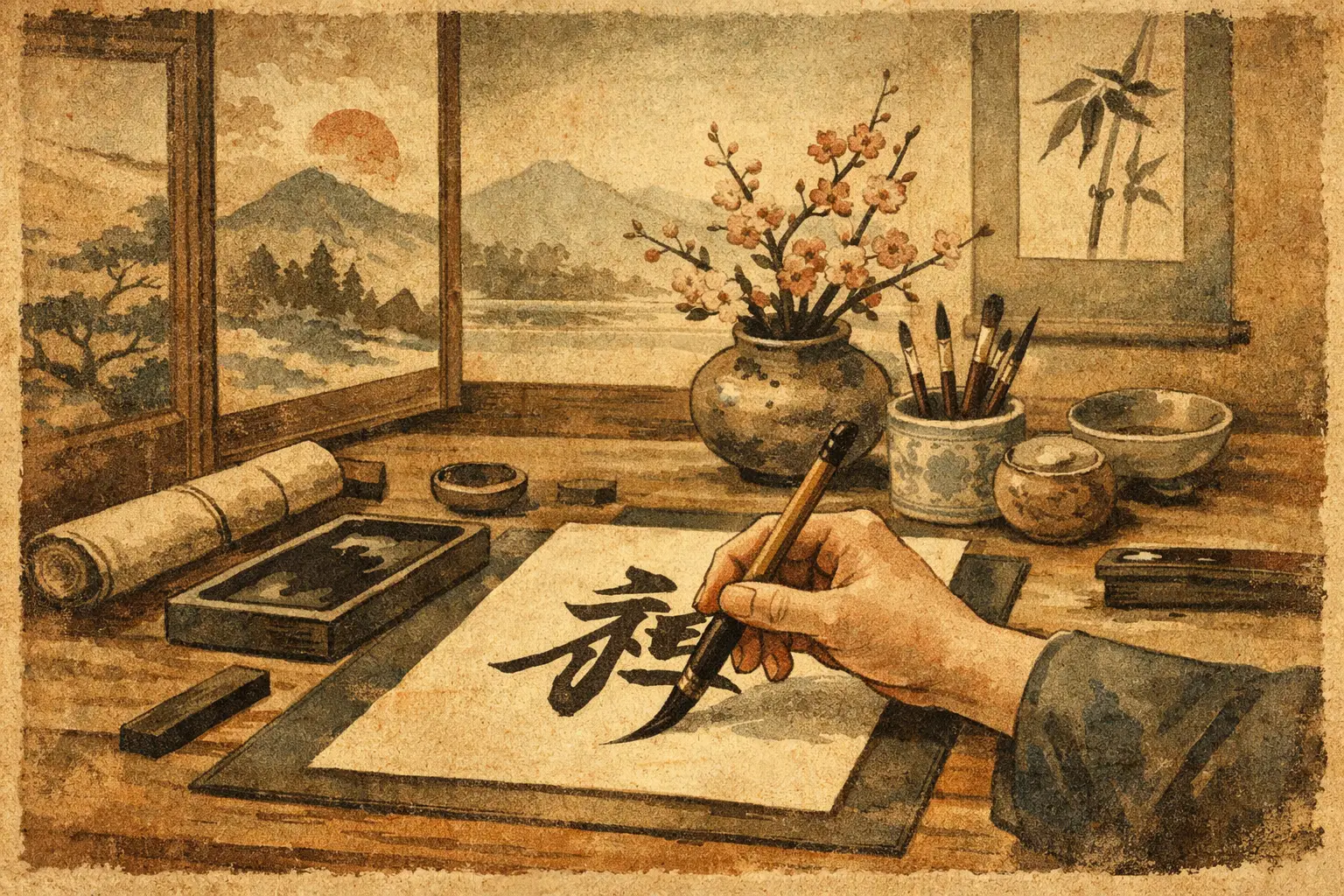
The first time you watch a brush lay down a bold black line on white paper, it feels almost unreal. One movement can look soft, sharp, calm, and alive all at once. That is why japanese calligraphy for beginners is so captivating – you are not just learning to write, you are learning how rhythm, pressure, and attention show up on paper.
For many Japan lovers worldwide, shodo – the way of writing – has a special pull. It sits somewhere between language, art, and meditation. It also connects beautifully with ideas many of us already love in Japanese culture, like wabi sabi, where small irregularities carry their own beauty, and mono no aware, that gentle awareness of a fleeting moment. A brushstroke is exactly that – one moment, impossible to repeat in quite the same way.
What Japanese calligraphy for beginners really involves
A lot of newcomers assume Japanese calligraphy starts with memorizing difficult kanji. Actually, the first challenge is much more physical. You are learning how to sit, how to hold the brush, how to breathe, and how to move from your arm instead of only your fingers.
That matters because shodo is not just about making neat characters. The line itself has character. A hesitant stroke looks different from a committed one. Too much pressure makes a line heavy. Too little can make it weak. Even before you write recognizable characters, you are training your body to create intentional marks.
This is also why beginners should not judge themselves too harshly. Beautiful Japanese calligraphy is not the same as perfect printing. Some of the most striking work has energy, spacing, and balance that feel expressive rather than rigid. Think of it less like copying a font and more like learning a disciplined art form with room for personal feeling.
The basic tools you need
You do not need a huge setup to begin, but your tools do shape the experience. Traditional calligraphy usually uses four essentials: brush, ink, paper, and an ink stone. In Japanese, these are often treated with a kind of respect because they are the heart of the practice.
For a beginner, a medium-sized brush is usually the most forgiving choice. A very small brush can feel harder to control, while a large one may be intimidating at first. Liquid ink is perfectly fine when you are starting. Grinding ink from a stick on a stone is a beautiful ritual, but it adds one more skill before you even begin writing.
Paper makes a bigger difference than many people expect. Thin, highly absorbent calligraphy paper shows every wobble and every pause. That can be frustrating, but it also teaches you quickly. If you want an easier start, use practice sheets made for brush writing. Some learners even begin with reusable water practice mats, which let you focus on movement without worrying about wasting paper.
There is a trade-off here. Water mats are less stressful and great for repetition, but they do not teach you exactly how ink spreads. If your goal is to understand the real feel of shodo, it is worth moving to paper fairly early.
How to hold the brush and make your first strokes
The brush is usually held upright, not at the low angle used in painting or Western penmanship. That upright position helps create a full, varied line. It may feel awkward at first, especially if you are used to gripping pens tightly.
Try to keep your grip stable but not tense. The movement should come from the arm and shoulder more than the fingertips. That sounds formal, but the reason is simple – larger movement gives your strokes more flow.
Before writing actual characters, practice basic lines. Make a straight vertical line. Then a horizontal one. Try pressing down gently at the start, moving steadily, and lifting with control. Next, try slight curves, hooks, and stops. These little drills may seem plain, yet they build the foundation for every kana and kanji you will write later.
If your lines look shaky, that is normal. Most beginners are fighting two things at once: unfamiliar posture and the fear of making a mistake. The second problem is often bigger. A brush responds well to confidence. Even an imperfect stroke can look appealing if it has clear intention.
Should you start with kana or kanji?
This depends on what drew you to calligraphy in the first place. If you are studying Japanese already, kana can be an inviting place to start because hiragana has flowing forms and appears everywhere in the language. If you are more interested in bold visual impact, simple kanji may feel more exciting.
Many beginners enjoy starting with a few easy kanji that carry strong meaning, such as yume for dream, kokoro for heart, or wa for harmony. These characters can feel rewarding because each one stands alone as a complete image. At the same time, they demand attention to stroke order and proportion.
Hiragana offers a different kind of beauty. It tends to look softer and more continuous, sometimes almost lyrical. In classical calligraphy, kana can be incredibly elegant, but that elegance is not always easy for beginners. Its apparent softness can hide how precise it really is.
A practical approach is to do both. Learn a handful of simple kanji for structure, then practice basic hiragana for flow. That balance keeps things interesting and helps you understand that Japanese writing is visually diverse.
Why stroke order matters more than you think
Stroke order is not just a classroom rule. In calligraphy, it directly affects balance, speed, and how the final character feels. Writing a character in the wrong order can make it look cramped or awkward, even if all the parts are technically there.
This is because each stroke prepares the next one. The brush lifts, turns, presses, and releases in a sequence. When that sequence is natural, the character feels coherent. When it is forced, the energy gets interrupted.
So yes, if you are serious about japanese calligraphy for beginners, learn proper stroke order early. It saves frustration later and helps your writing look more authentic from the beginning.
Common beginner mistakes that are completely normal
One of the biggest mistakes is rushing toward finished pieces. It is tempting to write a dramatic kanji on day one and hope it looks like something from a temple scroll. Usually it does not, and that is fine. Shodo grows through repetition.
Another common issue is pressing too hard. Beginners often think darker and thicker means better. In reality, variation gives calligraphy life. A line that starts firm and then lightens can feel much more expressive.
Spacing is another challenge. Many people focus so much on individual strokes that they forget the empty space around them. But ma – the meaningful use of space – is part of the beauty. A character needs room to breathe.
And then there is comparison. Looking at master calligraphers can be inspiring, but it can also make your own pages feel clumsy. Remember that even the most elegant work comes from long practice. The joy is in seeing your hand become steadier and your eye more sensitive over time.
How to practice without getting overwhelmed
Short, regular practice works better than occasional marathon sessions. Fifteen or twenty minutes a few times a week is enough to build familiarity. Start each session with simple lines, then one or two characters, and repeat them slowly.
It helps to choose characters or words you actually care about. If you love Japanese aesthetics, write bi for beauty or zen for calm. If travel inspires you, try yama for mountain or kawa for river. Personal connection keeps practice from feeling mechanical.
You can also pay attention to style. Some examples look bold and structured, while others feel more fluid, almost like ukiyoe lines moving across the page. Do not worry about finding your own style immediately, but notice what you respond to. That taste will shape your motivation.
If possible, learn from a teacher, workshop, or demonstration at least once. Books and videos can help, but calligraphy is one of those arts where small corrections make a huge difference. Seeing how someone loads the brush, pauses before a stroke, or adjusts posture can save you weeks of guesswork.
The deeper appeal of shodo
What keeps many people practicing is not just the visual result. It is the feeling of attention the practice creates. You dip the brush, steady your posture, and commit to one stroke at a time. There is no erasing, and that is part of the point.
That can feel intimidating at first, but it also becomes freeing. A page of practice shows exactly where you were on that day – distracted, calm, rushed, focused. In that sense, calligraphy is honest. It reflects the person holding the brush.
For anyone who loves Japan not only as a destination but as a source of aesthetic and cultural depth, shodo offers a direct way in. It is tactile, traditional, and personal. You do not need to be fluent in Japanese or trained as an artist to begin. You only need patience, curiosity, and a willingness to let the brush teach you something new each time you sit down.
Start with one brush, one sheet, and one simple character. That is more than enough to begin a practice that can stay with you for years.