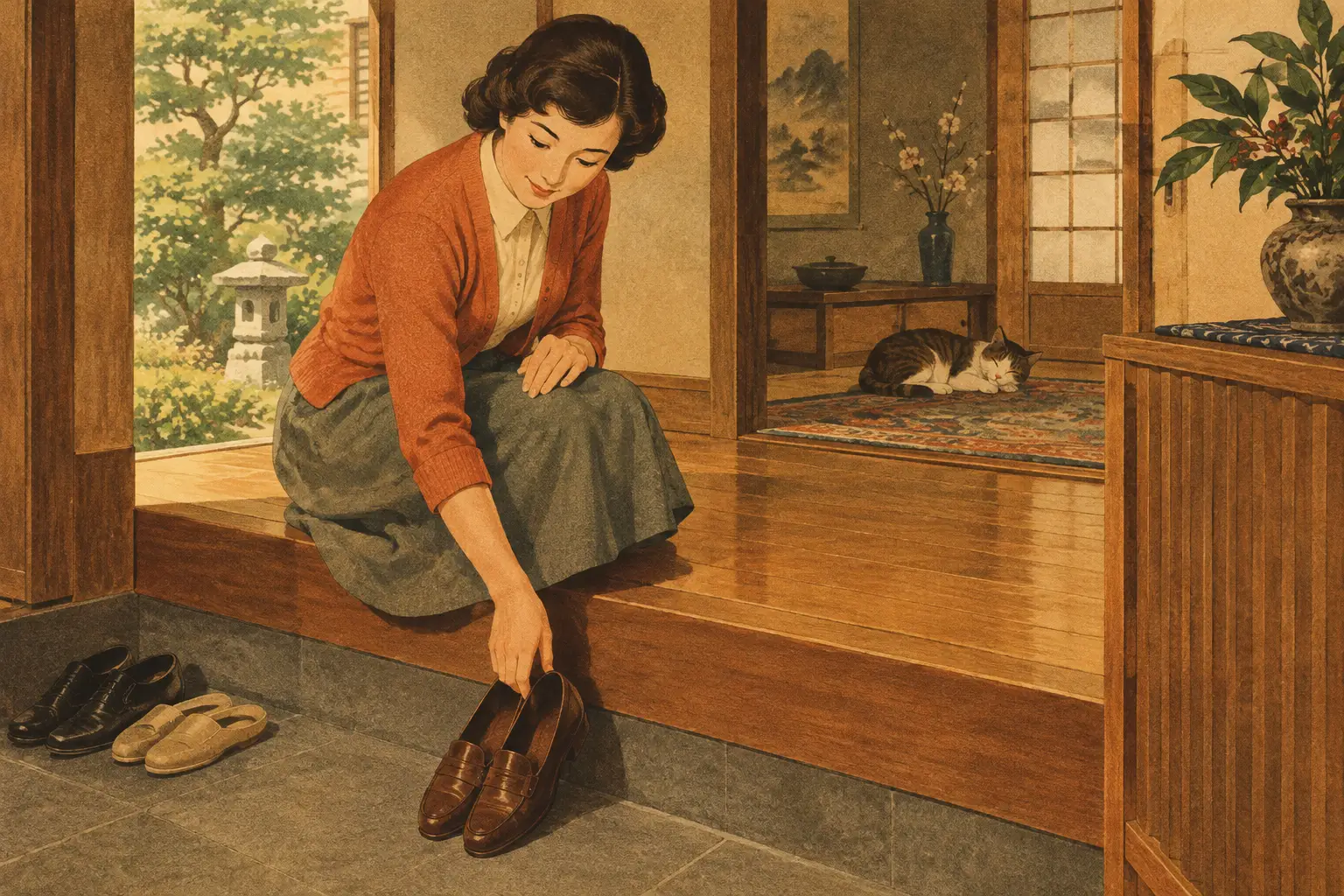
A small step at the entrance can change the whole feeling of a home. When visitors ask, “why remove shoes indoors?” in Japan, the answer is not simply “because it is cleaner.” Taking off shoes marks the moment you leave the public world behind and enter a cared-for private space. It is practical, polite, and deeply woven into everyday life.
For Japan lovers worldwide, understanding this custom makes a stay in a ryokan, a visit to a friend’s house, or a temple experience feel far less intimidating. You do not need perfect Japanese or encyclopedic etiquette. You only need to notice the entrance, follow the host’s lead, and treat the space with care.
Why Remove Shoes Indoors in Japan?
Japanese streets, train platforms, gardens, and shop entrances are part of the outside world. Shoes meet rain, dust, grit, and everything else picked up during a busy day. Indoors is a different zone: a place for resting, eating, sitting, and often sleeping close to the floor. Removing shoes creates a clear boundary between the two.
That boundary is usually visible at the genkan, the entryway found in Japanese homes and many traditional accommodations. The genkan floor is set lower than the raised living area. Step up, and you are stepping into the home. This little change in height quietly tells you what to do next.
The custom also makes sense in a culture where floor-level living has long been common. Futons may be laid out on tatami mats at night. Families sit on floor cushions for meals or tea. Children play on the floor. Even in homes with Western-style furniture, the floor remains a meaningful shared surface. Keeping it clean is not a fussy rule. It supports how people actually live.
There is a feeling here that Japan enthusiasts may recognize from ideas such as wabi-sabi: care for ordinary things, respect for use, and appreciation of a space that is quietly maintained. A pair of shoes lined up neatly in the genkan can be a small act, but it says, “I know I am a guest in this space.”
Cleanliness Is Only Part of the Story
It is easy to describe shoe removal as hygiene, and hygiene certainly matters. Shoes carry outdoor dirt, while bare feet, socks, or indoor slippers keep the living space more comfortable. During rainy seasons, this distinction becomes especially obvious.
But Japanese etiquette is rarely only about a rule. It is about consideration, or omoiyari. Removing shoes reduces work for the host and acknowledges that the household has its own rhythms. A host may have just cleaned the floors, prepared a meal, or arranged a tatami room for guests. Taking off your shoes says you recognize that effort.
It can also create a mental reset. Think about the relief of changing out of travel clothes after a long day. In Japan, leaving shoes at the door can offer a similar shift. The outside is busy, social, and unpredictable. Inside is where you settle, eat, bathe, and spend time with people close to you.
This does not mean every Japanese home is spotless or formal at every moment. Real homes are real homes. Families rush out the door, pets shed, and clutter happens. The point is the shared expectation that indoors deserves a different kind of care than outdoors.
The Genkan: Read the Room Before You Step
The safest travel habit is simple: pause at the entrance. Look for a lowered area, a shoe rack, rows of slippers, or shoes placed near the door. If you see them, take off your shoes before stepping onto the raised floor.
Place your shoes neatly, ideally with the toes facing the door so they are ready when you leave. In a private home, do not worry if you cannot make them look perfectly aligned. A sincere effort matters more than a choreographed move. If the host moves your shoes afterward, let them. They are helping you fit the household routine.
At a ryokan, guesthouse, traditional restaurant, tea room, temple lodging, or some cultural workshops, shoes may come off at the entrance. You may receive slippers, or you may simply walk in socks. Follow posted signs and observe what others are doing.
Some places are less obvious. Modern apartments, offices, clinics, schools, fitting rooms, and martial arts dojos may have their own rules. A stylish restaurant might have a Western-style entrance but a raised tatami dining area where shoes come off. When unsure, ask politely: “Should I take off my shoes?” That question is always better than confidently making the wrong assumption.
Slippers Have Their Own Etiquette
Slippers are helpful, but they are not a free pass to forget the rules. In many homes and ryokan, slippers are for wood or tile floors, not tatami. Tatami is made from woven rush and has a soft, natural texture that slippers can scuff or damage. If you enter a tatami room, leave the slippers outside it and walk in socks or bare feet, unless your host tells you otherwise.
The bathroom often has a separate pair of toilet slippers. Yes, this can surprise first-time visitors. The idea is straightforward: bathroom floors and living floors should not mix. Put on the toilet slippers when you enter, then take them off when you leave. Accidentally walking into the hallway wearing them is one of those classic visitor mistakes. It is not a disaster, but once you know the system, it is easy to avoid.
Slipper sizes can also be small. If your feet hang over the edge, do not panic. Wear them carefully, or ask if socks are acceptable. Comfort and safety matter more than forcing yourself into a pair that does not fit.
When You May Keep Your Shoes On
Not every indoor space in Japan requires shoe removal. Most department stores, museums, train stations, cafes, hotels, and contemporary retail shops expect shoes to stay on. Many restaurants do too. The rule is not “Japan means no shoes indoors.” The better rule is “watch for the boundary between outside and a more private or floor-centered space.”
There are also practical exceptions. A host may tell you to keep your shoes on because they are renovating, hosting a large gathering, or simply running their home differently. Accept their preference without arguing that you know the Japanese way. Good etiquette means responding to the people and place in front of you.
Health and mobility needs matter as well. Someone who needs supportive footwear, orthotics, or medical shoes should not feel excluded from visiting. In a home or small venue, communicate early and kindly. Clean indoor-only shoes or shoe covers may be a workable compromise, depending on the host and setting.
Bringing the Practice Home
Many travelers return from Japan and start leaving shoes by their own front door. It is an easy ritual to borrow, even in a home that does not have a raised genkan. A bench, a small tray for wet shoes, and a designated indoor slipper basket can make the transition feel intentional rather than messy.
The benefits are real: less tracked-in dirt, fewer wet footprints, and a calmer entryway. It can be especially useful for homes with carpets, young children, or pets. Still, it should work for your household, not become a rigid performance. If guests come from a culture where shoes stay on, a friendly sign or a warm verbal reminder is kinder than silent judgment.
You can also adapt the spirit instead of copying every detail. Maybe shoes come off at the door, but guests are welcome to wear clean socks. Maybe you offer slippers only in winter. Maybe you keep a basket of indoor footwear for people who need extra support. Cultural appreciation is strongest when it is thoughtful, not theatrical.
The next time you stand at a Japanese doorway, let the genkan slow you down for a second. Notice the change in level, arrange your shoes with care, and step inside with curiosity. That small gesture is not about passing an etiquette test. It is an invitation into the everyday grace of a place someone calls home.