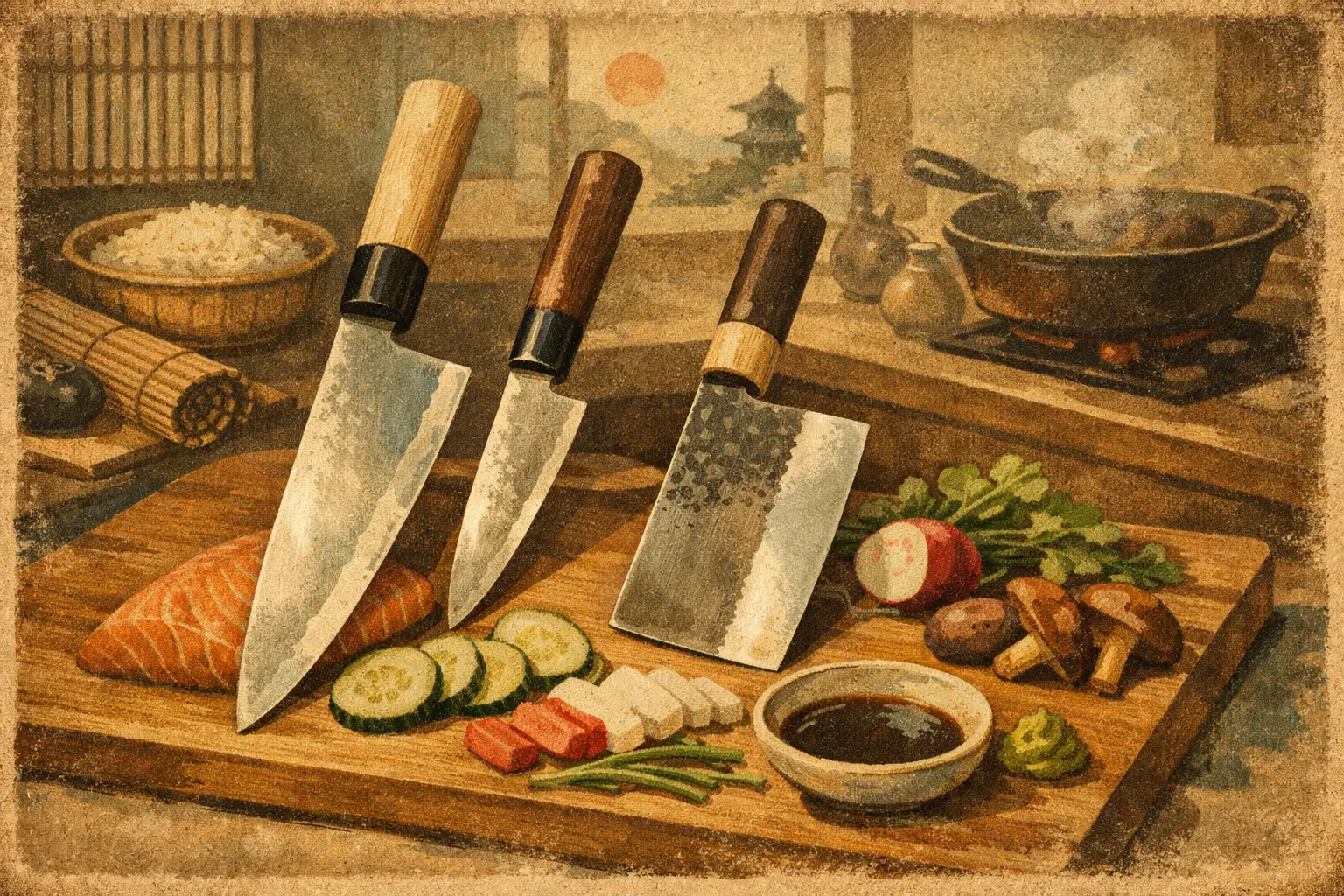
A ripe tomato should not collapse under a dull blade. Neither should a bunch of scallions turn into a slippery, crushed mess. That everyday frustration is why Japanese knives for home cooks are so compelling: they make ordinary prep feel more precise, more relaxed, and a little closer to the care behind Japanese food.
For Japan lovers worldwide, a good knife is not just another kitchen purchase. It is a practical connection to a long craft tradition. But you do not need a wall full of specialty blades, advanced sharpening skills, or restaurant-level technique to enjoy one. Start with the knife that fits the food you actually cook, then learn how to treat it well.
Why Japanese knives feel different
Many Japanese kitchen knives are designed with a thinner, harder blade than the average Western chef’s knife. The thin edge moves cleanly through vegetables, fish, herbs, and boneless meat with less wedging and tearing. You can feel the difference when slicing a daikon radish, trimming chicken thighs, or cutting paper-thin cucumbers for a sunomono salad.
That sharpness comes with a trade-off. A very thin edge is not meant for forcing through hard squash, twisting in an avocado pit, hacking at frozen food, or striking chicken bones. Think of it as a tool for controlled cuts rather than brute force. Used with attention, it can feel almost effortless. Used like a cleaver, it can chip.
There is also a lovely sense of wabi-sabi in a knife that earns gentle signs of use over time: a handle that becomes familiar in your hand, a blade that has been carefully sharpened again and again, and maybe the soft patina of carbon steel. The goal is not to keep it untouched. The goal is to use it with respect.
Japanese knives for home cooks: start with one
The best first Japanese knife is usually a gyuto or a santoku. Both are versatile enough for daily meals, from weekday stir-fries to a weekend Japanese curry spread.
The gyuto for cooks who want one main knife
A gyuto is Japan’s answer to the Western chef’s knife. It has a gently curved belly, a pointed tip, and enough length for most jobs. An 8-inch gyuto is especially comfortable for home kitchens because it handles onions, cabbage, carrots, herbs, boneless proteins, and fruit without feeling oversized.
Choose a gyuto if you already like the rocking motion of a chef’s knife or often cook for several people. Its tip is useful for detailed work, such as removing strawberry hulls or scoring fish skin. The profile also gives you a little more reach when slicing large vegetables.
The santoku for compact, vegetable-heavy cooking
A santoku is shorter and often feels less intimidating. Its relatively flat edge suits an up-and-down chopping motion, while its tall blade makes it easy to scoop ingredients from board to pan. It is a natural match for cooks who make lots of vegetables, tofu dishes, rice bowls, and quick weeknight meals.
Most santoku knives are between 6.5 and 7 inches. That smaller size can be a major advantage in an apartment kitchen or for anyone with smaller hands. It is not inherently better than a gyuto. It simply has a different rhythm.
Add a petty knife before chasing specialty blades
Once you have a gyuto or santoku, a petty knife is the most useful second purchase. Usually 4.5 to 6 inches long, it takes care of garlic, shallots, citrus, mushrooms, small fruit, and fine trimming. It is the knife you will reach for when a large blade feels like too much.
A nakiri, with its rectangular vegetable-focused blade, is wonderful if you genuinely prep piles of produce. A deba, yanagiba, or usuba can be beautiful and culturally fascinating, but they are specialized tools. Buy them because you want to learn their intended techniques, not because they look impressive in a knife block.
Choose steel for your real kitchen habits
Japanese knives commonly come in stainless steel, carbon steel, or stainless-clad carbon steel. This is where enthusiasm should meet honesty about your routine.
Stainless steel is the easiest choice for most home cooks. It resists rust, asks for less attention, and works well when dinner is busy and the sink is full. A quality stainless Japanese knife can still take a very fine edge. If you want a low-stress first knife, stainless is the smart place to begin.
Carbon steel is beloved for its sharpness, easy sharpening, and living character. It reacts with moisture and develops a patina, often blue-gray or dark gray, as it is used. That patina can be gorgeous, but carbon steel must be washed, dried immediately, and never left damp. A few minutes forgotten under a wet dish towel can lead to rust.
Stainless-clad carbon steel offers a middle ground. The core is carbon steel, while the outer layers are stainless. It reduces some maintenance without eliminating it. This can be a satisfying option for a cook who enjoys ritual and wants to participate more closely in the knife’s care.
Hardness matters, too. Harder steel generally holds a sharp edge longer, but it can be less forgiving of twisting and impacts. For a first knife, do not get distracted by a huge hardness number. A well-made blade, a comfortable handle, and good habits matter more.
Pay attention to handle and blade shape
Japanese knives may have a traditional wa handle, often octagonal or D-shaped, or a Western-style handle with scales secured to the tang. Neither is automatically more authentic or superior. The right one is the one that feels stable and comfortable when your hand is slightly damp.
A wa handle is often lighter, shifting the balance toward the blade. That can make a knife feel nimble during vegetable work. Western-style handles can feel familiar and more substantial for cooks used to classic European knives. If possible, hold a few knives before choosing. If that is not possible, check dimensions and reviews with your hand size in mind.
Also consider blade height. A taller blade gives your knuckles more clearance and makes scooping easier. A thinner, shorter blade can feel more agile for detail work. There is no universal winner, only a better fit for your cutting board and cooking style.
The habits that keep a Japanese knife happy
A Japanese knife deserves a few simple rules. Use a wood or quality plastic cutting board, not glass, marble, ceramic, or a plate. Those hard surfaces can dull or chip even an excellent edge quickly.
Hand-wash the knife with mild soap, rinse it, and dry it right away. Skip the dishwasher completely. Heat, harsh detergent, rattling against other utensils, and lingering moisture are especially rough on fine edges and natural handles.
For storage, use a blade guard, magnetic strip, or knife block that does not scrape the edge. Do not toss it loose into a drawer. When transferring chopped food, turn the knife over and use the spine rather than dragging the sharp edge across the board.
Sharpening is not a sign that you have failed your knife. It is part of ownership. A whetstone is the traditional and most flexible option, and it can become a satisfying kitchen ritual. For beginners, a reputable professional sharpening service is also perfectly reasonable. Avoid aggressive pull-through sharpeners, which can remove too much steel and damage a thin Japanese edge.
A sharper way to bring Japan into daily cooking
You do not need to cook sushi every week to appreciate a Japanese knife. Use it to make breakfast fruit feel special, slice vegetables for tacos, prep a comforting bowl of miso soup, or create neat ingredients for a bento lunch. The pleasure is in noticing how a well-chosen tool changes the small moments.
Choose one knife that welcomes you into the kitchen, not one that makes you nervous to touch. With a little care, it can turn daily prep into a quiet, useful ritual – a small piece of Japanese craftsmanship that becomes part of your own table.