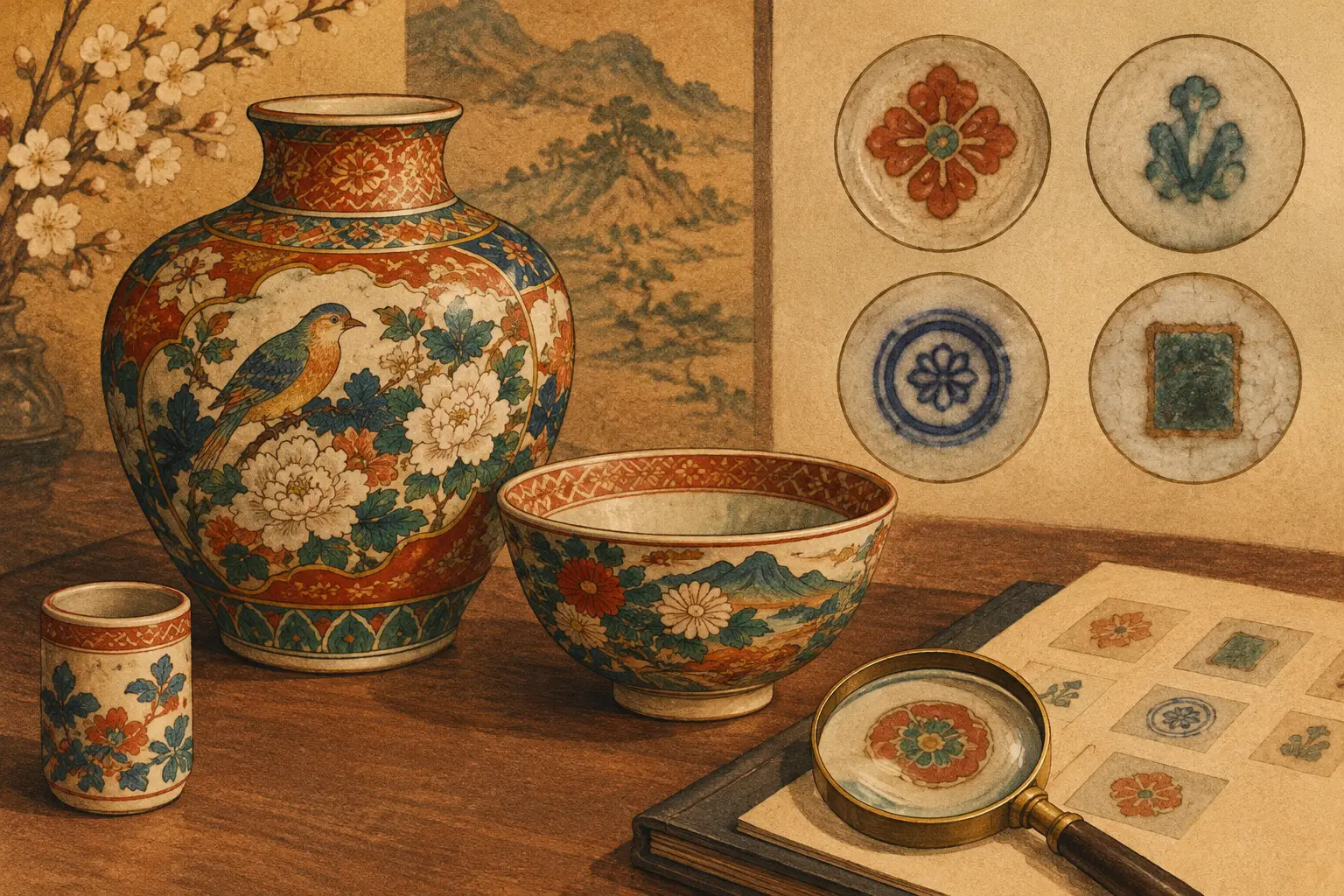
A Kutani plate can look as if it has borrowed its colors from a festival: iron red, deep green, rich purple, gold, and scenes crowded with flowers, sages, birds, or dramatic landscapes. Then you turn it over and find a few painted characters, a stamped cartouche, or perhaps nothing at all. Kutani pottery marks can be exciting clues, but they are rarely a simple answer key.
For Japan lovers worldwide, learning to read these marks adds a new layer to collecting. You begin to see a teacup or serving dish not only as a beautiful object, but as a small record of a kiln, a workshop, an exporter, an artist, and the changing taste for Japanese ceramics across centuries.
What Kutani pottery marks can tell you
Kutani ware comes from the historic Kutani region in Ishikawa Prefecture, near Kanazawa. The name covers a long and complicated ceramic tradition, from the bold wares of the 17th century to export pieces made for Western homes and modern studio ceramics. That long history is why a mark deserves context.
A mark may identify the region, the kiln, the painter, the decorating workshop, or the company that sold the piece. It may also identify the place where an item was intended to be sold. A piece marked “Japan,” for example, was generally made for export rather than for the domestic Japanese market.
The first useful lesson is simple: a Kutani mark does not automatically name the individual who painted your piece. In many workshops, one craftsperson formed the porcelain, another painted the design, and another applied the gold. The mark may represent the business behind that shared work.
Marks are usually found on the base, though they can appear inside a foot ring, beneath a lid, or occasionally within the decoration. Look before washing or polishing. A soft cloth, daylight, and a phone photo taken straight on will often reveal more than a quick glance.
The main forms of Kutani marks
Most collectors encounter handwritten marks, stamped marks, and paper labels. Each tells a slightly different story, and each has limits.
Hand-painted Japanese characters
Brush-written kanji are common on Kutani pieces. Some are loose and expressive, while others are surprisingly formal. The characters may say Kutani, identify a kiln, include an artist name, or use phrases associated with a studio or retailer.
A common mark is 九谷, read Kutani. It confirms an association with the Kutani tradition, but it does not date the object by itself. It also does not guarantee that every part of the work was made in the old Kutani area. The pottery trade has always involved movement between potters, painters, suppliers, and merchants.
A red painted seal-like mark can look ancient at first glance, but red alone is not proof of age. Red marks appear on pieces from many periods. Read the mark alongside the porcelain body, foot ring, decoration, and overall construction.
Stamped seals and printed backstamps
Stamped or printed marks became especially common as Kutani was produced for a wider market. You may see red, black, blue, green, or gold stamps, sometimes enclosed in a circle, square, fan, or gourd-like frame. A seal might name a company, a painter, or a line of wares.
Printed English words can be useful dating clues. “Made in Japan” is commonly associated with goods exported after 1914. “Occupied Japan” points to the postwar occupation period, from 1945 to 1952, although it still does not tell you the exact maker. “Japan” on its own appears on a broad range of export wares, so it should be treated as one clue among several.
Paper labels
Do not dismiss a surviving label. A label can preserve a maker’s name, a gift-shop origin, or a retailer that is not named in the painted mark. Photograph it before handling the piece too much. Old adhesive dries out, and an appealing original label can disappear in seconds.
That said, labels can be added later. If the label and the mark tell conflicting stories, do not force them to agree. Keep both possibilities open until other evidence supports one.
Read the style before you read the signature
The fastest way to make mistakes with Kutani is to focus only on the base. Start with the front. Kutani decoration changed over time, and style often gives a better starting range than a mark that is difficult to translate.
Older Ko-Kutani-related styles are admired for strong compositions, saturated greens, yellows, and purples, and striking areas of dark enamel. They can have a graphic intensity that feels surprisingly modern. Genuine early pieces are uncommon and valuable, so a casual antique-market find should be approached with healthy skepticism.
Later Kutani styles are often more elaborate. Kinrande uses generous gold over red grounds and is the image many American collectors picture when they hear Kutani. Akae emphasizes red-painted decoration, often with dense fine-line work. You may also encounter pieces with detailed figural scenes, floral medallions, or designs influenced by ukiyoe prints.
Meiji-period Kutani, made roughly from 1868 to 1912, was widely exported and can be spectacular. It was also made in large quantities and in varying grades. A lavish surface does not automatically mean a rare treasure. Look for balanced painting, crisp details, thoughtfully placed gold, and a porcelain form that feels well finished rather than merely busy.
Modern Kutani can be equally rewarding. Contemporary artists may use traditional overglaze colors in quieter, more personal ways. Here, a clean artist signature, a gallery label, or a kiln mark can be more useful than it is on older workshop ware. This is where the Japanese appreciation for wabi sabi can matter: slight variation from the hand and fire is part of the object’s character, not necessarily a flaw.
A practical way to identify a mark
When you bring home a Kutani piece, make a small record before searching for a translation. Photograph the entire object, the base, close-ups of the mark, and any damage. Measure the height and diameter. Then note the colors, subject, and any English wording.
Next, try to establish whether the mark is painted, impressed, stamped, or printed. An impressed mark was pressed into clay before firing and may be felt with a fingertip. A painted mark sits on the glazed surface. This distinction can help you avoid comparing unlike examples.
If you do not read Japanese, resist the temptation to identify individual kanji by their visual resemblance alone. A single character can be written in many styles, and a maker’s mark may use older forms, abbreviations, or artistic calligraphy. Ask a knowledgeable dealer, a Japanese ceramics specialist, or a collector group for help, and provide clear photos of the whole piece, not just the mark.
It also helps to search by visual features rather than a hoped-for name. Describe the cartouche shape, mark color, wording, and ceramic style. A red square seal with two characters on a gold-and-red vase is a much better starting point than assuming every red mark belongs to the same famous maker.
Common traps for new collectors
One trap is treating “Kutani” as a guarantee of a particular era. The name describes a tradition with many branches, and production continues. Another is assuming that a famous-sounding mark confirms a famous artist. Marks have been copied, loosely imitated, and applied by retailers for a long time.
Be cautious with pieces that combine an extraordinary claim with weak craftsmanship. If a seller says an item is Edo-period but the porcelain looks machine-perfect, the gold appears freshly bright, and the story rests entirely on a vague red seal, pause. Age can bring wear, but it does not always look dramatic. The point is not to demand damage. It is to look for a believable relationship between materials, technique, style, and claim.
Condition matters, too. Fine hairline cracks, repaired rims, and worn gilding affect value, but they do not erase the pleasure of owning a piece. A modestly priced Kutani bowl with a well-painted scene may be a better first purchase than an expensive object with an unclear attribution. Collect what makes you want to learn more.
Let the mark lead to a fuller story
The best part of studying Kutani pottery marks is that they slow you down. A few characters on the underside can lead you toward Ishikawa craft history, the Meiji export boom, a family workshop, or a contemporary artist keeping old enamel traditions alive. That sense of connection is close to mono no aware: the awareness that a beautiful object carries time within it.
So turn your next Kutani piece over, take a careful look, and let the mark be a beginning rather than a verdict. Whether it identifies a celebrated kiln or remains partly mysterious, the search is part of the joy of bringing Japanese craft into your home.