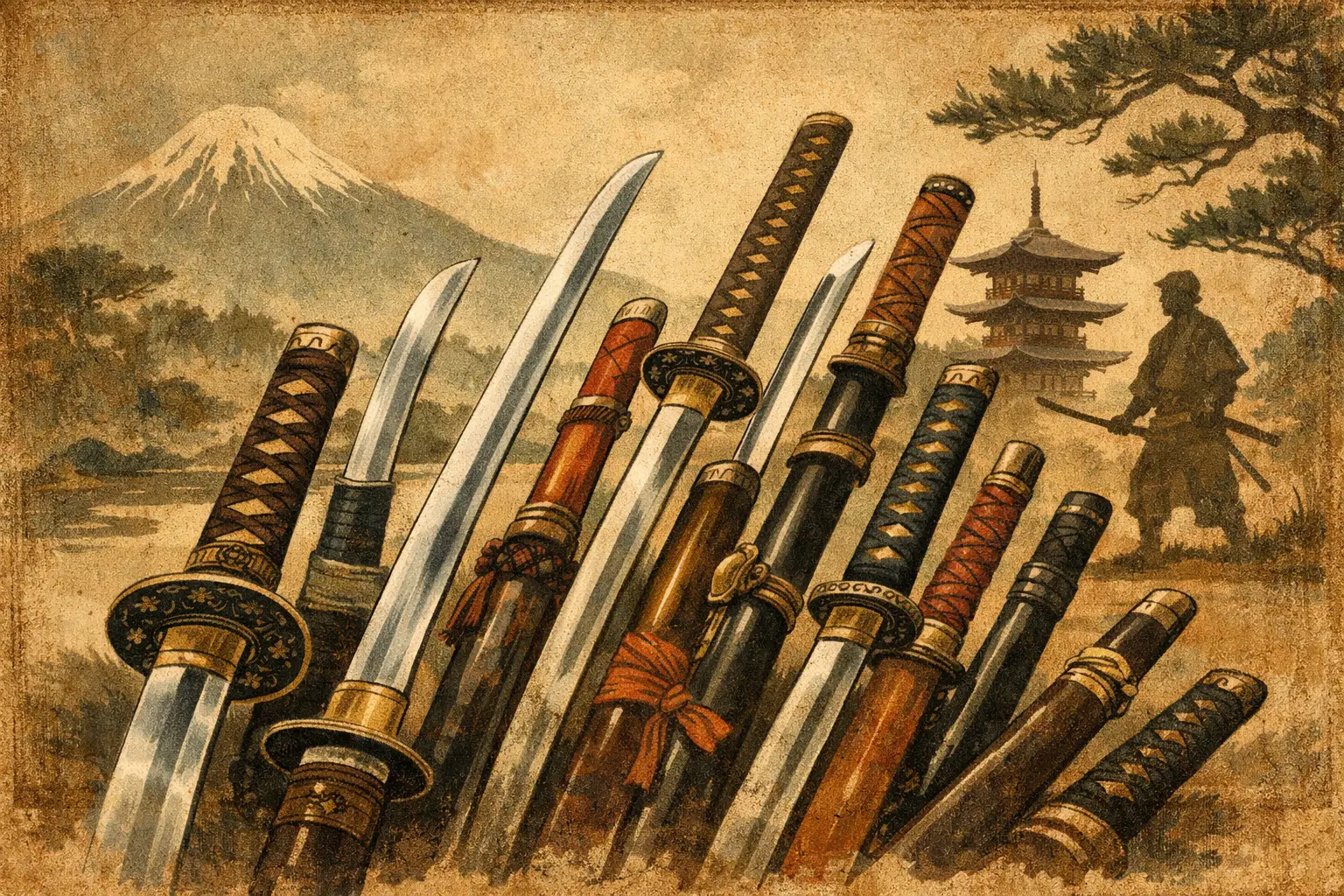
A Japanese sword is never just a weapon. The shape of the blade, the curve, the length, even the way it was worn all tell a story about status, battle, travel, ceremony, and changing ideas of beauty. If you have ever looked at the many types of japanese swords and wondered why some seem similar while others look completely different, the answer usually comes down to one thing – purpose.
That is what makes this subject so fascinating for all Japan lovers worldwide. A sword from the Heian period was not made for the same world as one from the Edo period. Mounted cavalry, close indoor fighting, ceremonial display, and personal defense all pushed swordsmiths to create different forms. Once you know what each blade was meant to do, the whole category starts to make sense.
Types of Japanese swords at a glance
When people outside Japan say “samurai sword,” they usually mean the katana. But the katana is only one member of a much bigger family. The best-known types of japanese swords include the tachi, katana, wakizashi, tanto, nodachi, odachi, and nagamaki. There are also specialized blades such as the kodachi and kaiken.
Some overlap in size, and historical labels are not always perfectly neat. That is part of the charm. Japanese sword history has a bit of wabi sabi in it – beautiful form, practical adaptation, and categories that do not always fit into modern checkboxes.
Tachi and katana – the shift most people notice first
Tachi
The tachi came earlier than the katana and is closely tied to mounted warfare. It usually has a deeper curve and was worn edge down, suspended from the belt. That wearing style matters because it reflects a battlefield context in which drawing from horseback and striking downward were central.
Tachi often feel more courtly and aristocratic in appearance too. Many surviving examples are elegant in a way that immediately suggests an older military culture. If the katana is the blade of the later samurai image most people recognize, the tachi belongs to an earlier age of noble warriors.
Katana
The katana developed into the iconic sword many people picture instantly. It is generally shorter than a tachi, worn edge up through the belt, and designed for a faster draw. That edge-up style worked well for drawing and cutting in one motion, especially in closer combat.
This is one reason the katana became so famous. It fit a changing martial world and later became deeply symbolic of the samurai class itself. It is practical, balanced, and visually clean. There is a kind of mono no aware in the katana’s legacy – beauty shaped by a world that was always changing.
The companion blades – wakizashi and tanto
Wakizashi
The wakizashi is the shorter companion sword often worn with a katana as part of the daisho, the paired set associated with samurai status. It was useful indoors, where a full-length katana could be awkward, and for situations that called for a more compact blade.
For travelers and culture lovers, the wakizashi is one of the most interesting swords because it shows how everyday life shaped sword design. Not every blade was about open battle. Some were about moving through castles, houses, and city streets where space was tight and etiquette mattered.
Tanto
The tanto is a dagger rather than a sword in the casual modern sense, but it belongs in this conversation because it shares the same forging traditions and cultural world. It is short, direct, and highly varied in style. Some tanto were made for combat, others for utility, and some became refined artistic objects.
You will also see beautifully mounted tanto that feel almost jewel-like. That balance of function and artistry is a recurring theme in Japanese craft traditions, whether you are looking at blades, lacquerware, or ukiyoe prints.
Long battlefield blades – nodachi and odachi
Nodachi
The nodachi is a very long field sword associated with open battle. It offered reach and dramatic cutting power, but it was also harder to carry and draw than a standard katana. That trade-off is important. A bigger sword was not automatically better – it depended on terrain, fighting style, and the skill of the user.
Nodachi have a larger-than-life reputation today, and for good reason. They look astonishing. But historically, their use was more limited than pop culture often suggests.
Odachi
Odachi is often used almost interchangeably with nodachi, though some people draw distinctions based on context or size. In practical terms, both refer to very large swords. Some surviving odachi were ceremonial or votive rather than intended for ordinary battlefield use.
That tells you something valuable about Japanese swords as cultural objects. They were not only tools of war. They could also be offerings, symbols of prestige, and expressions of craftsmanship on a grand scale.
The in-between forms – kodachi and nagamaki
Kodachi
The kodachi is sometimes described as a “small tachi.” It is shorter than a standard tachi but mounted in tachi style. This is one of those categories where history gets a little fuzzy. The distinction is not always obvious to beginners, and even specialists may focus on mounting, period, and intended use rather than just blade length.
If you are visiting a museum in Japan or reading sword labels carefully, kodachi is a useful term to know. It reminds us that classification is not only about measurements. It is also about tradition and context.
Nagamaki
The nagamaki has a long blade with an unusually long handle, giving it a profile somewhere between a sword and a polearm. It was designed for powerful sweeping cuts and required a different handling style than a katana.
This is where the story of Japanese arms gets especially interesting. The neat modern idea that every warrior just carried one standard sword falls apart quickly. Real military history is messier, more inventive, and much more fun to explore.
Small but significant – kaiken and related blades
The kaiken is a small dagger, often associated with women of samurai families, though its uses and meanings varied over time. It could serve practical self-defense purposes, but it also had ceremonial and social significance.
This matters because sword culture in Japan was never only about battlefield masculinity. Blades were tied to household life, ritual, travel, status, and personal identity. Once you widen the lens, the world of Japanese swords becomes richer and more human.
How sword types changed with Japanese history
The easiest way to understand these blades is to connect them to historical change. Earlier eras favored forms suited to mounted combat, which helps explain the prominence of the tachi. Later periods, especially as fighting conditions shifted and urban life became more important, encouraged the rise of the katana and wakizashi.
Long battlefield swords had their place, but they were less convenient in many daily settings. Shorter companion blades became essential when architecture, etiquette, and close quarters shaped how a warrior moved. Peace also changed things. During the Edo period, swords remained powerful status symbols even when many were no longer used regularly in war.
So if you are asking which sword was “best,” the honest answer is that it depends. Best for horseback combat is not best for a castle corridor. Best for personal defense is not best for ceremony. Japanese sword design is really a history of adaptation.
What beginners usually get wrong about types of Japanese swords
The most common mistake is assuming every curved Japanese blade is a katana. Another is treating sword names like fixed product labels, as if each category had one exact length and one exact use forever. History is not that tidy.
It also helps to avoid romantic oversimplification. Japanese swords are extraordinary works of art, but they were also practical objects shaped by real needs. Their beauty comes partly from that tension. Form follows use, and then over time use turns into tradition.
For collectors, travelers, and anyone building a deeper connection to Japan, this is the rewarding part. You start with admiration for the blade itself, then you notice how much social history is hidden in details like curvature, mounting, and how the sword was worn.
Which Japanese sword should you learn first?
Start with the katana, tachi, wakizashi, and tanto. Those four give you the clearest foundation because they show the most important differences in wear, size, and function. After that, the longer and more specialized forms like odachi, nodachi, and nagamaki make a lot more sense.
If you are the kind of person who loves Japanese temples, crafts, clothing, and old towns, swords fit naturally into that wider picture. They are not separate from Japanese culture. They belong to the same world of disciplined making, aesthetic refinement, and lived history that you feel in a tea bowl, a kimono pattern, or the quiet wood of a shrine.
The best way to enjoy this subject is to stay curious, not obsessed with memorizing categories. Let each blade type point you back to the people, places, and eras that shaped it. That is where the real connection begins.